


Imagine a dining room in Chicago in the 1890s. The hall outside is lit by electricity, still new enough to be shown to guests. On the table, in silver holders, the candles are burning, and nobody at the table could say why.
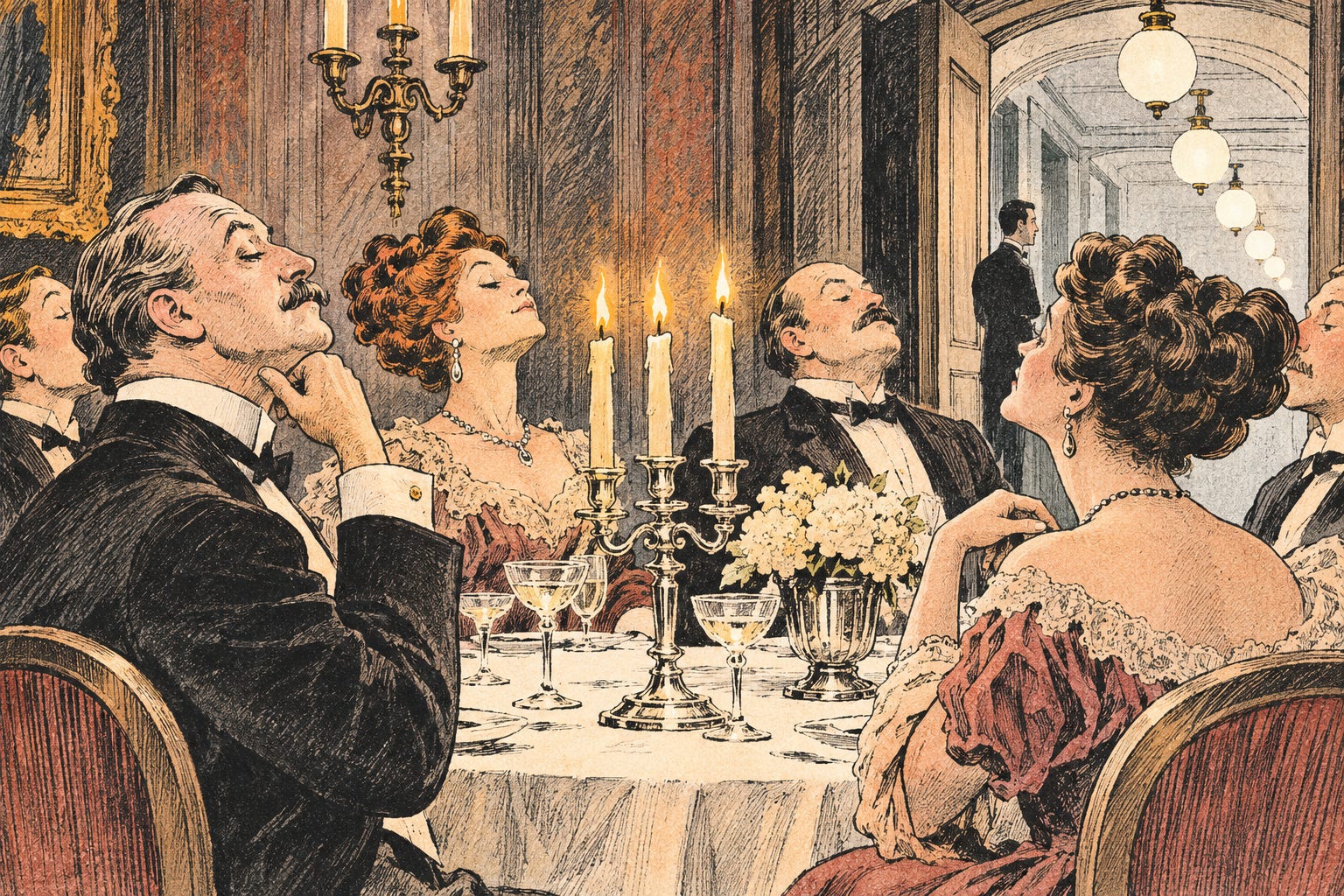
In 1899 Thorstein Veblen noticed the candles. For a dozen years or so, he observed, candlelight had been the most agreeable light at a well-bred dinner. Thirty years earlier, when candles were the cheapest light a household could buy, nobody would have said so. Once no one needed them, they became beautiful. They no longer gave, in Veblen’s words, an acceptable light “for any other than a ceremonial illumination.”
Seventy years later, on Christmas Day 1969, Seiko put the Astron on sale in Tokyo: a quartz wristwatch that kept time far better than any balance wheel. Within a decade the Swiss mechanical watch had become a candle. The industry tells what happened next as a story of resilience and heritage. Veblen would have told it as a change of lighting. Nobody now buys a mechanical watch to learn the time. The mechanical watch survived by ceasing to be useful, which in Veblen’s account is precisely how an object becomes beautiful.
The man who noticed the candles was an unlikely guest at anyone’s candlelit table. The son of Norwegian immigrant farmers, he did not learn English until he started school. He took a doctorate at Yale, could not find a post, and spent most of the next seven years reading on his father’s farm in Minnesota. He wrote The Theory of the Leisure Class the way a naturalist writes about a species he has no wish to join.
The book was meant as an exposure: a field report on his own America, written in a Latinate deadpan that never quite admits it is joking. A century on, the industry it describes best has read it as a manual. In 1950 the economist Harvey Leibenstein even gave the name “Veblen effect” to demand that rises with price. Open the sixth chapter, “Pecuniary Canons of Taste,” and Veblen is already in the boutique.
Start with the complications. Most objects alleged to be beautiful, he wrote, are “calculated to puzzle the beholder—to bewilder him with irrelevant suggestions and hints of the improbable,” while giving evidence of far more labour than their purpose requires. The beautiful object, in other words, is the one that leaves you wondering how it was done.
Consider a cage the size of a lentil, turning once a minute to average out the errors of a pocket watch that would spend its life upright in a waistcoat. It is now fitted to a wrist that never keeps still, and watchmakers still debate what it achieves there. Hints of the improbable. Labour in excess.
The same chapter holds a rule the industry follows more faithfully than any chronometer standard. Beauty, Veblen argued, lies in the plain and the typical: “the canon of beauty requires expression of the generic.” The demand for waste pulls the other way. Veblen means what he calls conspicuous waste: spending more than a thing requires, where others can see it. Nothing displays it better than novelty, since replacing something that still works proves you could afford not to need it. Novelty turns objects of taste into “a congeries of idiosyncrasies,” a heap of quirks, each one there to look new. At any spring fair both forces are on show. The forms are fixed: the round case, the three hands, the silhouettes of 1950s divers and 1960s chronographs, unchanged for half a century. The novelty is all surface. The same case returns each April in a new dial, a new metal, a new collaboration. The shape stays generic; the idiosyncrasy is what is for sale.
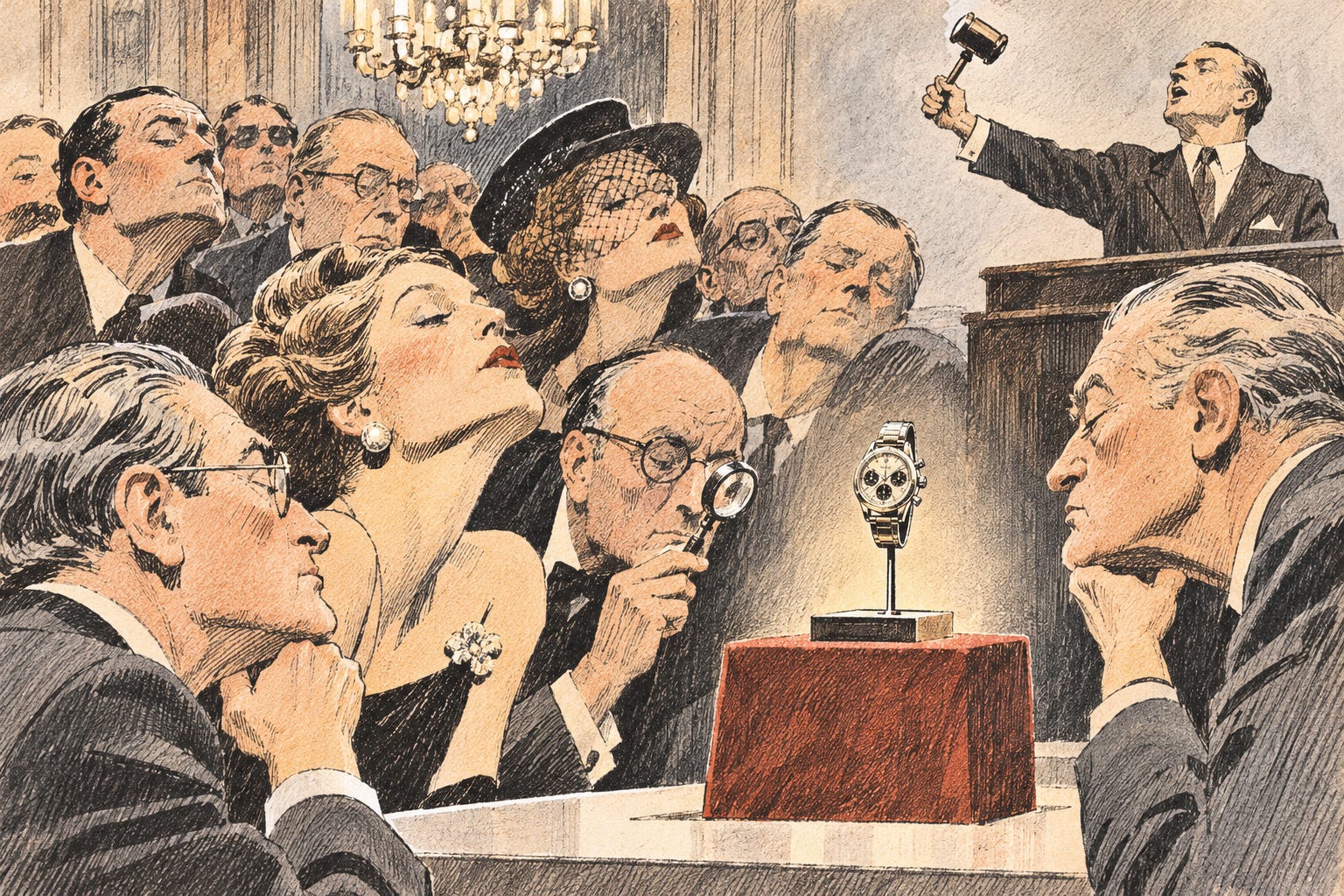
Now the Daytona. Rolex introduced it in 1963 as the Cosmograph, reference 6239, a hand-wound steel chronograph that dealers struggled to sell; some discounted it to get it off the shelf. The version with the contrasting “exotic” dial, later named for Paul Newman, was a commercial failure. As late as the 1980s a 6239 could be had for under four thousand dollars. Then, on 26 October 2017, at Phillips in New York, Newman’s own 6239 sold for $17,752,500. Nothing about the watch had changed. Its surroundings had.
Veblen had described the same sequence more than a century earlier, with a spoon. Take two spoons, he suggests. One is hand-wrought silver and costs ten or twenty dollars; the other is machine-made aluminium and costs ten or twenty cents. Both carry soup equally well. Yet ask their owners which is the more beautiful, and the silver spoon wins without contest. Veblen wants to know why.
Suppose, he says, the silver spoon turns out under an expert’s eye to be a clever machine-made imitation, with the same shape and the same surface. Its value to its owner, including the pleasure he took in simply looking at it, “would immediately decline by some eighty or ninety per cent, or even more.” The owner believed he was admiring the spoon’s beauty. He was admiring its price. When the price went, the beauty went with it. “The case of the spoons is typical,” Veblen concludes. We enjoy knowing that something is expensive, and we call the feeling beauty.
The Newman Daytona ran the experiment backwards. For years the 6239 was the aluminium spoon: competent, discounted, unloved. What changed was not the watch but what people knew about it: that it was rare, that a film star had worn one, that other collectors would now pay almost anything to own it. Once it became expensive, it became beautiful.
That is the story of the old watch. The new steel Daytona has the opposite problem. Its price is set by Rolex, and for what the watch has come to mean, that price is too low. Veblen has a word for a thing too cheap for its own reputation. Goods, he wrote, are “humilific, and therefore unattractive,” when they lack “a margin of expensiveness on which to rest a complacent invidious comparison.” Humilific: humbling, the opposite of honorific. A bargain humbles the person who buys it.
So the market supplies the missing margin, and it pays in two currencies: money and time. The first is money. The secondary market long priced the steel Daytona far above its list, and the gap became a credential in itself.
The second currency is time, and it is the more Veblenian of the two. The exchange has been repeated, in some version, at a great many counters. A man in a good jacket asks, with practised casualness, whether there might be a steel Daytona. There is a list, he is told. Nobody can say how long. Would he like to see something else while he’s here? He would.
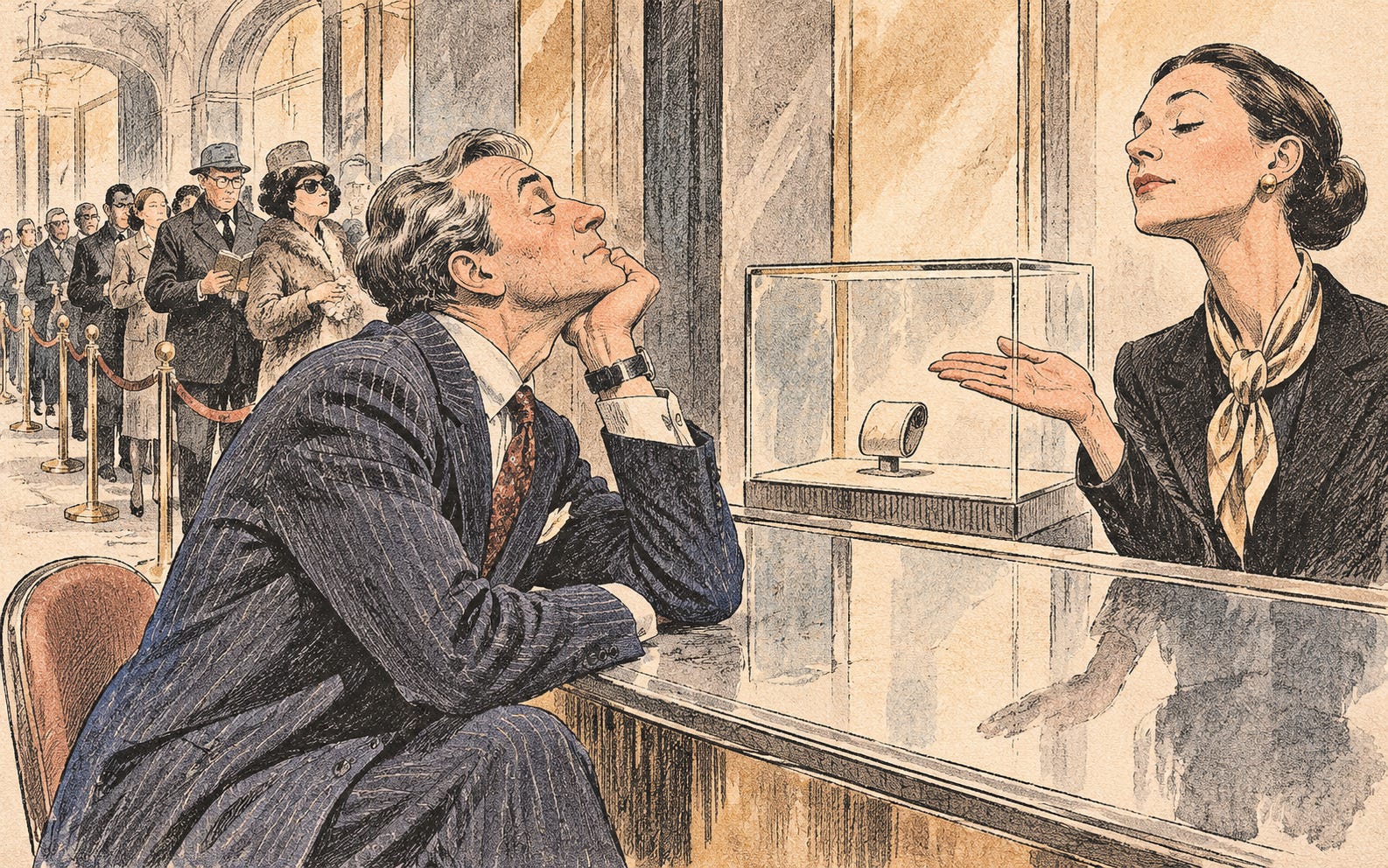
Veblen called this conspicuous leisure: time visibly spent on nothing useful. In his account it was the earliest way the privileged showed their rank, older even than spending. A man proved he stood above others by being seen not to work. The waiting list is its purest modern form: years spent not owning a watch, and the waiting is the point. In some markets, collectors report, the wait carries a further tribute: buy the watches nobody asked for, and you may earn the right to buy the one everybody did. The brand need not raise the price. The queue raises it.
None of this makes the Daytona less beautiful, and here Veblen is at his most uncomfortable. “The honorific element and the element of brute efficiency,” he writes, “are not held apart in the consumer’s appreciation.” The dial and the queue arrive as one impression, and the impression is called beauty. You cannot see the watch without the wait in it.
Behind all of this sits the status quo, and Veblen explains how it reproduces itself. At first, people looked down on cheap things for a social reason: owning them showed you could not afford better. Over generations the reason was forgotten and the reflex remained, until cheapness itself felt shabby. Taste is habit that has forgotten it was ever a habit. Veblen quotes an unnamed political sage: “A cheap coat makes a cheap man.” And he adds, with no apparent irony, that “there is probably no one who does not feel the convincing force of the maxim.”
The Swiss industry is built on that maxim. A watch is worn like the coat, on the body and in plain view, and it is read the same way: the object stands for the man. This is why no major house can sell cheaply without damaging every watch it has already sold. A cheaper model does not simply widen the market; it tells existing owners that what they bought was worth less than they believed. A price rise has the opposite effect. It costs the owner nothing, and it makes the watch already on his wrist more expensive and therefore, by the logic of the maxim, better.
Veblen doubted that a consumer who refused every wasteful element, “Diogenes-like,” could even “supply his most trivial wants in the modern market.” Here the century proved him wrong: today’s Diogenes can buy a plastic quartz watch for the price of lunch, and it will keep better time than anything in a Geneva window. Then, in March 2022, the Swatch Group put Omega’s moon watch into bioceramic at a Swatch price, and queues formed outside the shops. Veblen was wrong about Diogenes and right about everyone standing behind him.
Veblen’s last chapter turns to education, and it is the one that should make collectors and watch writers uncomfortable. It is called “The Higher Learning as an Expression of the Pecuniary Culture,” and its subject is the classical education of his day. Latin and Greek, Veblen argued, were prized not because anyone used them, but because learning them took years that only people with time to spare could afford. The knowledge was a display of leisure. The serious collector’s knowledge works the same way. He can tell two references apart at a glance, date a dial by the shape of a single numeral, and recite the variants of a bezel the way a schoolboy once recited Latin grammar. None of it tells the time. All of it shows that he has had the time. Watch writing belongs to the same economy, this journal included: an essay that sets an 1899 economist against a steel chronograph, for readers who already own one, is as pure a display of conspicuous leisure as the genre allows. Veblen would have filed it with the candles.
Strip away the waste, the queue, the tribute and the learning. Is anything left worth wanting?
Veblen seems to say yes. A display of efficient workmanship, he writes, “is pleasing simply as such,” even when what the work is ultimately for is futile, because in the moment of admiring it we are not thinking about what it is for. Here, apparently, is the remainder.
Go to the bench. A north-facing window, because north light changes least across the day. A watchmaker with a loupe in one eye, a bridge of German silver held in brass tweezers. She draws its edge across a file, then across a wooden stick charged with paste, tilts it to the light, and draws it again. The bevel she is making is a fraction of a millimetre wide, and it sits on the underside of the bridge, facing the dial. No one will ever see it, the owner included. She knows this. She makes it anyway, and makes it well.

Then you turn the page.
No such workmanship, Veblen continues, will “in the long run, enjoy the approbation of the modern civilised consumer unless it has the sanction of the canon of conspicuous waste.” The machine product is more perfect, and “this does not save them from disesteem.” That is the quartz watch. Seventy years before the first one went on sale, Veblen had already explained why the luxury trade would never quite accept it: a machine that keeps better time than any craftsman is, by his rule, the wrong kind of perfect. The hand-made article must keep its own margin of imperfection, never so wide as to look bungled, “nor so narrow as to suggest the ideal precision attained only by the machine.” Haute horlogerie’s whole aesthetic of the human hand sits inside that sentence: perfect enough to show skill, imperfect enough to show it wasn’t a machine.
So the remainder is real, and it is fragile. It lives at the bench, in the watchmaker’s instinct to make a thing well whether or not anyone is looking, and desire can honestly attach to it. Want the bevel for the bevel’s sake, and you want the one thing in the industry Veblen never mocked. But he did not expect the market to reward it for long without the waste attached, and a hundred and twenty-seven years later the industry has not proved him wrong.
The candle still gives light. It just isn’t why anyone lights it.
About the Author
Sergio Galanti is the founder and editor of WatchDossier, contributor to Italian and international watch publications, and advisor to private collectors.
No compensation or brand affiliation influenced this essay. Opinions are the author’s own.
