


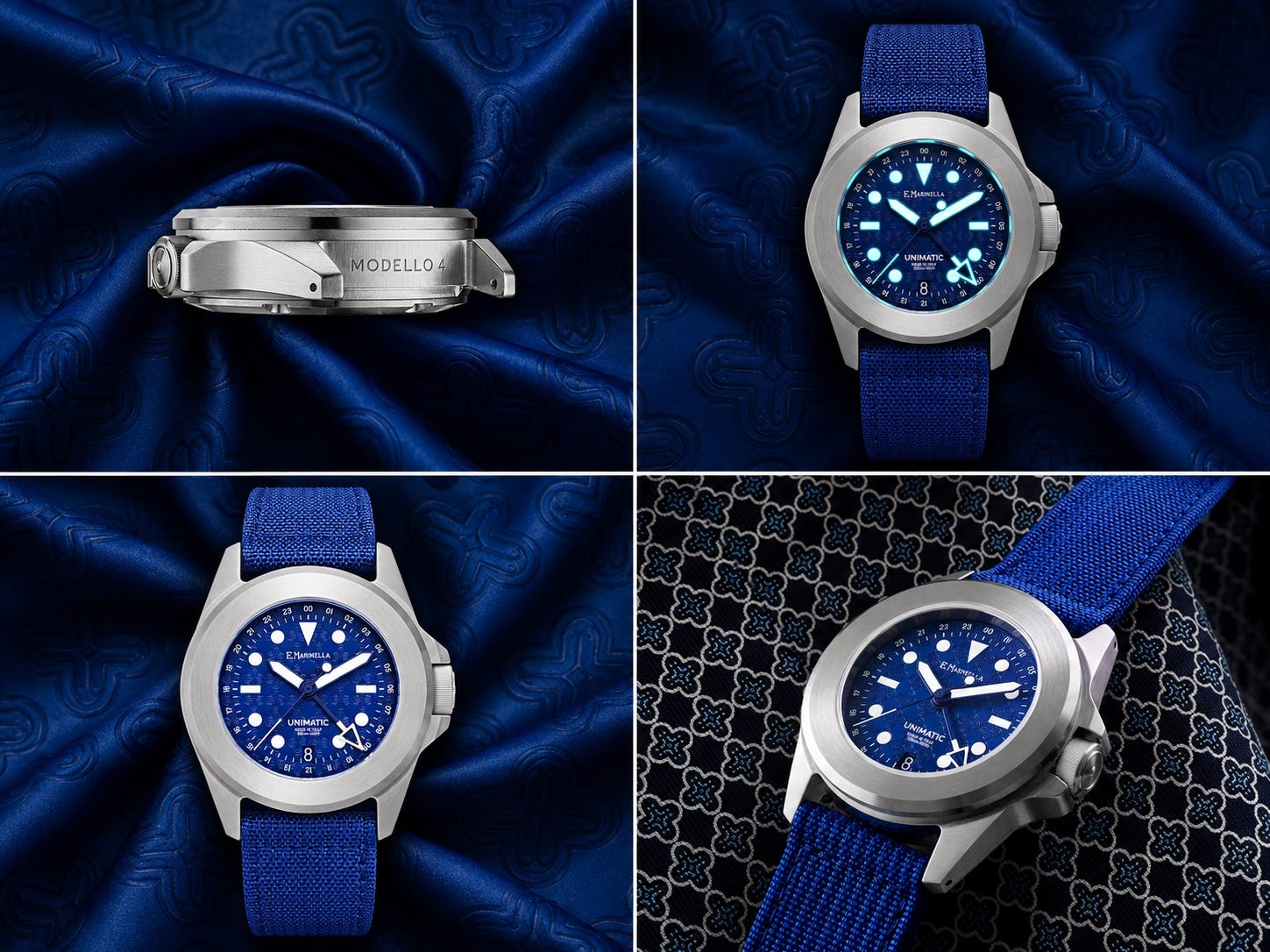
The necktie has been dying for twenty years, and nowhere was its decline more officially blessed than in Japan, where the Ministry of the Environment’s 2005 Cool Biz campaign invited the salaryman to lose the tie so the office thermostat could rise to 28°C. A century-old Neapolitan tie house could have read that as a eulogy. E. Marinella seems to have read it as a change of address. On 9 October, in a numbered edition of 100 sold only at its Tokyo Midtown and Marunouchi counters and through the Japanese retailer Floens, the knot moved to the wrist: the Unimatic Modello Quattro U4-GMT-EMJDM.
The suffix does a lot of work.
JDM, for Japan Domestic Market, comes from tuner-car culture, where it means the version you were not supposed to be able to get. Here it labels an Italian watch built around a Japanese movement, dressed in the codes of a Neapolitan house that was founded, by its own account, as “a little corner of England in Naples,” and sold back to Tokyo. This isn’t really nostalgia. It’s a hall of mirrors. Naples learned English cloth. Japan learned Neapolitan tailoring and became its most devoted congregation. The watch industry borrowed the limited-edition drop from streetwear. Everyone is quoting someone, and the quotation marks have become the product.
Unimatic speaks this grammar fluently. Founded in 2015 by two industrial designers trained at Milan’s Politecnico, Giovanni Moro and Simone Nunziato, the brand has turned the collaboration into something closer to an operating system than an event. Massena LAB. Hodinkee. Todd Snyder. Morgan Motor. Since autumn 2025, the Modello Quattro GMT has appeared in Morgan livery (100 pieces, £745) and with two Todd Snyder dials ($998). The platform stays; the partner changes. From Marinella, Unimatic gets a Japanese retail address and a patina of old-world tailoring it couldn’t produce in Milan. From Unimatic, Marinella gets a low-risk way into a category where a tie maker has no natural standing. The watch is launched alongside a “JDM Collection” of komon ties, a pocket square, a glasses case, a scarf-tie and a scrunchie. It’s the hero product of a capsule, and its job is to make the scrunchie make sense.
Read the release the way the French critic Roland Barthes read soap-powder advertisements in Mythologies (1957).1 It opens: “Some objects transcend their function through the details that define them.” Nobody does the transcending; the objects manage it alone. Patterns are “capable of becoming signatures, carrying identity from one generation to the next,” as if the blue had chosen itself. The house’s codes “are translated into the architecture of the Modello Quattro,” a passive that erases the meeting where someone picked a debossed micro-pattern over the alternatives. The boilerplate’s last sentence reaches for a “timeless idea of style.” This is myth in Barthes’s exact sense. A commercial decision, two brands paired for one market in one autumn, is retold as essence. The Japanese release has a decider: Maurizio Marinella, the house’s third-generation owner, chose the base watch and the strap. The English one has only codes that translate themselves. None of it is false. It is the story told in place of the decision.
The most revealing silence concerns the movement. The English release calls it “the automatic NH34A calibre.” The Japanese release, published a week earlier, calls it what it is: Seiko NH34A. In Tokyo, Seiko is a provenance worth printing. In Milan, it’s ex-nominated into a reference number, so that “Made in Italy” can sit alone on the dial. It is the same movement wrapped in two myths, depending on which end of Eurasia is reading.
The object deserves precision: a 40mm brushed 316L case, 49mm from lug to lug. The fixed monoblock bezel is a plain steel ring that turns down the GMT’s usual rotating insert and moves the 24-hour scale onto the dial’s rail. The lugs are drilled. A flat 2.8mm sapphire crystal carries an internal anti-reflective coating. There’s an 8mm screw-down crown, 300 metres of water resistance, and every piece is tested. Inside, the NH34A beats at 21,600 vph with a reserve of a little over 41 hours, and its 24-hour hand is set independently of local time: a “caller” GMT, the humbler sibling of the traveller’s “flyer.” Honest, serviceable, everywhere.
The dial is where the money went.
Tilt it toward a window. The bezel’s brushing runs in tight concentric arcs that catch the light like a coin worn smooth in a pocket. The blue is not a watch blue. It’s inkier, nearer to silk in shadow than to lacquer. The debossed motif, Marinella’s small four-lobed cross, shows up only at an angle and is gone the moment you straighten your wrist, much like the weave of a tie seen across a dinner table. Unimatic’s ladder phantom hands are done in the same blue, so in daylight they sink into the cloth and only their lume rungs stay visible, floating. Turn it over and the caseback carries four engraved tie patterns: komon, pin dot, solid and regimental. A wardrobe in steel.
It’s lovely. It’s also, every gram of it, colourway.
Who buys it? Mostly not the watch collector, who already knows the U4 GMT and can buy it in any number of liveries without walking up to a tie counter. The buyer is the Marinella client. He knows the shop on the Riviera di Chiaia and may have been given a box of its ties, which served as Italian diplomatic currency after President Cossiga began handing them to foreign leaders in the 1980s. For him, ¥253,000 including tax comes to not quite six of the komon ties in the same capsule. Less a watch purchase than a wardrobe completed. The pleasure lies in recognition, the small shared nod when someone across the table spots the blue.
As an asset, the numbers are modest. There are 100 pieces, sold domestically, and the online channel won’t ship abroad, so the scarcity is engineered by geography. This one will invite grey-market traffic toward collectors abroad. But that scarcity comes from distribution, not from the watch, and it’s the most perishable kind, because the next livery is always already in the queue. The cultural capital accrues to the brands. The owner gets a well-made Unimatic and a story about Tokyo.
That leaves subtraction. Take away the myth of timelessness, the Naples–London–Tokyo relay and the bought-in Seiko calibre. Take away the shared case, the blue, the pattern, the engraved ties, the capsule and the scrunchie. What’s left is a fixed-bezel, 300-metre, 40mm GMT from a small Milanese studio with sound proportions and real design discipline.
It is a good watch. It just isn’t this watch.
Everything singular about the EMJDM was decided in a meeting, and none of it would survive a different one. The forbidden-fruit shimmer the launch works so hard to grow, the thrill of the edition you aren’t allowed to buy outside Japan, has nothing to attach to except the prohibition itself. By all means want the U4 GMT; the platform earns it. Want this one and you are wanting a tie you can’t knot, from a counter you may never stand at, for the pleasure of the refusal.
The appetite is real. The fruit is wax.
About the Author
Sergio Galanti is the founder and editor of WatchDossier, contributor to Italian and international watch publications, the author of Against the Grain: A Cultural History of Swiss Independent Watchmaking, and advisor to private collectors.
No compensation or brand affiliation influenced this essay. Opinions are the author’s own.
Subscribe to watchdossier.ch to receive more insights on luxury, craftsmanship, and collecting.
Roland Barthes (1915–1980) was a French literary critic and semiotician. Mythologies (1957) collects short essays on French popular culture, from soap-powder advertisements and professional wrestling to steak-frites and the Citroën DS. Its closing theoretical essay, “Myth Today”, argues that a culture’s myths turn history into nature: what particular people chose, at a particular moment and for particular reasons, comes to look obvious, inevitable and eternal. The devices are often grammatical: sentences without an agent, verbs of essence, appeals to timelessness and continuity. Barthes coined “ex-nomination” for the way the dominant class of his day avoided naming itself; by extension, it describes any message that leaves out the name of whoever shaped it. WatchDossier uses the method descriptively. Calling a release mythological does not mean calling it false. It means noticing the gap between what was decided and the story told in its place.