


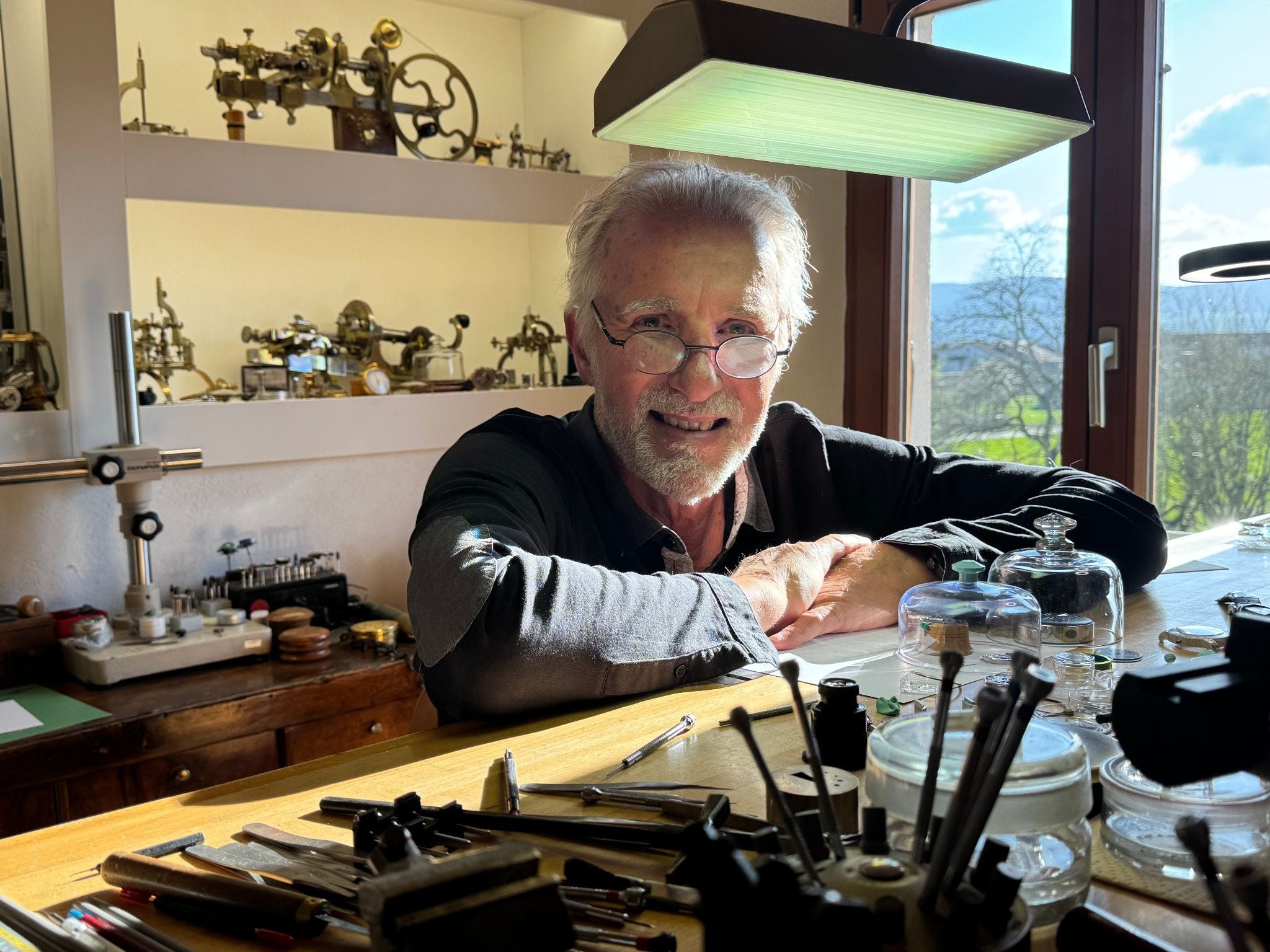
Last spring, I spent an afternoon with Antoine Preziuso at his home atelier near Geneva. It is the kind of place in which the distinction between workshop, archive and living space has become largely academic. Watches appear in drawers, on benches and in conversation. Old movements sit beside newer experiments. Tools share space with objects accumulated over more than four decades. And Preziuso moves between them without much concern for chronology.
We spoke for several hours. About the Quartz Crisis and Patek Philippe, restoration and independence, Harry Winston and Japan, the crash of 2008, meteorites, tourbillons, CNC machines, artificial intelligence, his children and the question of what happens to a watchmaker’s name when the watchmaker is no longer there. At various moments he would interrupt himself, reach for another watch, open a caseback or disappear briefly to retrieve something connected to the story he was telling.
Somewhere during that afternoon, a contradiction began to emerge.
After forty-five years, there should be an Antoine Preziuso watch that can be recognised from across a room. There should be a case, a dial, a gesture repeated often enough to become shorthand. Luxury prefers this kind of legibility. A successful form becomes a collection; a collection becomes a system; the system learns to reproduce recognition with minor changes in colour, material and complication.
Preziuso has done almost the opposite.
His work moves from minute repeaters to meteorites, from rectangular chronographs to triple tourbillons, from jewellery pieces to austere constructions, from restored nineteenth-century movements to watches conceived before a client had asked for them. Preziuso acknowledges the problem himself. His collections, he says, do not have a consistent visual DNA, and he has often been reproached for it.
The criticism is understandable. It is also, perhaps, the key to understanding him.
A brand without a stable visual language asks more of the buyer. It cannot rely as heavily on instant recognition; each new object has to explain itself again. Preziuso recognises the commercial difficulty. Speaking about distribution networks, he says they want something that can be understood quickly: ‘fast food, fast learning, fast understanding.’ He contrasts that with the education independent watches can require from collectors.
The broader conclusion is mine rather than his: what looks like weak brand discipline may be the clearest expression of his independence. Preziuso’s signature is not a case shape or an arrangement of numerals. It may be the refusal to let one successful object dictate the next.
That instinct predates the brand as we know it. Preziuso left watchmaking school at the end of the 1970s and entered a profession whose future was far from secure. Quartz had not merely changed the product; it had changed the kind of labour the industry needed. He remembers a school in transition, still teaching mechanical watchmaking while adding electronic modules, circuits and batteries. The more complete watchmaker, trained to repair and make parts by hand, was entering a market with fewer obvious places for those skills.
Patek Philippe gave him a first foothold and, technically, what he describes as a second school. Personally, it clarified something else. He did not want the factory life. He recalls feeling that in a factory he was ‘just a number.’ An older colleague told him how quickly the years would pass. Preziuso decided he did not want them to pass that way.
Independence initially meant something less glamorous than it does now. It meant finding work. He bought old watches, repaired them, restored damaged parts and took on jobs from Geneva retailers that could no longer find enough watchmakers capable of dealing with earlier mechanical pieces. He remembers even established houses having drawers of watches waiting to be repaired.
But repair did not remain enough. As mechanical watchmaking began to return, Preziuso moved further into complicated pieces and prototypes. Some came from commissions; others began with his own initiative. The sequence matters because it does not always resemble modern product development. Sometimes the idea came first, the watch second, and the customer only afterwards.
The Harry Winston story makes the point neatly. Preziuso had been to New York and photographed the entrance at 718 Fifth Avenue. He decided that a house known for diamonds should also have a complicated mechanical watch, and made a tourbillon whose design referred to that entrance. He then presented it without a prior commission. His account is characteristically direct: they looked at the watch, asked who he was, and told him to leave it there.
Other projects followed across the 1990s and early 2000s: work for Breguet and Universal Geneve, development for de Grisogono, collaborations involving Gerald Charles and Goldpfeil, and Harry Winston’s Opus 2. The common thread is less a house style than a working method: curiosity converted into watches, sometimes for other names, sometimes for his own.
That freedom nearly disappeared precisely when the business became more successful.
Around 2000, demand rose and the company grew to twenty-eight employees. Preziuso considered a manufacture for perhaps thirty or forty people. On paper, this is the familiar upward arc: more orders, more staff, greater capacity.
His memory of it is less triumphant. He says he was no longer really practising his profession. Instead he had become ‘a cop, a doctor, a psychiatrist, an entrepreneur’ - all the roles required to manage an organisation rather than sit at the bench. This is one of the clearest points in the conversation: he did not want to lose the watchmaking job in order to run a watchmaking company.
The financial crisis of 2008 then hit hard. Orders were cancelled after cases, dials and other components had already been ordered. Preziuso says he kept employees for almost a year despite the lack of work, then used his contacts to help many of them find positions at larger Geneva houses.
What followed is one of the most revealing images from the afternoon. With work reduced, he remembers sweeping the workshop, tidying it, and finding that creativity returned.
That sentence should not be turned into a manifesto he did not make. But placed beside everything else he said, it suggests a definition of independence that is less about vertical integration than about proximity: remaining close enough to the object, the tools and the decision-making that an idea can still interrupt the plan.
Preziuso is explicit about one part of this. For him, independence is freedom. He recalls wanting that freedom when he left factory life, and later defines an independent as a creator who knows where he wants to go. He also rejects the idea that independence necessarily means making every component in-house. Watchmakers, he points out, have always relied on specialised suppliers. He can make a screw; that does not mean making every screw is the point.
This makes the absence of a stable design DNA more interesting. The contemporary luxury industry has turned recognisability into one of its most efficient tools. A brand teaches the public a shape and then protects it. The repetition is not necessarily laziness; it is strategy. Recognition lowers the cognitive cost of desire. The buyer does not have to understand the watch again. The buyer already knows what it is.
Preziuso recognises the opposite difficulty in his own work. He says his changing designs are harder for distribution networks to explain. At the same time, he resists the alternative. In the conversation, he contrasts brands that repeat the same design in different colours, materials and complications with his own tendency to change. For him, independents have more freedom to do precisely that: change and innovate.
Look across the watches and the forms wander. The motives are more stable.
Complications attract him because he likes technical challenges. Meteorites return repeatedly because, in his own explanation, they make him think about space and the abstraction of time. Old movements matter because restoration was one of the foundations of his career, and he still likes giving historical mechanisms another life. Small functional irritations can provoke solutions: a date obscured by a passing hand, a jumping-hour display whose reading bothers him, a tourbillon whose purpose on the wrist he wants to reconsider.
The strongest evidence comes when I ask whether he creates for a particular person or in response to something internal. His answer is unambiguous: ‘I answer something internal to me.’ He says he makes the watch to make himself happy, compares the process to a child making a sandcastle, and then adds the commercial complication: afterwards, someone has to buy it.
That is not a scalable doctrine. It may not even be a sensible one. But it explains why the work resists the neatness normally demanded of a mature brand.
His distinction between buyers follows the same logic. Preziuso separates the consumer, the collector and the investor or speculator. His use of ‘consumer’ is deliberate: he says he wants the person who wears the watch and lives with it rather than leaving it in a safe in the hope that its price will double or triple. He also respects what he calls the ‘true’ collector, who buys because he loves the watches. The speculator is different. Preziuso says there have been occasions when he suspected someone intended to resell and simply told him the watch was not for sale.
The interpretation again belongs to the essay: in a market that increasingly asks a watch to prove itself as an allocation, an asset or a tradable position, Preziuso’s preference restores something stubbornly physical to the transaction. He wants the object to be lived with.
There is an irony here. The less consistent the brand appears, the more personal the individual object can become. A watch that does not primarily reinforce a house code has more room to complete a particular encounter between maker and wearer. The cost is weaker instant recognition. The gain is that the next watch is not obliged to advertise the previous one.
This raises the harder question of succession.
His children, Laura and Florian, grew up around the workshop. Preziuso says he never ordered them into watchmaking or jewellery, and encouraged them to work elsewhere before returning to the family orbit. Today they have their own professional lives while remaining connected to his work. Yet he does not speak as though continuation of the brand were guaranteed. He considers several possibilities aloud: the children, perhaps the grandchildren, perhaps an outside investor or future owner.
But what, exactly, would such a successor inherit? The archive can be transferred. The name can be transferred. The watches can be catalogued, serviced, resold and displayed. A fixed design code, had there been one, could be repeated with relative ease.
The more difficult inheritance would be the permission not to repeat it.
Near the end of our conversation, the subject turns to technology. Here too, the easy caricature fails. Preziuso is not simply nostalgic for hand tools. He calls modern technology ‘magical’ and describes how CNC machining can now accomplish, with extraordinary cleanliness, work that once required long hours of filing and finishing. He is equally fascinated by artificial intelligence. He tells me he had asked ChatGPT to draw watches and movement ideas and had received in seconds visualisations that once would have cost tens of thousands of francs to produce.
The next step in the conversation matters because it was not his claim alone. I suggested that if increasingly powerful tools become available to everyone, competitive advantage may shift even more towards the quality of the idea. Preziuso agreed and pushed the thought further: everyone may have access to the same tool, but not everyone will have the ideas to innovate or change. After the idea comes implementation - the hands, the ability to make it real.
That exchange seems a better ending than a nostalgic defence of the old workshop. Preziuso’s career does not support a simple opposition between hand and machine, past and future, authentic and industrial. He has used suppliers, collaborated with larger houses, grown a company, reduced it again, worked with old ebauches, embraced CNC and experimented with AI.
What remains unusually consistent is something harder to place in a catalogue.
Independence, in his own language, is freedom. The further inference is ours: for Preziuso, that freedom appears most clearly in the continued possibility of making the next watch differently from the last.
After forty-five years, what remains most consistent is not a form, but a freedom: the freedom to let each new watch begin again.
That may be his signature.
About the Author
Sergio Galanti is the founder and editor of WatchDossier, contributor to Italian and international watch publications, the author of Against the Grain: A Cultural History of Swiss Independent Watchmaking, and advisor to private collectors.
No compensation or brand affiliation influenced this essay. Opinions are the author’s own.
Subscribe to watchdossier.ch to receive more insights on luxury, craftsmanship, and collecting.
Was hoping to see more workshop images, as that is always such a great sight. But I really enjoyed reading your account of Antoine Preziuoso's path.