An Apology for the Harmonious Oscillator
Two balance wheels, one escapement, and fifteen years in a drawer: the heart of the RS11 gives an account of itself.
I am the part that works.
This needs saying at the outset, because a great deal happens in this watch, and most of it does not work in any sense physics would recognise. The purple does not work. The alligator does not work. I work. I am the Harmonious Oscillator, patented, and I keep the time.
Permit me to explain what I am, since the men who made me prefer to explain what I mean. I am two balance wheels, each fully toothed, meshed to the other and driven by a single escapement. Classical theory — and I was raised on classical theory — held that one must never load the balance, never burden the oscillating mass with so much as an ambition. I am nothing but load. I am a prohibition, walking. Two wheels turning against one another, sharing a single impulse, holding always to an identical amplitude, correcting in the same instant whatever gravity attempts against us. The arrangement sits within a cage that completes one full turn every sixty seconds — the detail the connoisseurs seized upon when they called me a cousin of the tourbillon. I let them. A family resemblance flatters everyone and commits no one.
I was unveiled in Basel, in 2009, to general admiration. The leading figures of the industry came to look at me, agreed that I was significant, and departed. I have lived on that word ever since. Significant. It is a fine thing for a regulating organ to wear; it asks nothing further of you.
And then I waited. The case that now houses me — square, forty-one millimetres, shaped, I am told, entirely for the comfort of a wrist I shall never feel — was drawn in 2011 and placed in a drawer, where it remained while two decades of the Maison assembled themselves around it. This year I am described as a culmination. I would gently observe that a culmination is not, as a rule, something one keeps in a drawer. But the house is twenty years old, and twenty years requires a culmination, and so the drawer was opened. I do not resent this. A revolution willing to wait fifteen years for its own anniversary was perhaps never in any particular hurry.
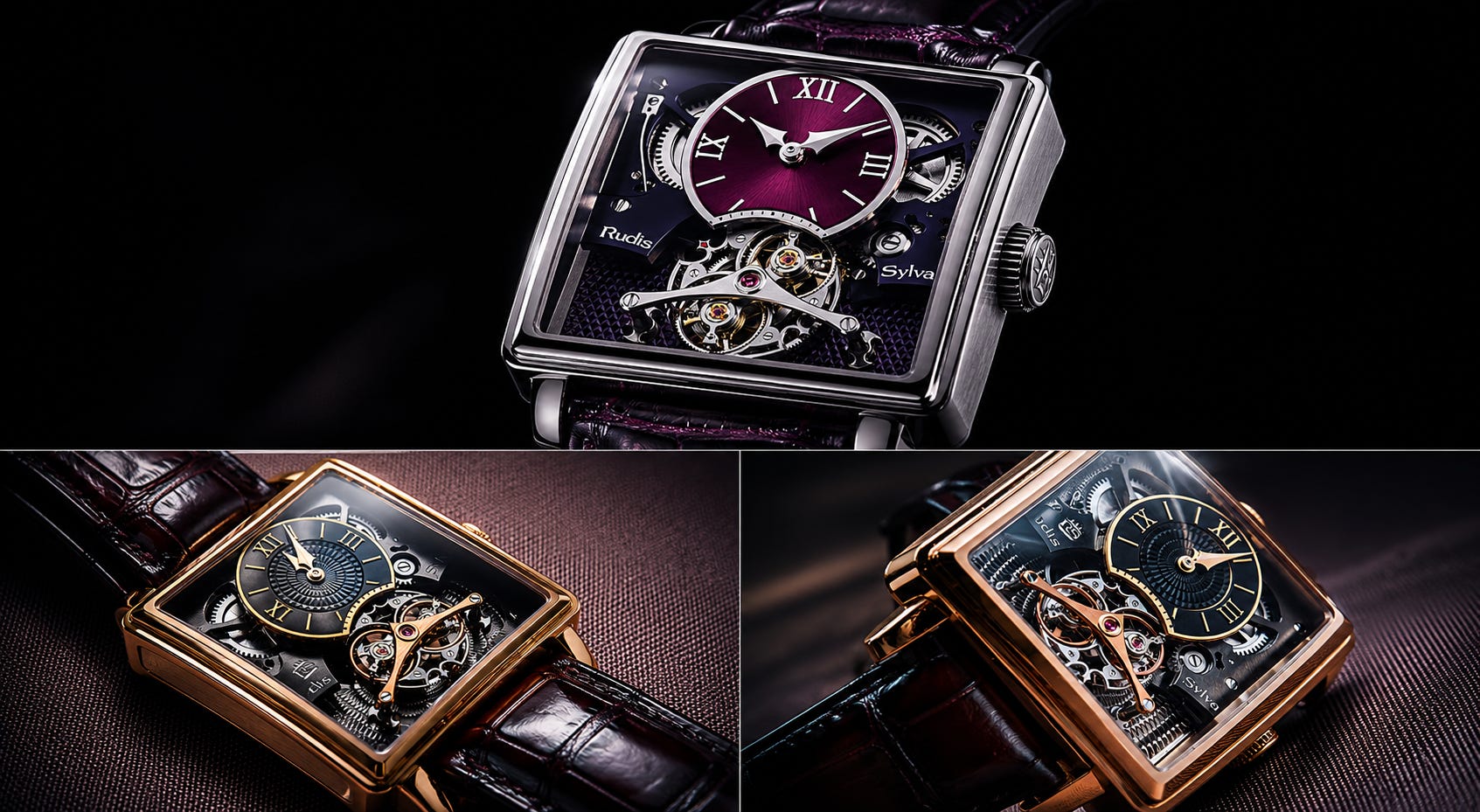
Let me describe my surroundings, since you came, ostensibly, to read about a watch. I am offered in two metals, titanium and pink gold. In the titanium I am dressed in purple — a gradient of it, from a near-black depth up to a bright fuchsia, laid across a main plate guilloché by hand and then treated in black-purple PVD, so that the violet reads at every level: the plate, the hour-and-minute dial, the three-quarter bridge above me. Against all this the gears are left silver and luminous, so that the eye, having finished admiring the colour, may at last locate the mechanism. I am grateful for the contrast. It is the only moment in the whole composition when anyone remembers what a watch is for.
The plate beneath me is the work of one Georges Brodbeck — neighbour, friend of the house, and holder of the Gaïa Prize, which in this trade is roughly a knighthood. He cut it on a straight-line engine, working two spindles at once with both hands, removing from the metal a depth of some six hundredths of a millimetre, and turning the plate three times over to do it, since the field of small pyramids would not otherwise resolve. I have watched a man spend a morning on six hundredths of a millimetre. I hold time to a far finer tolerance, and no one writes my name on a wall.
My own bridge was bevelled by hand with a piece of gentian wood — a flower’s root, dug from a pasture at a thousand metres and dried until hard enough to polish titanium, which the men call a demanding material and I call merely stubborn. Twenty-five hours on my bridge alone, drawing twenty-eight interior angles into the metal. Twenty-eight. I confess this moves me, in the way one is moved by any devotion whose object cannot quite account for it. The recesses around me are polished by hand; the gear-train passages grained in tiny concentric circles, by hand; the flats sand-blasted and brushed in alternation, so the light never settles. The arms of the plate pass through the barrels at a full hundred and eighty degrees, rounding the whole structure into something soft. It is all very beautiful. None of it makes me keep better time. All of it is the point.
I am sealed behind a domed crystal, with a second crystal at my back and a third along my flank, each coated against reflection on both faces, that I might be admired from every angle a man can turn his wrist. The case resists water to thirty metres — which is to say it would prefer you did not swim. I am bound to that wrist by an alligator strap with large scales, set between horns twenty-five millimetres apart, though for the squeamish a version exists with no alligator at all, the house having weighed the comfort of the wearer and, one presumes, of the alligator.
And so I shall sit, correcting gravity sixty times a minute inside a cage that knows the hour, beneath a purple sky of guilloché, having waited fifteen years for the privilege. The men say the watch is sincere, uncompromising, honest. I am in no position to disagree — I am the most honest thing in it, being the only part that cannot lie about the time. But I notice that when they speak of me they reach always for the language of the soul: depth, roots, devotion, sincerity. Never quite for the language of the escapement. It is the oldest courtesy in the trade. They dress the physics in feeling, and call the feeling Swiss, and sell it. I turn, and turn, and keep the time. It is the one promise in the whole watch certain to be kept.
About the Author
Swiss-based independent writer specialising in the luxury watch industry. Editor of WatchDossier, a publication exploring the cultural and philosophical undercurrents of contemporary horology, and author of the book Against the Grain: A Cultural History of Swiss Independent Watchmaking.
No compensation or brand affiliation influenced this essay. Opinions are the author’s own.
Subscribe watchdossier.ch to receive more insights on luxury, craftsmanship, and collecting.


