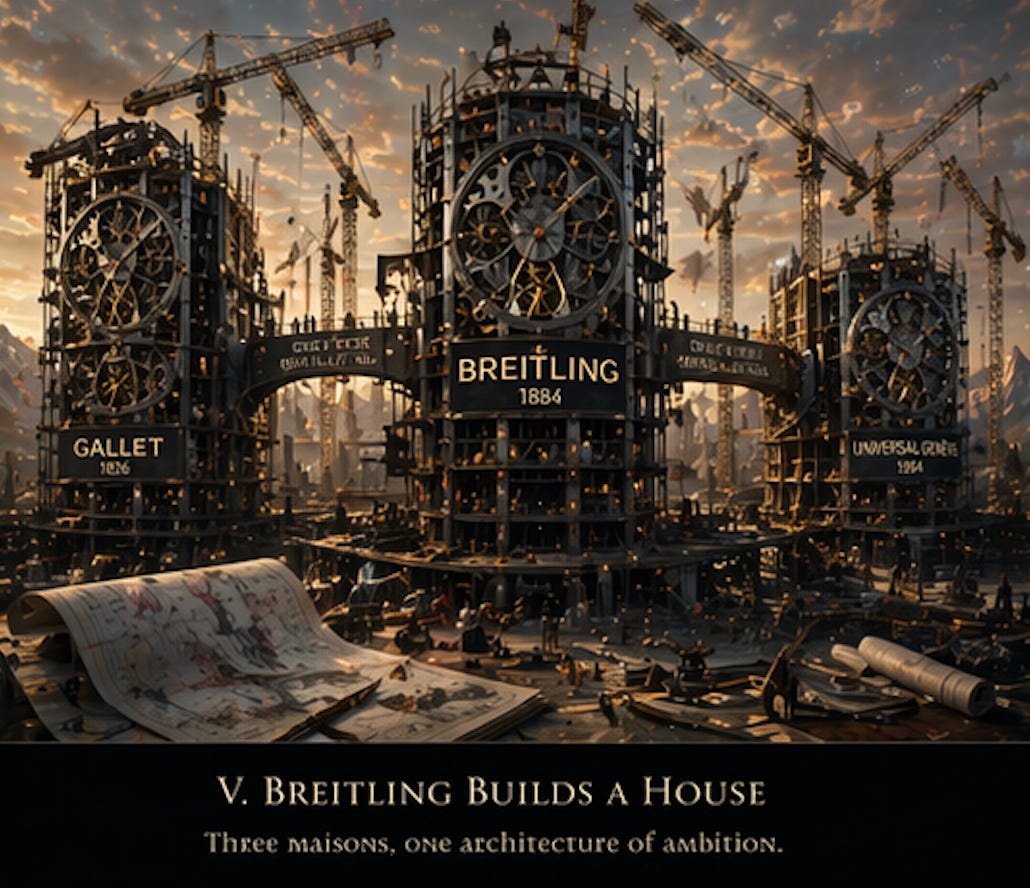
Breitling Builds a House.
While Richemont sheds a brand, Breitling is assembling a group. The consolidation era isn’t ending. It’s inverting.
At the end of 2023, Breitling acquired Universal Genève for sixty-nine million dollars. In the spring of 2025, it acquired Gallet for an undisclosed sum. In November 2025, at Dubai Watch Week, Georges Kern stood before a two-storey pavilion and announced what the two acquisitions were for: a structure called House of Brands, uniting three watchmakers under a single strategic umbrella. Gallet, founded in 1826, would relaunch as Breitling’s entry-level sister brand, priced between three and five thousand Swiss francs, sold through Breitling’s own boutiques. Universal Genève, founded in 1894 and once known as le couturier de la montre, would be positioned above Breitling in the ultra-luxury segment, operating with its own identity and distribution. Breitling itself would remain the core — the middle register of a three-tier architecture that had not existed eighteen months earlier.
This does not fit any established playbook. When LVMH acquired TAG Heuer and Zenith in 1999, it was a conglomerate adding to an existing luxury portfolio. When Richemont bought Jaeger-LeCoultre, IWC, and A. Lange & Söhne in 2000, it was a group with deep infrastructure absorbing brands into a proven distribution architecture. In both cases, the acquirer was already a group. The brands being acquired were active, profitable, and strategically coveted. The transactions were competitive — multiple bidders, premium prices, intensive due diligence. What Breitling has done is categorically different. A single brand, backed by private equity, has purchased two dormant names and is attempting to build a multi-brand group from the ground up. The acquirer is not a conglomerate. It is trying to become one.
The structural logic is not difficult to discern. Kern himself has been candid about the arithmetic. Breitling’s average sale price has risen considerably over the past eight years. The brand has moved upmarket, which means it has vacated the price segment it once occupied. Customers walk into Breitling boutiques and walk out because the watches are too expensive. Gallet solves this problem from below: an entry-level brand with genuine heritage, manufactured by Breitling, available through existing retail infrastructure. Universal Genève solves it from above: a collector-oriented ultra-luxury proposition that Breitling’s own name could never credibly support. The logic is segmentation — three brands covering a price spectrum that no single brand can stretch across without losing coherence.
This is, on one level, entirely rational. Tudor performs exactly this function for Rolex. The difference is that Tudor was not acquired — it was built, over decades, from within the same corporate family. Breitling is attempting to replicate that architecture through acquisition, and it is doing so with brands that have no existing customer base, no active production, no current retail presence, and no demand stability to speak of. This is where the Tissot framework from 2000 becomes useful as a diagnostic. Tissot argued that brand value is a function of the stability of future demand — the predictability of cash flows over time. By that measure, Universal Genève and Gallet have no brand value at all. They are names with history but without demand. What Breitling is betting on is the opposite of Tissot’s thesis: that heritage, carefully reactivated, can manufacture demand stability where none currently exists. The bet is that the name is enough.
Whether the bet will pay depends on a set of questions that have no precedent in modern watchmaking. Has any single brand successfully built a multi-brand group in this industry before? The answer, as far as the available evidence shows, is no. LVMH, Richemont, and Swatch Group all began as holding structures or conglomerates with diversified interests. They acquired watch brands into pre-existing corporate architectures. Breitling is attempting the reverse — building the architecture around the brands as they are being revived. This is not portfolio diversification in the Richemont sense. It is something closer to a startup thesis applied to heritage watchmaking: acquire undervalued intellectual property, invest in product development and narrative construction, and extract value from the gap between the brand’s historical reputation and its current commercial dormancy.
The private equity dimension is impossible to ignore. Breitling is backed by CVC Capital Partners and Partners Group. These are not patient family offices or luxury-native holding companies. They are financial sponsors with return horizons and exit expectations. The House of Brands, whatever else it is, is also a value-creation narrative for investors — a story about optionality, about multiple revenue streams, about a platform that is worth more than the sum of its individual brands. In the language of private equity, Breitling is building a platform company. In the language of horology, it is building a maison. The two vocabularies describe the same structure, but they imply very different time horizons and very different definitions of success.
The leadership structure announced this month suggests the architecture is being formalised rapidly. Jean-Marc Pontroué, formerly of Roger Dubuis and Montblanc, succeeds Kern as Breitling’s CEO. Grégory Bruttin continues as managing director of Universal Genève. Erwan Rossignol, previously Breitling’s global director of wholesale, takes on Gallet. Kern moves to CEO of the House of Brands, overseeing the strategic umbrella while the three brands develop their own operational autonomy. This is, in miniature, the Richemont model — a holding structure with independent maisons. Except that Richemont built its model over three decades and thirty billion francs’ worth of acquisitions. Breitling is attempting it with two deals totalling perhaps eighty million dollars and a handful of executive appointments.
Read alongside Essay IV, the pattern becomes clear. Richemont is shedding a brand that no longer fits its portfolio logic. Breitling is acquiring brands that fit nothing yet. In both cases, the consolidation model of the 1990s and 2000s — the model Pierre Tissot described with such confidence in the Swiss Watchmaking Journal — is being renegotiated. The old assumption was that bigger portfolios meant more stable demand and more predictable cash flows. The new reality is more selective and more contradictory. Groups are pruning brands that dilute their positioning. Individual brands are assembling groups from dormant names. The direction of travel is no longer uniform. Consolidation is not ending. It is mutating into something the original framework did not anticipate: a landscape in which the most interesting structural moves are being made not by the established conglomerates but by the actors they once would have acquired.
Whether Breitling’s house will stand is a question for the market to answer over the next five years. Universal Genève’s first new production — restored archival movements, grand feu enamel dials, prices well above Breitling’s range — is already in the world. Gallet’s relaunch is scheduled for late August. The products will either find an audience or they will not. But the structural ambition is already legible, and it is significant regardless of commercial outcome. A single watchmaker has looked at the conglomerate model, decided it can be replicated at a fraction of the scale and cost, and placed a bet that heritage, properly narrated, can be converted into demand. It is, in its way, the most radical test of brand theory the industry has produced since the consolidation era began.
About the Author
Sergio Galanti is an independent brand strategist and writer in the luxury watch industry. He is the editor of WatchDossier, a publication devoted to the cultural and philosophical undercurrents of modern horology.
No compensation or brand affiliation influenced this essay. Opinions are the author’s own.
Subscribe watchdossier.ch to receive more insights on luxury, craftsmanship, and collecting.


