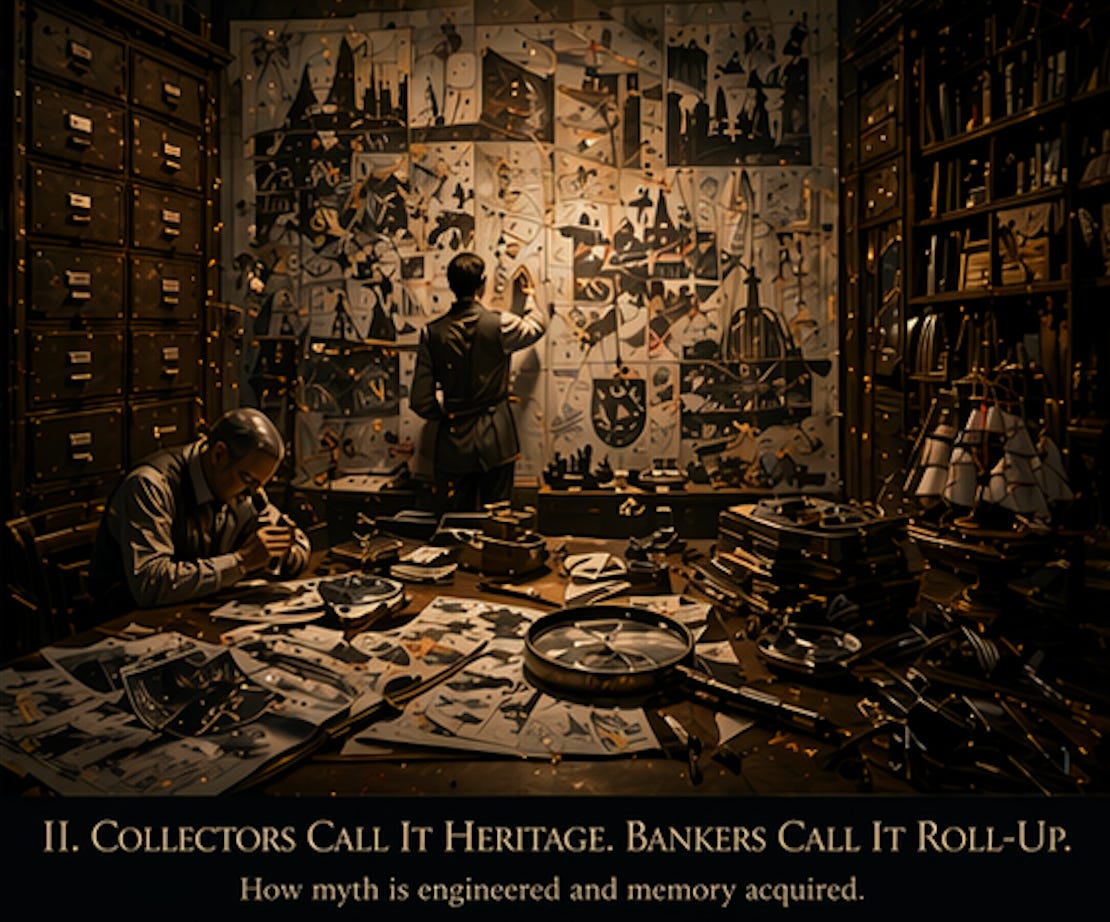
Collectors Call It Heritage. Bankers Call It Roll-Up.
The heritage you consume was not inherited. It was engineered.
In 1997, the Vendôme Group — the luxury arm of what is now Richemont — acquired a small Florentine company called Officine Panerai for approximately one million dollars. The purchase price alone tells you everything you need to know about what Panerai was at the moment of acquisition. It was not a luxury brand. It was not, in any meaningful commercial sense, a watchmaker. It was a former military instrument supplier whose entire historical output amounted to roughly sixteen hundred watches, nearly all of them manufactured by Rolex using Cortébert pocket watch movements, delivered to the Italian Navy between the mid-1930s and the late 1950s. After 1970, Panerai ceased producing watches for the navy entirely. For the next two decades, the company made depth gauges and compasses. A brief civilian revival in 1993 produced small batches of reissued Luminor and Radiomir models that caught the attention of Sylvester Stallone, who wore one in a film. That was, in essence, the asset Richemont acquired: a name, a Florentine address, a handful of military patents, and a movie star’s endorsement.
Today, Panerai is a global luxury brand producing tens of thousands of watches annually at its own manufacture in Neuchâtel, fitted with proprietary in-house calibres across the 2000, 3000, 5000, and 9000 series. It operates boutiques on four continents. Its heritage narrative — Italian Navy frogmen, secret underwater missions, combat-diving instruments built for elite special forces — is among the most potent in the industry. Collectors refer to pre-1997 models as “Pre-Vendôme” pieces, a designation that functions simultaneously as a provenance marker and a mythological boundary: the watches from before the corporate era, touched by the aura of the original.
Every element of this narrative is factually grounded. Panerai did supply the Italian Navy. The watches were designed for combat divers. The Luminor’s crown-protecting bridge was engineered for water resistance under operational conditions. None of this is fabricated. But the narrative as it now exists — the heritage as a consumer proposition, the history as a brand asset — was constructed almost entirely after acquisition. Before 1997, Panerai’s military past was not a story told to customers. It was not told at all. There were no customers. The company had produced sixteen hundred watches over thirty years for a single client and then stopped. What Richemont acquired was not a heritage brand. It was the raw material from which a heritage brand could be built.
The construction was meticulous. Angelo Bonati, a Cartier executive appointed to run the new acquisition, orchestrated the transformation on a minimal budget. The Florence boutique near the Duomo was renovated and repositioned as a pilgrimage site for collectors. A community of enthusiasts, the self-named Paneristi, was cultivated through early internet forums — Panerai was among the first watch brands to benefit from the promotional power of user-generated content. The PAM reference numbering system turned each watch into a collectible with a serial identity. Limited editions in runs of five hundred or a thousand created artificial scarcity. And beneath all of this, the military backstory — real but previously unnarrated — was amplified, refined, and delivered to a market that received it as organic heritage rather than corporate positioning.
Panerai is the clearest case, but it is not the only one. The consolidation era of the 1990s and 2000s produced a pattern that can be observed across multiple acquisitions: a brand enters a group with one self-understanding and exits with another. Richemont’s acquisition of Les Manufactures Horlogères in 2000 brought Jaeger-LeCoultre, IWC, and A. Lange & Söhne into the portfolio. Each of these brands had genuine horological depth. But the narratives that now surround them — Jaeger-LeCoultre as the watchmaker’s watchmaker, IWC as the engineer’s timepiece, Lange as the apotheosis of Glashütte hand-finishing — were sharpened, codified, and strategically differentiated after they came under common ownership. The group’s task was not merely to distribute these brands but to ensure that each occupied a distinct narrative position within the portfolio, minimising cannibalisation and maximising the addressable market. Heritage, in this context, is not something a brand inherits. It is something a group assigns.
This is what the consolidation era actually accomplished. The standard account describes it as industrial strategy — economies of scale, distribution synergies, supply chain integration. Pierre Tissot’s 2000 article in the Swiss Watchmaking Journal exemplified this view: brands were capital assets, valued for demand stability and portfolio diversification. But the deeper operation was narrative. Groups did not merely acquire production capacity. They acquired the right to author a brand’s past. And in authoring that past, they manufactured the “heritage” that now functions as the industry’s primary pricing justification.
The distinction matters because heritage, once established, acquires an authority that resists scrutiny. When a collector pays a premium for a Panerai Luminor, part of what is being purchased is the story of the Italian Navy frogmen — the sense that this watch descends from instruments forged in combat. The story is true. But the story as a consumer-facing brand proposition did not exist before 1997. It was constructed by a luxury conglomerate that recognised, correctly, that a military backstory could be converted into a pricing architecture. The heritage is real. The narrative is engineered. And in luxury watchmaking, the narrative is what you pay for.
This is not a criticism. It is a description of how the industry works. Every luxury brand engages in some version of this process — the selective curation of history in service of a commercial proposition. What the consolidation era did was industrialise it. By concentrating dozens of brands under a small number of corporate owners, each with sophisticated marketing operations and global distribution, the groups were able to perform heritage construction at scale. The result is the landscape we now inhabit: an industry in which the past is not merely remembered but actively managed, in which provenance is a product category, and in which the line between what a brand was and what a group has decided it should have been is no longer visible to the consumer.
The consumer does not need to see it. That is, in a sense, the entire point. The heritage narrative works precisely because it presents itself as discovered rather than constructed — as something the group found in the archive and brought to light, rather than something it manufactured in the boardroom. The Pre-Vendôme Panerai is cherished for its authenticity, for its distance from corporate influence. But the category “Pre-Vendôme” was itself created by the post-Vendôme era. The boundary that marks authenticity is a product of the system it claims to precede.
Collectors call it heritage. Bankers call it roll-up. Both are describing the same acquisition. They are simply telling different stories about what was bought.
About the Author
Sergio Galanti is an independent brand strategist and writer in the luxury watch industry. He is the editor of WatchDossier, a publication devoted to the cultural and philosophical undercurrents of modern horology.
No compensation or brand affiliation influenced this essay. Opinions are the author’s own.
Subscribe watchdossier.ch to receive more insights on luxury, craftsmanship, and collecting.


