


There is a moment, and if you spend any time around watches you have seen it, when a reference stops being a watch and becomes a rumour. Last spring you could have bought it; the dealer had two. Now the dealer has a list, and the list has a waiting time, and the waiting time is quoted to you the way a sommelier quotes a vintage — with a small, grave pride, as though duration were a flavour. Nothing about the watch has changed. The case is the case it was. The movement keeps the time it always kept. What has changed is the number of people who have decided, more or less at once, that they cannot live without it.
That simultaneity is the whole phenomenon, and it is worth staring at before we agree to call it meaningful.
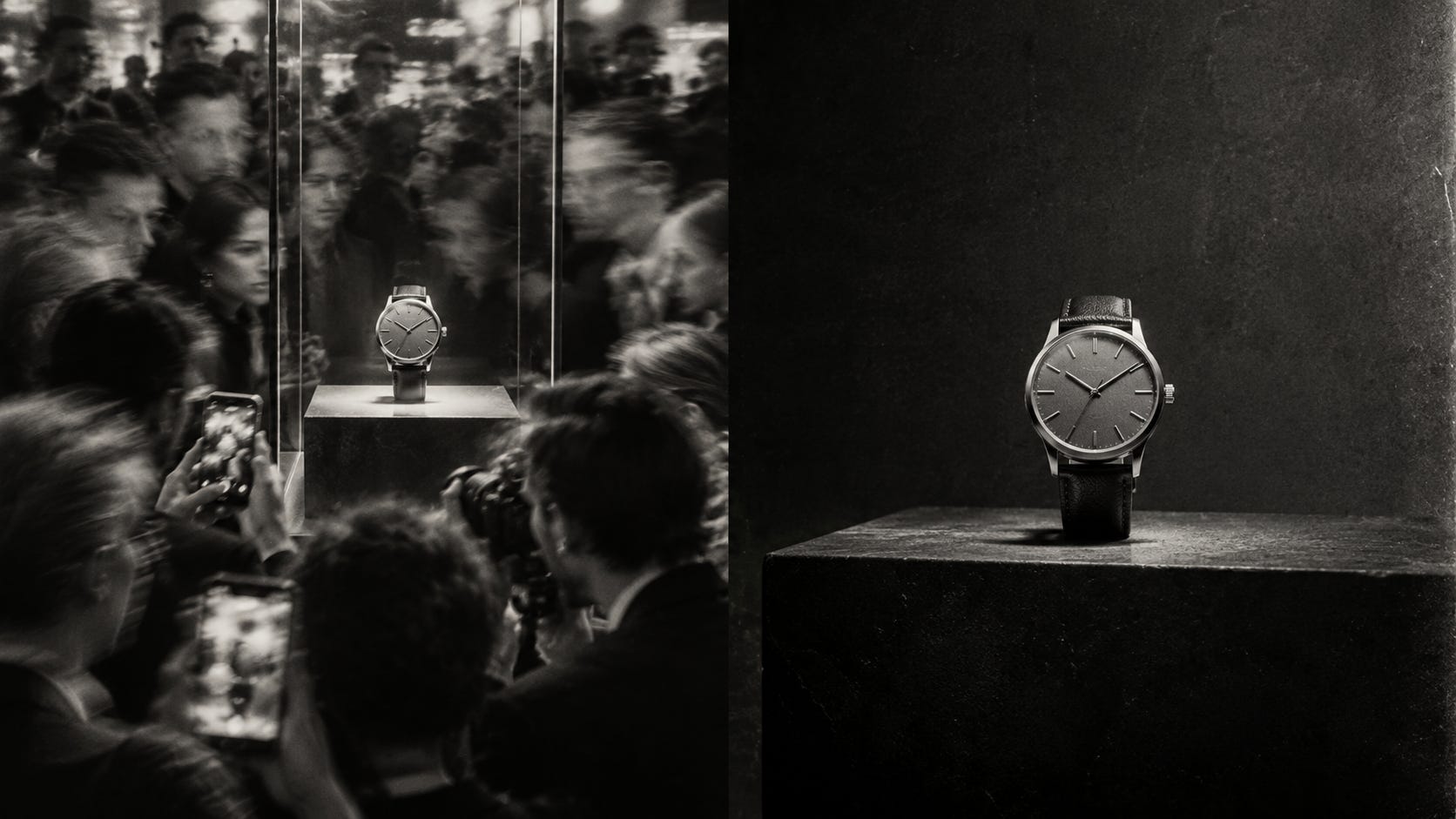
The trade will tell you the watch is hot, and it will offer the heat as information. Everyone wants it is spoken as though it settled something — as though the wanting were a verdict the watch had passed, rather than a weather system that had merely passed over it. But everyone wants it is a sentence about everyone. It reports, with real precision, what a certain number of people currently desire. On the actual question — is the watch any good, does it matter, will it deserve in ten years the certainty it commands this afternoon — it is silent. Perfectly, structurally silent. Popularity is not a property of the object. It is a headcount.
The difficulty is that a headcount feels like knowledge, and most of the time the feeling is earned. We are social animals with limited hours. When a thousand people prefer one restaurant to the empty one beside it, the crowd has done our research for us, and we are usually right to trust it. Social proof is a magnificent shortcut. It is also, in the particular conditions of the watch market, a trap laid with unusual care — because here the crowd is small, and reflexive, and very often the people selling you the watch are the same people assuring you that everyone wants it. The shortcut delivers you precisely to where the interested parties were standing. You feel you have done your looking. You have in fact borrowed a stranger’s eyes, and they were not disinterested.
This is the part worth saying plainly. The hype cycle is not a way of knowing things; it is a way of not having to. It supplies the sensation of certainty and excuses you from the labour that certainty is meant to cost. You know the watch is wanted. You have never once had to decide whether it is good.
And the wanting is manufactured, which the enthusiasm seldom pauses to consider. The allocation that arrives dressed as scarcity. The waitlist that works less as a queue than as an instrument, each name on it an advertisement to the next. The photographs — the same watch, the same wrist, the same three degrees of tasteful tilt, repeated until ubiquity begins to feel like consensus and consensus begins to feel like proof. None of it is sinister, exactly. It is an industry doing what industries do: converting a product into a phenomenon, then selling you the phenomenon at the phenomenon’s price. The engineering is the point. The heat was built.
You see the trick most clearly in its ruins. The MoonSwatch, when it landed in 2022, was a scrum — queues down the street, a plastic Omega flipping for several times its counter price, the photographs beyond counting. Today you walk in and buy one. Nobody decided it was worse; there was no announcement, no recall, no flaw brought to light. The crowd simply moved, the way crowds move, to the next thing, and the watch was left holding the exact merits it always had, which for a quartz Swatch were never the argument and never pretended to be.
It is not a new disease, and it does not need a plastic case to catch. In the 2000s the fever was Panerai — a big Italian cushion of a watch that Hollywood had adopted, Stallone on the wrist and a waiting list forming behind him, until for a few seasons no window display of a certain kind was complete without one. Then fashion, which had wanted its watches enormous, began to want them restrained, and the heat drained off to wherever heat goes. The watches themselves did not change. They were the same honest, slightly plain divers they had always been. What had come and gone was the crowd — and with it the conviction that they were the most important objects in the room.
Now the mirror image, quieter still. Andreas Strehler builds movements other watchmakers study — his own wheel geometry, a remontoir, a moon-phase whose error is counted in millennia — for an audience that mostly cannot name him. Ludwig Oechslin, who gave Ulysse Nardin the Freak, now makes watches under the Ochs und Junior name pared to the fewest parts that will do the work, and markets them to almost no one. Neither has ever been hot. Both are only good. Fashion, having nothing to gain from either, has never once turned its head.
So the discipline is almost embarrassing to state and nearly impossible to practise in a crowd: keep apart two questions the market never tires of running together. Is it wanted? and Is it any good? They are different questions. They sometimes share an answer — now and then the fashionable watch is also a great one, and there is no prize for perversity, no virtue in wanting a thing only because no one else does. But fashion answers the first question alone, while dressing itself as an answer to the second, and the collector’s whole task is to notice the costume. One test does most of the work: ask what will be true of the watch when no one is talking about it. Significance is the part that survives the silence. Fashion is the noise — it has no life in the quiet, which is where, sooner or later, every watch you actually own goes to live.
None of this argues against enjoying a fashionable watch, and it would be a joyless reading that took it so. Delight is not the error. If a watch pleases you and half the internet happens to agree, the agreement costs you nothing; wear it in good conscience and good company. The error is narrower, and more seductive — letting the wanting do your deciding, taking the fact that everyone wants a watch as proof that it is worth wanting. Detachment, here, is not coldness. It is the refusal to hand your eye to a crowd that is, at that very moment, reaching for yours. A fashionable watch may well be excellent. You are simply not entitled to conclude it from the fact that everyone is reaching.
About the Author
Sergio Galanti is the founder and editor of WatchDossier, contributor to Italian and international watch publications, the author of Against the Grain: A Cultural History of Swiss Independent Watchmaking, and advisor to private collectors.
No compensation or brand affiliation influenced this essay. Opinions are the author’s own.
Subscribe to watchdossier.ch to receive more insights on luxury, craftsmanship, and collecting.