


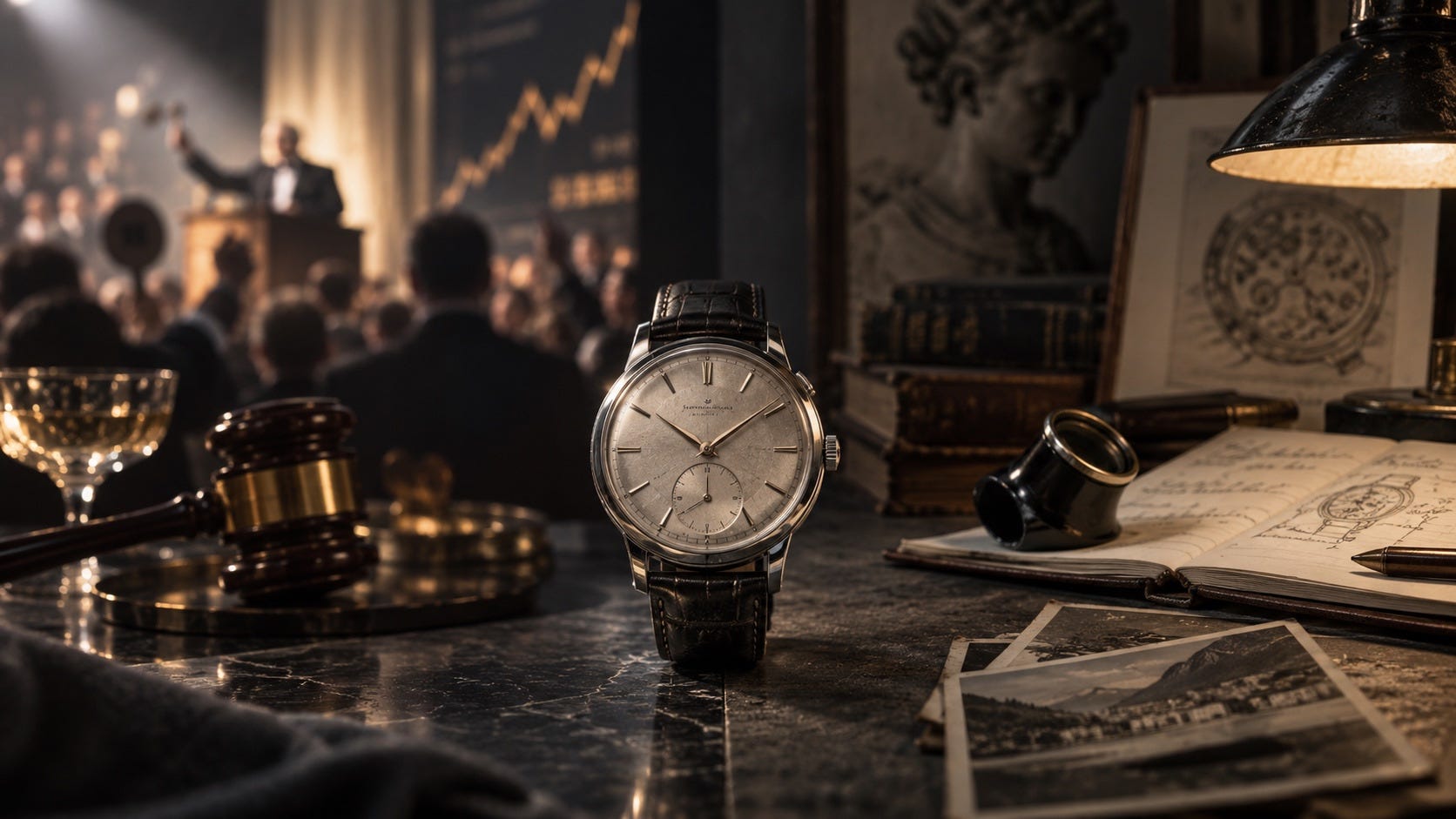
A saleroom applauds when a lot beats its estimate — real applause, not a polite ripple, and the further the hammer overshoots the louder the room gets. It is loudest for the lots the catalogue had already named as the sale’s stars. Everyone is clapping for a number. They would say they are clapping for the watch, and some of them believe it, but the watch has not changed in the four seconds since bidding opened; only the price has. What the room ratifies with its applause is not the object. It is the figure — the amount one person was willing to pay on a Tuesday in November, which is a different and much smaller fact than the applause takes it to be.
The confusion between those two facts is the most durable illusion in collecting, and it is not an accident. It is manufactured, daily, by an industry with every reason to manufacture it.
There is a quiet perfection in the fact that the stars are chosen in advance. Months before the sale a specialist decides which lots will carry the room, and the catalogue duly frames them — the full-page plate, the essay, the provenance laid out like a pedigree. The significance is declared first. The applause arrives second, on cue, and is then received as confirmation of the very thing that was settled in an office a few months before. The noise proves nothing except that the framing worked.
Consider what happens to the word value under pressure. Say a watch is up forty percent this year. The sentence sounds like information, and in a narrow sense it is: it tells you that demand for this object has risen faster than demand for most others. But watch how quickly the sentence is asked to do more work than it can bear. Up forty percent becomes important. Important becomes significant. Significant becomes worth owning. By the end of the chain the price has been quietly promoted from a record of appetite into a verdict on merit, and nobody noticed the promotion happen, because each step felt like common sense.
It is worth slowing down enough to separate the things the single number has swallowed. There is price, which is what the market will pay today. There is historical significance, which is whether the watch did something or meant something. There is rarity, which is a fact about supply and says nothing on its own about whether the scarce thing deserved to be made. There is quality, the actual character of the object in the hand. There is personal relevance, the private reason a particular collector might want a particular watch. And there is suitability — whether the thing belongs in this collection, assembled by this person, for these reasons. Six different questions with six different answers, and the market’s genius is to price the first and let it stand in for the other five.
The mechanism is not sinister so much as structural. Everyone in the ecosystem prices things, because pricing is what they are equipped to do. Dealers price inventory. Auction houses price consignments. Indices price the aggregate. The brands, in their way, price desire itself. What none of them can price is significance, because significance is not a market fact; it is a judgement, and judgements do not clear at a hammer. So significance gets proxied. The number stands in for the thing the number cannot measure, and because the number is public and precise while significance is neither, the proxy wins. In time the market stops pretending the price is a proxy at all. The price simply becomes the meaning, and to suggest otherwise begins to sound naïve, almost rude — like asking why anyone would want the thing everyone wants.
You can watch the equation break in both directions, if you are willing to look.
It breaks upward when a watch is expensive and horologically minor. A Richard Mille RM52-01 — the skull tourbillon, its bezel and caseback cut from TZP ceramic, its skull sculpted in red gold, its price the cost of a comfortable house — is a marvel of several things: materials science, brand architecture, the industrial manufacture of longing. Horological significance is not obviously among them. The tourbillon at its centre is a nineteenth-century idea rendered in twenty-first-century composites; the skull — a structural bridge, the brand will tell you, and not mere ornament — is nonetheless a mood, and the mood is what you are paying for. The price is real. The demand is real. The importance is borrowed — rented from a market mood that will end the way market moods end, and when it ends the watch will still be exactly what it always was, which was never quite what the number said.
And it breaks downward, more interestingly, when a watch is important and underpriced. A 2006 Haldimann H1 Central Tourbillon — a flying tourbillon the size of a pocket-watch escapement, turning in a lyre-shaped cage at the dead centre of the dial, made by Beat Haldimann and two colleagues at the rate of a couple of dozen pieces a year, by hand, without a CNC machine in the building — is one of the more quietly radical objects independent watchmaking has produced this century. It barely troubles a saleroom, and when it does it changes hands for a fraction of what the loud names command — not because anyone has weighed it and found it wanting, but because the market has scarcely turned to look. Here the market is not lying. It is simply not paying attention. The significance is present and unpriced, waiting, and the only people who can see it are the ones looking at the watch rather than the chart. This is the more valuable thing to notice, because the upward break merely costs you money, while the downward break is where collecting actually happens.
Which brings us to the test, and the test is a subtraction. Take any watch you are about to buy, or already own, or are being told you should want, and remove the price from it. Not lower the price — remove it. Remove the auction record, the index line, the figure your friends will hear. Now ask what is left that you would still want. Sometimes a great deal is left: the object is beautiful, the maker did something no one else did, the reference completes an argument your collection has been making for years. Sometimes nothing is left at all — and the honest recognition of that nothing is among the most useful things collecting can teach you. Because if the desire does not survive the removal of the price, then you were never collecting the watch. You were holding a position in it. Which is a respectable thing to do, and should be called by its right name.
None of this makes price contemptible, or the market a mistake. The market is very good at the one thing it does. It converts appetite into numbers with a speed and a candour no committee of connoisseurs could match, and a collector who ignores it entirely is not principled, only poorer. The point is narrower, and harder to keep hold of: the market’s number is the market’s opinion. It is a live, shifting, occasionally hysterical opinion about how much someone else wants what you have, and it is worth knowing — the way the weather is worth knowing. It is simply not the same as knowing what you own.
The market prices watches every day. It has never once priced a collection — whatever the results page implies. When a great collection goes to auction it is not valued so much as dismantled, its pieces sold one by one to buyers who each came for a watch; the headline total is arithmetic performed afterward, a sum where a collection used to be. And on the rare occasion one changes hands whole, for a single figure, that figure still prices the objects and not the coherence — because the coherence was never in the watches. It was in the judgements that gathered them: what was kept, what was declined, what one person understood that the chart did not. That is the part with no market, the part the saleroom can neither dismantle nor announce, in that burst of applause, on a Tuesday in November. It leaves with the collector, as it always did.
About the Author
Sergio Galanti is the founder and editor of WatchDossier, contributor to Italian and international watch publications, the author of Against the Grain: A Cultural History of Swiss Independent Watchmaking, and advisor to private collectors.
No compensation or brand affiliation influenced this essay. Opinions are the author’s own.
Subscribe to watchdossier.ch to receive more insights on luxury, craftsmanship, and collecting.