


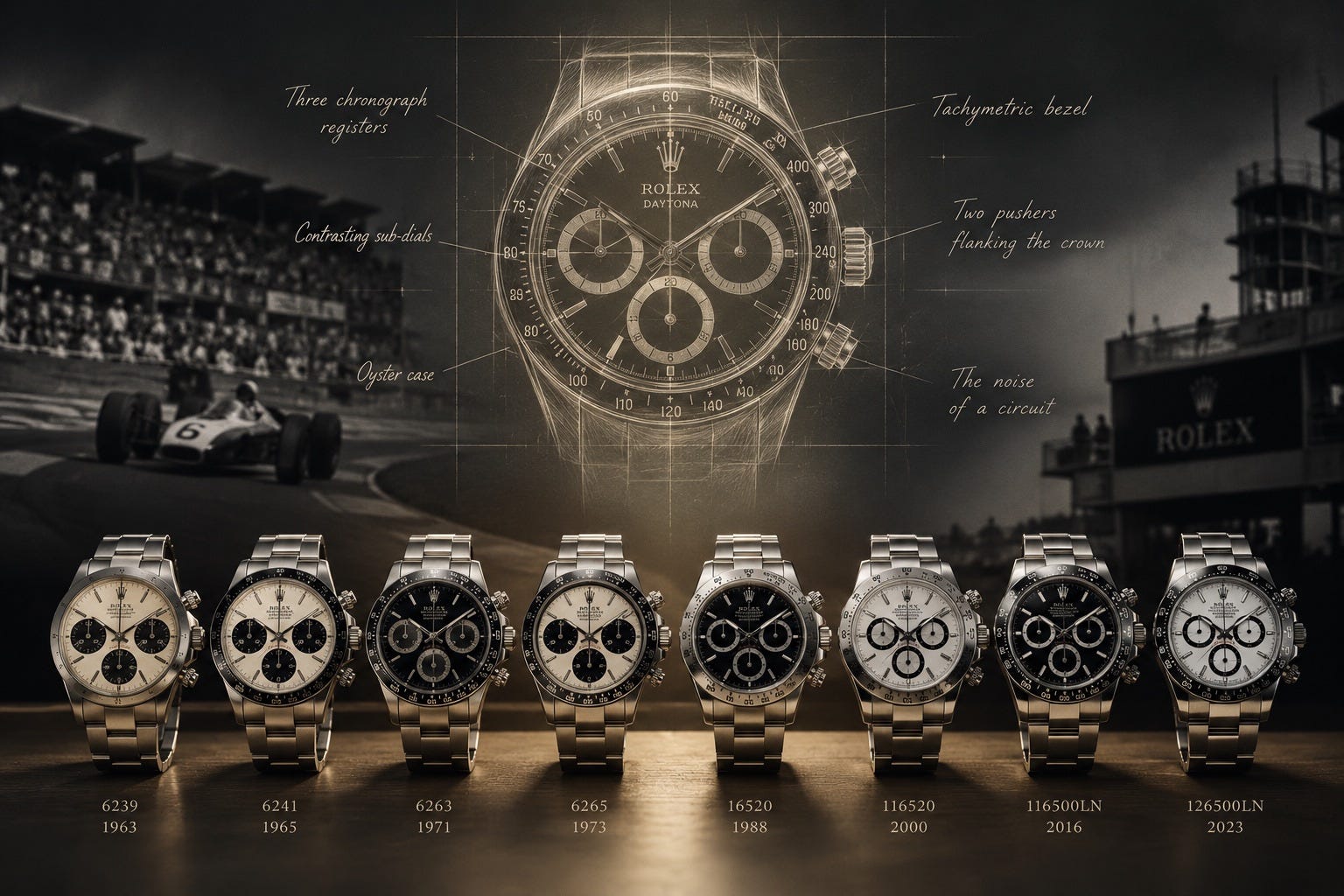
Try naming the Daytona. Not a reference — not the one you own or the one you are waiting for, but the watch that arrives, unbidden, when the word is spoken. It is a vivid picture and a surprisingly stable one, shared across collectors who have never met: three chronograph registers, a tachymetric bezel, two pushers flanking the crown, contrasting sub-dials, an Oyster case, and somewhere behind it the noise of a circuit. Compact, symmetrical, the four words in their correct hierarchy. Now try to buy it.
You cannot. The watch in the picture corresponds to nothing Rolex has ever sold. No single reference delivered all of it at once. The image is an average of watches, a composite assembled out of sixty years of near-misses — and it is the one most collectors actually want. The references on the tray are only approximations of it. The one Daytona that cannot be bought is the only one that fully satisfies.
The conventional way to tell the Daytona’s story is chronological, and it is not wrong, only insufficient. Reference 6239 arrives in 1963 and moves the tachymeter from the dial to the bezel. The 6240 brings screw-down pushers and makes the word Oyster mean something. The 6263 and 6265 settle the manual-wind face into the shape most people, if pressed, would still draw. The 16520 makes the watch automatic in 1988. The 116520 puts a Rolex movement inside it in 2000. The 116500LN gives the steel Daytona a black ceramic bezel in 2016, and the 126500LN rearranges the whole composition once more. Reference follows reference; each improves on the last. Told this way it is a story of progress, and progress is a story with a direction, and the direction points at the watch on the shelf today.
But that is the salesman’s history, and it explains nothing that matters. It cannot explain why the watch in everyone’s head is not the current one. It cannot explain why the object that governs the entire market is an abstraction that no boutique stocks. To account for that you have to run the story backwards — not from the model down to the copies, but from the copies up to the model. You have to ask not how one Daytona became the next, but how the succession of them slowly manufactured the idea of the Daytona, an idea that is now stronger than any of the watches that produced it.
The instinct of every collector is essentialist. We believe the Daytona has an essence, that the 6239 contained it in embryo, that everything since has been the patient unfolding of a form that was always latent in the first one. It is a beautiful belief and it is false. The 6239 did not contain the Daytona. It began a sentence that took decades and a dozen references to finish, and the meaning of the sentence was only legible once most of it had been spoken. The archetype did not precede the series. It condensed out of it.
Look at what was missing at the start. The earliest 6239s do not always carry the word Daytona on the dial. They have pump pushers, not the screw-down pushers that now seem constitutive. The Oyster promise is incomplete. A great many of the features that a collector today would list as essential to a Daytona were simply not there in 1963, and were added, one at a time, by watches that were each responding to the ones before them. Screw pushers arrive and, in retrospect, look as though they had always been implied. The mature dial arrangement stabilises and begins to feel inevitable. Innovation, in this object, has a retrograde logic: each new feature, once added, ceases to look like an addition and begins to look like a gap the watch had left open and has now, belatedly, closed. The past is continually revised to have been leading here.
So the reference does not define the model. The model judges the reference. Each new Daytona is measured against an abstraction that no engineer at Bienne ever drew, and that abstraction sits above all of them, correcting them, absorbing them, deciding what counts.
* * *
Once you see the object this way, its most famous internal dramas stop being a catalogue of variants and start being a demonstration of how little a difference has to be to carry almost everything.
Consider the manual-wind family, which is where the market’s obsession with difference reaches something close to laboratory purity. The 6239 and the 6241 are, functionally, the same watch; the principal distinction is the bezel — engraved metal on one, black acrylic on the other. The 6262 and 6264 repeat the pairing with an upgraded calibre nobody can see. The 6263 and 6265 divide again along the same seam, black against metal, now with screw pushers. The functional interval between these watches is close to nothing. You could wear any of them for a lifetime and never once feel the difference in the hand or on the wrist. The symbolic interval between them is measured in hundreds of thousands of francs. A collector can stand in front of two watches that keep the same time and cost the same to service, and describe one as ordinary and the other as extraordinary, and be completely right, and the whole of the rightness lives in a ring of metal.
And then there is the dial they now call Paul Newman, which is the purest case of all, because it is the case where a difference stopped being a difference and became an object.
Nothing about the exotic dial changed what the watch did. It rearranged signs — the numerals, the typography, the little blocks of colour, the treatment of the sub-dial rings and the outer track. These were decorative distinctions and the market treated them accordingly, which is to say it did not want them. The exotic-dial watches were slow to sell. The dial was quietly dropped. For years it was the version you took off the price because nobody could move it. What happened afterwards had nothing to do with the watch and everything to do with a name attaching itself to the watch, and the name doing what names do, which is to convert an accident into a destiny. The later value of the Paul Newman cannot be explained by anything the watch does. Its chronograph is not a thousand times better than the standard version’s. Its worth lives entirely in a web of things that are not the watch: rarity, provenance, recognition, celebrity, the pleasure of knowing, the small aristocratic thrill of being able to read a dial that most people cannot. The Paul Newman is not a rare watch. It is a difference that acquired a body.
What matters here is the mechanism, not the anecdote. Distinction, in this world, does not come from the essential object. It comes from the differences arranged around it, and the collector’s particular genius — the thing that separates him from the ordinary consumer choosing a colour — is that he does not merely select the difference. He learns to read it. He becomes fluent in a language of variation that runs to Panda and reverse Panda, Big Red and floating Cosmograph, tropical and porcelain, Patrizzi and Zenith and the inverted six. It is a magnificent vocabulary and it is worth pausing on where it came from, because Rolex did not write most of it.
This is the point at which the Daytona becomes genuinely strange, stranger than any theory of consumption quite prepares you for. Rolex produced the watches. The differences that now organise the entire market were, for the most part, produced by someone else. A dial that drifted from black to brown under ultraviolet light over thirty years. A word that sat a fraction high on the dial for one production batch. A typographical quirk. None of these was designed to mean anything. Each of them became decisive later, retrospectively, through the labour of scholars and auctioneers and dealers and obsessives who noticed the difference, named it, and by naming it made it legible. Once a difference is legible it can be desired, and once it is desired it can be priced. A variation that began as a manufacturing accident, or as nothing at all, ends as an identity — with a nickname, a market, and a queue.
There are, in other words, two Daytona series and not one. The first is industrial, produced at Bienne and Plan-les-Ouates. The second is cultural, produced in catalogues and forums and the back rooms of dealers, and it is the second series that most of the money is now chasing. This should make us cautious, and it is worth saying plainly: a great deal of the taxonomy that collectors treat as settled fact — the marks, the maker codes, the sequences of who-made-what-when — is reconstruction, a set of working hypotheses assembled after the event by people with an interest in the answer. Some of it is doubtless correct. Some of it is a story the market needed and therefore found. The important thing for the argument is not which entries are true. It is that the manufacturer never controlled the code. The people consuming the object went on producing it long after the factory had stopped.
* * *
The market completes what the factory begins. And because it does, the model never sits still. At any given moment some particular reference is elevated into the position of the thing everyone means — the newest steel automatic when it cannot be had, the 6263 for the purist, the 16520 for the collector who thinks the transitional dials are where the interest lies, the Paul Newman for the market that has decided provenance is the only luxury left. The privileged reference migrates. There is the macro-model, the Daytona, which is stable and eternal and imaginary; and inside it a shifting population of micro-models, each briefly crowned, each the temporary answer to the question of which Daytona is the Daytona. This is why the hobby has no terminus. You do not, in the end, buy a Daytona and stop. The system has evolved to propose, always, one more difference that matters, one more reference that is suddenly the one, one more gap between what you have and what the word means.
After six decades of this, the object has become something other than a chronograph that happens to exist in many versions. It has become a small language, and like any language it generates statements faster than anyone can make them. Metal bezel. Black bezel. Pump pusher. Screw pusher. Exotic. Standard. Manual. Automatic. Zenith. Manufacture. Steel. Gold. Platinum. Oyster. Oysterflex. Each is an adjective, and every adjective modifies the same noun, and the astonishing thing is that the noun survives all of them. You can change the movement, the winding, the case size, the crystal, the bezel material, the bracelet, the very century the thing belongs to, and it remains, unmistakably, a Daytona. What persists is not any of the parts. It is the relation between them — a grammar robust enough to absorb the replacement of every word in the sentence.
Rolex has made hundreds of thousands of physical Daytonas. It has never made the Daytona — the one in the head, the composite that every real one gestures at and none contains. That watch is not in the vault at any auction house and it is not coming to the boutique; it is nowhere because it is everywhere, and no reference exhausts it. This is the quiet scandal beneath the whole enterprise. The Daytona was not designed and then diluted into copies. It was assembled, in reverse, out of its own copies — manufactured by the series it is supposed to have fathered, built by six decades of collective wanting. The physical watches are only the evidence; the object of desire is the idea, and the idea was made by the wanting. Which is the part that understanding does nothing to cure. I know exactly how the composite was built, and I want it anyway — more than any of the watches I could actually put on.
© 2026 Sergio Galanti. All rights reserved. This essay is an extract from the author’s forthcoming book The Grail Problem: The Most Famous Watch Nobody Could Buy; no part of it may be reproduced, in any form, without the author’s written permission.
About the Author
Sergio Galanti is the founder and editor of WatchDossier, contributor to Italian and international watch publications, the author of Against the Grain: A Cultural History of Swiss Independent Watchmaking, and advisor to private collectors.
No compensation or brand affiliation influenced this essay. Opinions are the author’s own.
Subscribe to watchdossier.ch to receive more insights on luxury, craftsmanship, and collecting.