On the Verb “To Develop”
A note on language, affiliation, and the prestige economy of watchmaking.
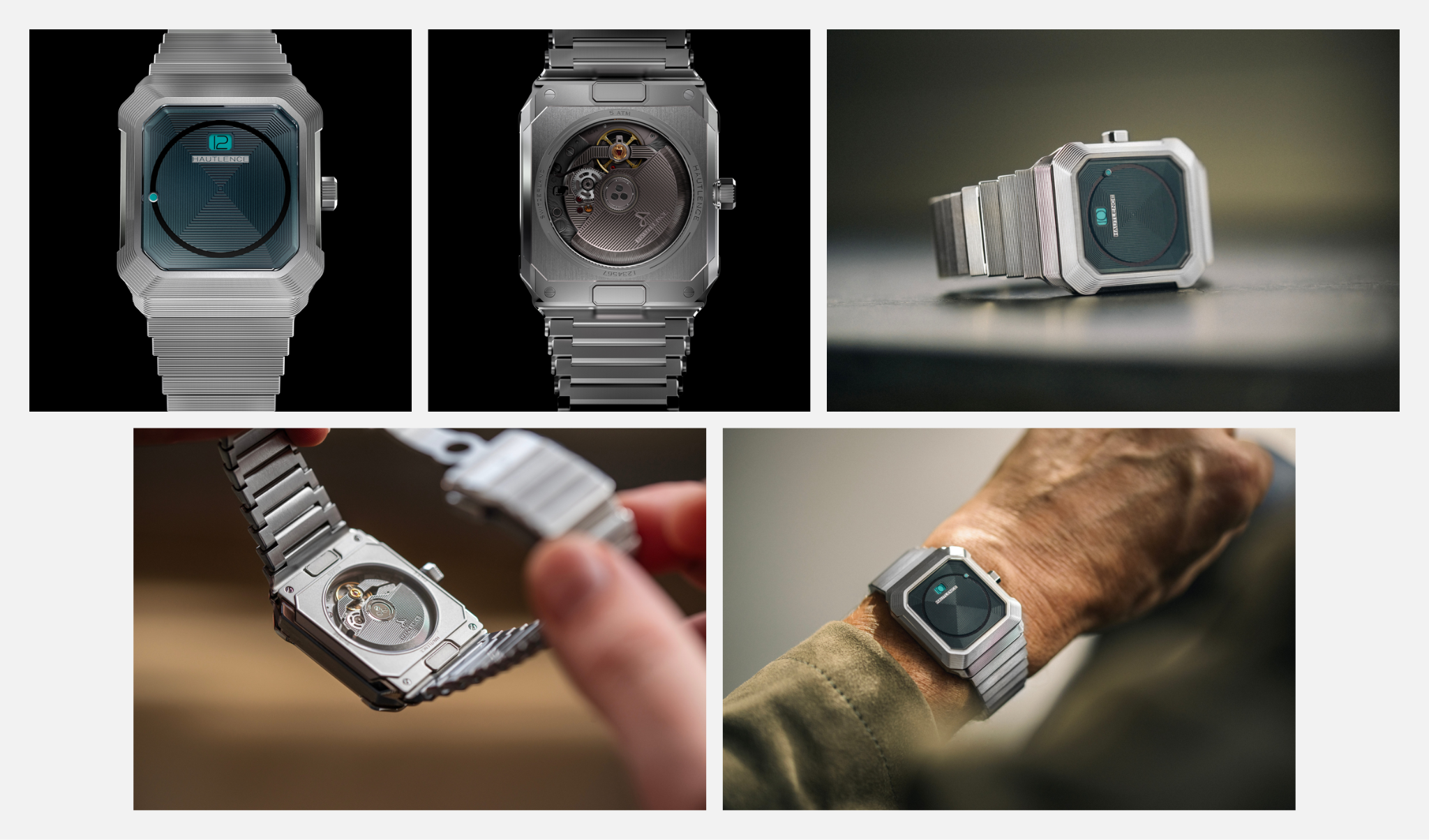
Among the more elegantly deployed sentences in the press release for the new Hautlence Kubera Series 1, one stands out for the patient labour it performs on the reader’s behalf. “The jumping hours and peripheral minutes module,” the brand explains, “developed by Agenhor in collaboration with HAUTLENCE, completes this mechanical architecture and turns the act of reading the time into a dynamic visual experience.” The sentence is technically accurate, properly punctuated, and entirely true within the limits it sets for itself. It is also a small masterpiece of the curatorial imagination.
To appreciate the achievement, one must first understand what the name Agenhor performs in such a sentence. Founded in Geneva in 1996 by Jean-Marc and Catherine Wiederrecht, Agenhor — Atelier Genevois d’Horlogerie — is among the most respected complication houses in Switzerland. Maker of the AgenGraphe, the chronograph caliber that powers Singer Reimagined and the H. Moser Streamliner. Developer of Hermès’ Temps Suspendu, of Van Cleef & Arpels’ Pont des Amoureux, of MB&F’s HM2 and HM3, of much of Harry Winston’s complicated catalogue between 2008 and 2010, of nine GPHG awards across three decades. The quiet supplier behind a generation of watches collectors have admired without precisely knowing why. To name Agenhor is to invoke a particular kind of legitimacy: the legitimacy of the small Geneva atelier, of the independent expert, of the partner who could not be bought.
This last assumption requires some maintenance.
In March 2023, MELB Luxe — the Meylan family parent vehicle that owns H. Moser & Cie. and Hautlence — announced that it had taken a minority stake in Agenhor SA. Edouard Meylan, owner of MELB Luxe and CEO of H. Moser, joined Agenhor’s board of directors. The transaction was reported openly, in the trade press, in March of that year. MELB Luxe described it, in its own words, as a “win-win situation.”
The Hautlence press release of April 2026 does not mention any of this.
To be clear about what is being said and what is not: Agenhor remains majority-owned by the Wiederrecht family, and is run today by Jean-Marc’s sons Nicolas and Laurent. The work the company does for Hautlence, for H. Moser, for Hermès, for Van Cleef & Arpels, and for its other clients is real, accomplished, and excellently conceived. The minority stake is, as far as anyone has reported, exactly that. The collaboration, in some plain and durable sense, is a collaboration. The trouble is only with the word.
“In collaboration with” is, in ordinary English, the language of arms-length partnership. It is the phrase one uses to describe two distinct entities, brought together by mutual interest, each retaining its independence. It is not, ordinarily, the phrase one uses to describe a transaction between a brand and a supplier in which the brand’s owner sits on the supplier’s board, holds a financial position in the supplier’s outcomes, and shares back-office synergies with a sister brand which uses the same supplier. The latter relationship has its own perfectly respectable name in industrial English. It is called affiliation.
But affiliation is not a word that performs prestige. Collaboration is.
One could argue, and the industry will, that the distinction is technical, that minority stakes do not constitute control, that the Wiederrechts continue to make Agenhor’s decisions, that the board seat is a courtesy, and that all of this is, in any case, transparent to anyone who reads the trade press. All of which is true. None of which addresses the question. The question is not whether the press release lies. The question is what the press release does not see fit to mention, and what that omission tells us about the words the industry has at its disposal.
Watchmaking has, in recent years, been generous with its vocabulary. In-house once meant a manufacture producing its own assortments; today it means a brand briefing the architecture while a Swiss specialist does the engineering. Independent once meant unaffiliated; today it means not owned by Richemont, Swatch, LVMH, or Kering — which leaves a great deal of room. Family-owned is now compatible with portfolio holdings, distribution subsidiaries on three continents, and minority stakes in supplier networks. The vocabulary has not collapsed. It has merely become accommodating.
The newest accommodation, discreetly inaugurated by the Kubera, is the verb to develop. To develop, in the previous regime, was to undertake a piece of work for someone else, the boundary clearly drawn. To develop in collaboration with, in the present regime, is to do that work for someone with whom one has financial entanglements, while maintaining the syntactic appearance of distance. The sentence holds. The syntax obliges. The reader is invited to read carefully, or not at all.
The Kubera is, in any honest reading, an excellent watch. The Agenhor module is excellent. Wiederrecht’s lineage, three decades into making time visible by ingenious means, requires no defence. None of this is the point. The point is the small but interesting development in the language by which the watch is announced, and the question of whether the buyer, holding the watch in the palm, deserves the difference between a partnership and a position.
The Swiss commercial register, as always, is quietly available to anyone who wishes to consult it. The press release is quietly available to anyone who does not. Both serve their respective publics with admirable precision.
About the Author
Sergio Galanti is a Swiss-based independent writer specialising in the luxury watch industry, and an advisor to private collectors and investors. He is the editor of WatchDossier (watchdossier.ch), a publication exploring the cultural and philosophical undercurrents of contemporary horology, and the author of Against the Grain: A Cultural History of Swiss Independent Watchmaking.
No compensation or brand affiliation influenced this essay. Opinions are the author’s own.
Subscribe to watchdossier.ch to receive more insights on luxury, craftsmanship, and collecting.


