One Less Than Before
U-Boat takes a millimetre off its bestseller and calls the result a philosophy. The number on the dial tells a plainer story.
One Millimetre
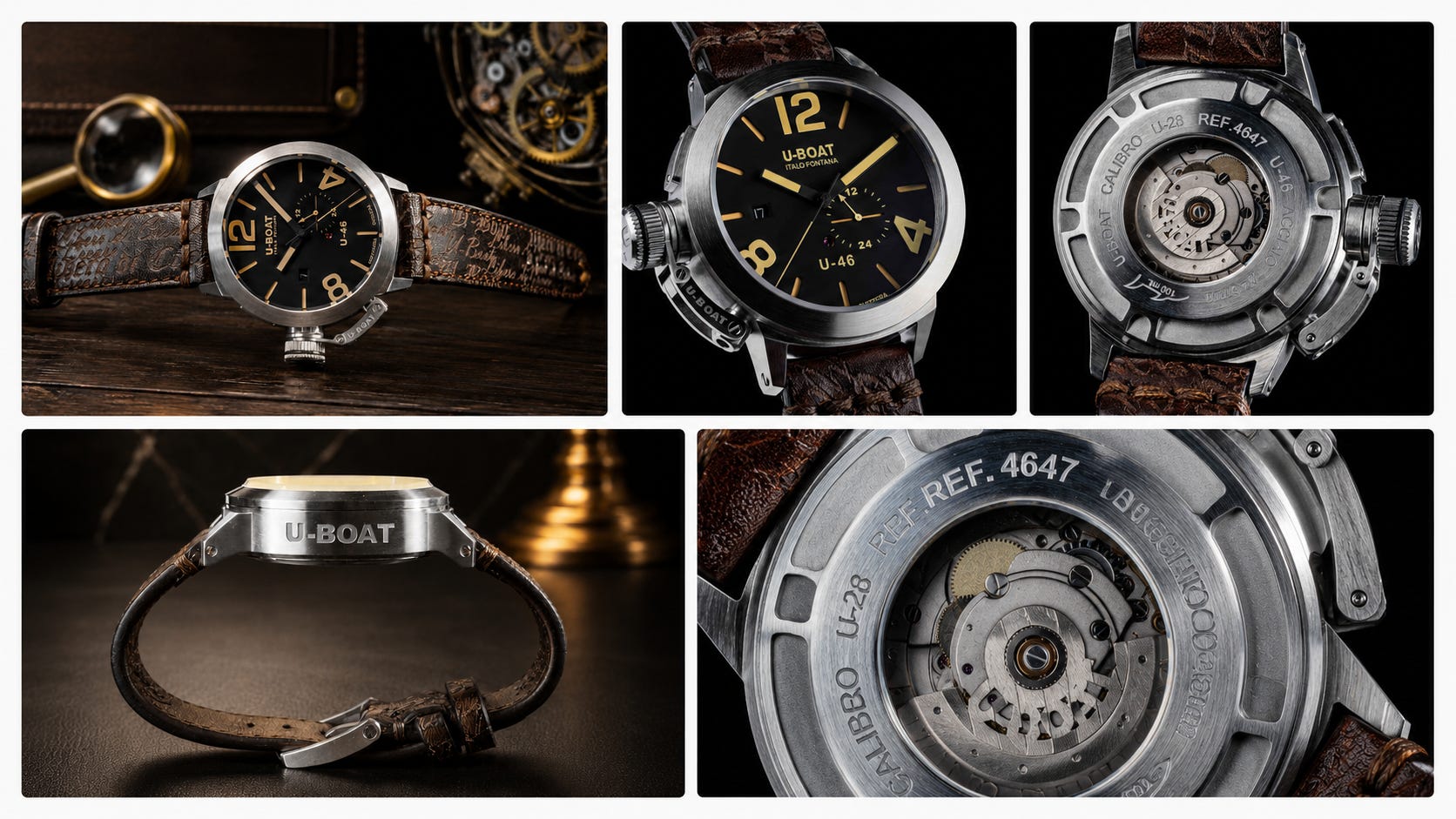
U-Boat has redrawn its most familiar watch and announced the news in a sentence that doubles back on itself. The icon resizes; its character remains unchanged. The case loses a millimetre—forty-seven becomes forty-six—and the company that has sold scale for a quarter of a century would like us to read the reduction as a refinement rather than a retreat. The new Classico is called the U-46. The old one was the U-47. The model name is a ruler.
There is something almost candid in that. Other brands bury their dimensions in the spec sheet. U-Boat stamps the millimetre on the dial and then writes three pages explaining why it does not matter.
A Maison Built on Largeness
To follow the explanation, you have to know what U-Boat is for. The brand was founded in Lucca in 2000 by Italo Fontana, and built on a family story: a grandfather, Ilvo, commissioned in 1942 to design a pilot’s watch for the Italian Navy, a watch that had to be big enough to read in a cockpit and was never produced. Bigness, in the founding myth, was not a style. It was a function. The cockpit needed it.
Fontana inherited the drawings and removed the function. What remained was the size. For twenty-five years U-Boat has sold the appearance of an instrument—the oversized case, the crown exiled to the left flank, the bolted protective cap guarding a crown that nothing threatens. In 2009 the company produced the U-1942, advertised as the largest wristwatch ever made. The proposition was always that more is more.
So a millimetre off the bestseller is not a small edit. It is the brand negotiating with its own first principle.
The Grammar of Retreat
Read the press release closely and you find it is built almost entirely on antithesis. Watches that follow trends, and others that move through them. A design that evolves while remaining true. One millimetre less that does not change the essence but refines the proportion. Each sentence sets a concession against a conviction and lets the conviction win on points. The machinery exists to perform a single trick: to make subtraction sound like resolve.
It is a familiar grammar. It is the grammar a brand reaches for when it is doing something it once swore it would never do, and needs the doing to read as continuity. The copy is not lying. It is managing.
The Market It Claims to Ignore
What is being managed is the market. The industry spent the 2000s inflating and the 2020s deflating; the oversized case that once made a watch legible across a crowded room is now the thing a younger collector quietly returns to the drawer. Forty-seven millimetres has become a number you apologise for. Forty-six is the apology, rounded down.
U-Boat, of course, is the brand that insists it does not watch the market—Fontana is the romantic figure who explores materials, in the company’s own phrasing, without being influenced by it. The Classico U-46 is the market answering back. The millimetre is a response to demand, dressed in the language of indifference to demand. There is no shame in this. There is only the small comedy of a maison built on not caring producing a watch that is, in its most literal dimension, an act of careful listening.
What Stays the Same, and What That Means
Beneath the new size, almost nothing else moves. The same Sellita SW200, customised to U-Boat specification, beating at 28,800 and holding forty-one hours. The same left crown, the same satin 316L, the same serial number on its little riveted plate, the same Tuscan calfskin aged to look older than it is. The smoked caseback still shows the movement through a mineral crystal darkened enough to flatter it—a window that lets you see the engine while softening the view of what the engine actually is. Visible is not the same as legible. U-Boat has always understood that distinction better than it lets on.
So when the company promises that the character is unchanged, it is telling the truth, and the truth is more interesting than the promise. The character was never the forty-seven millimetres. It was the performance of an instrument that stopped being an instrument decades ago—the costume of function worn long after the function left. Take a millimetre off the costume and the costume is still a costume. The soul of the icon survives the cut precisely because the soul was never structural. It was theatrical.
The Honest Number
There is a version of this watch that arrives without commentary: a forty-six-millimetre Classico, beige or black, for the wrist that found forty-seven too loud. That watch needs no defending. It is a sensible product from a brand learning, late and gracefully, the virtue of slightly less.
What the press release adds is the insistence that nothing was conceded. The watch is more honest than its announcement. It tells you exactly what changed, and by how much, in its own name. U-46. One less than before. The icon, it turns out, can count.
About the Author
Sergio Galanti is a Swiss-based independent writer specialising in the luxury watch industry, and an advisor to private collectors and investors. He is the editor of WatchDossier (watchdossier.ch), a publication exploring the cultural and philosophical undercurrents of contemporary horology, and the author of Against the Grain: A Cultural History of Swiss Independent Watchmaking.
No compensation or brand affiliation influenced this essay. Opinions are the author’s own.
Subscribe to watchdossier.ch to receive more insights on luxury, craftsmanship, and collecting.


