Reading Time Sideways, Now in the Dark
The Digitrend gains a sapphire hood, its first lume, and a quietly humbler movement — while losing none of its conviction that 1979 was a mistake.
AMIDA has spent two years selling a future that never arrived, and it has become very good at it.
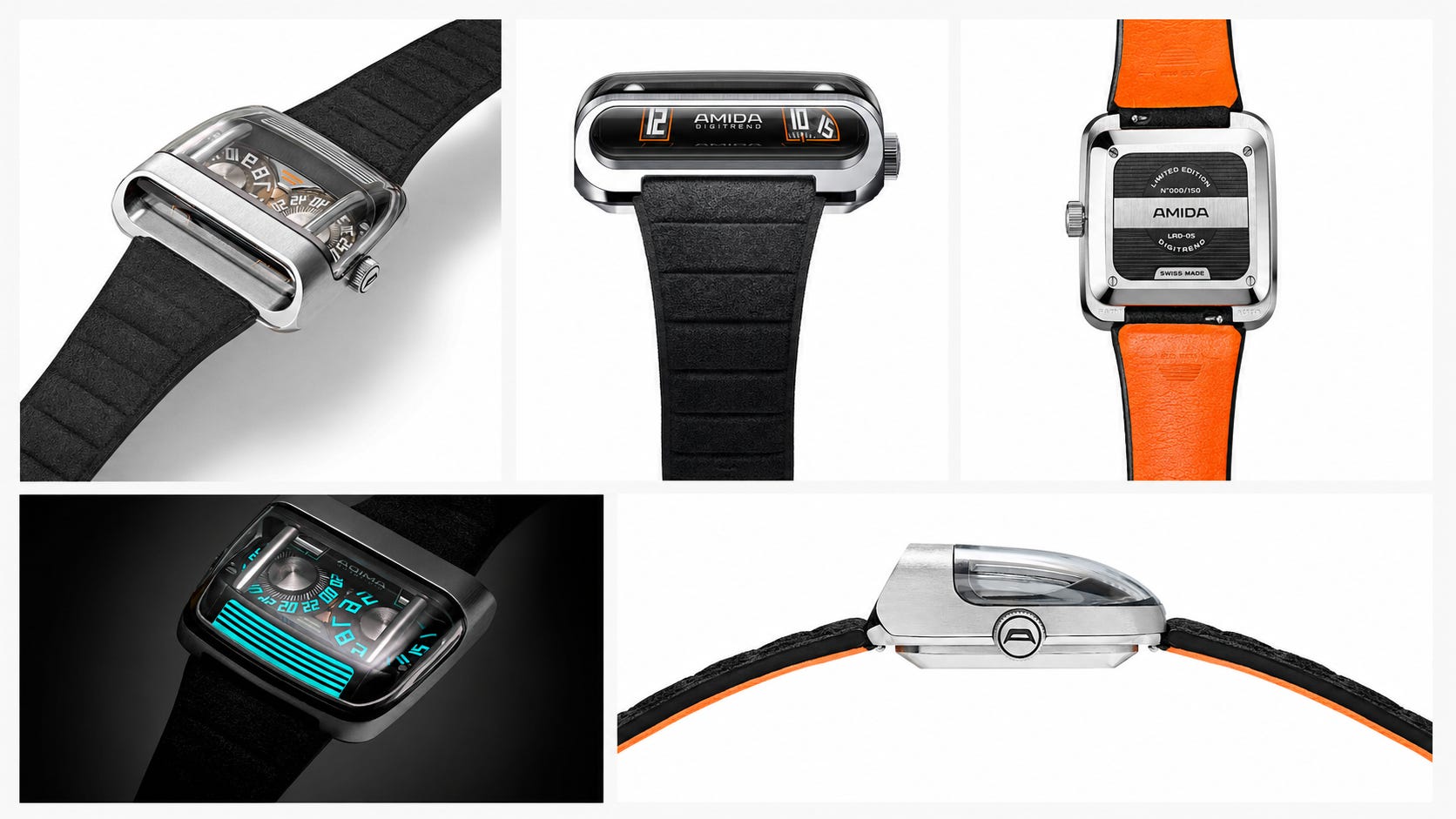
The Digitrend OSII Black — limited to 150 pieces, embargoed to June 23 — is the third act in the brand’s revival of a 1976 curiosity: a dial-less driver’s watch that tells the time sideways, through a prism, on the flank of a wedge-shaped case. The original was a casquette, a cap watch, shown at Basel in the same season as two now-canonical strangers. The Casquette. The Computron. The Digitrend. For one fair, the industry believed the future would be read at a glance, from the dashboard, without turning the wrist. Then quartz arrived, AMIDA folded in 1979, and the future was quietly repossessed.
That repossession is the brand’s entire subject. AMIDA’s revival, led by designer Matthieu Allègre, does not so much describe a product as recite scripture. The press materials announce not a watch but a “Historical Correction.” Allègre speaks of resuming abandoned work, of building “the machine they dreamed of making, but couldn’t.” Buyers become participants — an “active part” of a community holding the line against the obsolescence of mid-century nerve. It is a limited edition sold as a belief system.
One admires the audacity. One also notices that a community of 150 is, by another name, an allocation.
The object, to its credit, nearly earns the sermon. The 2025 Open Sapphire opened two-thirds of the case to view; the OSII Black goes further, replacing the metal shell with a hood machined from a single block of sapphire, so that light reaches the movement from every angle and, for the first time in the Digitrend’s life, floods it. The internal framework is now blacked — the lede says PVD, the specification says DLC, a small slippage left for the reader to catch — sculpted rather than concealed, its edges salted with Super-LumiNova. Hold it and the weight arrives first: fifteen-odd millimetres of sapphire and steel sitting high on the wrist, a paperweight that learned to keep time. Tilt it, and the light slides across the discs as the hour jumps. In daylight it is an architectural model under glass. After dark, the watch that once disappeared entirely now glows from within — a “Nocturnal Form,” in the brand’s tireless idiom. It is, against one’s better judgment, lovely.
It is also, beneath the hood, quietly less than it was.
Consider the engine. The 2025 edition ran on Soprod’s Newton, the P092, good for forty-four hours. The OSII Black’s specification names a “Soprod Newton P024.” No such movement exists. The Newton is the P092; the P024 is a separate, plainer ébauche on the ETA 2824-2 base, and its numbers — twenty-five jewels, thirty-eight hours — are precisely the ones AMIDA now prints. The base calibre, in other words, appears to have slipped a tier, from a dedicated Soprod movement to a commodity workhorse, while the price climbed roughly fourteen percent to 5,150 francs before tax. The in-house jumping-hour module — nine components, and the watch’s real achievement — carries over. But the thing turning it is more ordinary than before, and the entire narrative is built on the floors above it.
This is not a scandal. It is a tell.
The Digitrend was never an instrument of efficiency. It is, famously, a watch you read rather than glance at — the precise inversion of its 1976 brief. What the lume corrects, then, is not legibility but absence. The watch now persists through the night; it performs its identity around the clock. That is the genuine upgrade, and it has nothing to do with knowing the time. Not function. Presence.
Whether presence appreciates is the investor’s problem, and the comparison here is instructive and unkind. Girard-Perregaux revived its own 1976 casquette with Richemont’s balance sheet behind it, a manufacture’s name on the case, and vintage originals already trading at multiples. AMIDA is an enthusiast-led house iterating a single model through coatings and colourways — steel, then sapphire, now lume — sold direct, in runs of 150. The scarcity is real. The depth is not. A three-year-old revival brand offers the hope of a secondary market, not a record of one, and anyone underwriting this as an investment has already accepted the brand’s founding premise — that history took a wrong turn — as settled fact rather than marketing conceit.
Which is, in the end, the quiet brilliance of the exercise. AMIDA has built a watch that frames the future as something stolen from us, then sells the receipt. The “Lost Future” is superb copy precisely because it cannot be falsified; a future that never happened can be neither delivered nor disproved, only commemorated — ideally in sapphire, in the dark, at 5,150 francs. You are not buying a jumping hour. You are buying a position on history, and a small luminous wedge to prove you hold it.
The watch keeps time beautifully. Sideways. In the dark.
You will still have to turn your wrist to read it.
About the Author
Sergio Galanti is a Swiss-based independent writer specialising in the luxury watch industry, and an advisor to private collectors and investors. He is the editor of WatchDossier (watchdossier.ch), a publication exploring the cultural and philosophical undercurrents of contemporary horology, and the author of Against the Grain: A Cultural History of Swiss Independent Watchmaking.
No compensation or brand affiliation influenced this essay. Opinions are the author’s own.
Subscribe to watchdossier.ch to receive more insights on luxury, craftsmanship, and collecting.


