


Sixty-Five Minutes, Twenty-Seven Seconds
Kerbedanz began by making watches about their owners. Its newest finds its maker’s birthday in the arithmetic of every dial. Whose time, then, does a Kerbedanz tell?
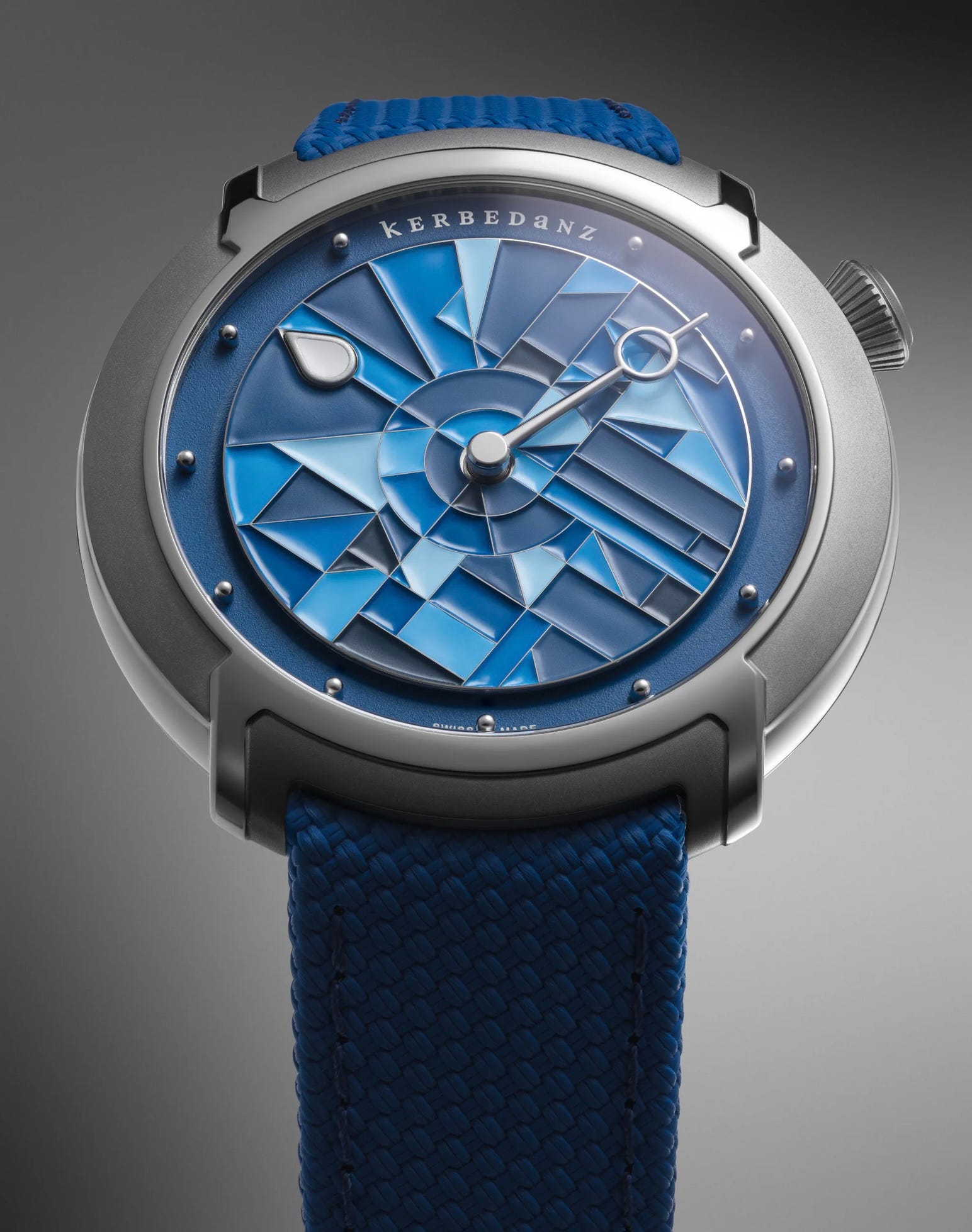
Every watch with two hands keeps an appointment its owner rarely notices. The minute hand catches the hour hand a little after one o’clock, again a little after two, and so on: eleven meetings in twelve hours. Divide one by the other and the interval is fixed at 65 minutes and 27 seconds. Nobody designs it. It is arithmetic. It has been kept, punctually and unseen, in every two-handed watch ever made.
Kerbedanz has built a watch to make that appointment visible. In the 65′27″, launched this spring, the hour hand is gone. In its place an hour disc carries a single diamond, and a lone minute hand sweeps above it. When the two meet, the hand becomes a lens, and for a moment the stone is larger than itself. Then the house noticed something else. Aram Petrosyan, its co-founder and designer, was born on 27 September 1965. Read from right to left, the interval gave the year and the day of his birth.
The brand calls this an unexpected alignment, and for once the marketing phrase is exact. It is also a fitting point of arrival for a house that has spent fifteen years circling a question most watchmakers never pose: whose time does a watch tell?
For its first six years, the answer was the client’s. Founded in Neuchâtel in 2011 by Petrosyan and Kalust Zorik, Kerbedanz made nothing but commissions: watches conceived for one wrist and, often, for one biography. This was no boutique conceit. In 2012 and 2013, Petrosyan recalls, the house sold more than two hundred unique pieces a year, and even now nine in ten of the collectors he meets want something no one else will own. A symbols specialist, Michel Cugnet, wrote a small book to accompany each piece, explaining what it meant. One commission, for instance, carried the recipient’s birthplace micro-engraved on its dial: a house made small enough to wear. The brand liked to say that its only true ambassadors were the people who had created a watch with it.
It was a beautiful idea and an unstable one. A watch that is entirely about its owner says very little about its maker. Ask about the early years today and the house will concede, without much prompting, that some commissions are not pieces it would sign now: a fifty-millimetre case on a bracelet paved with diamonds, made because a client wanted it. When meaning belongs to every patron, the signature belongs to none.
The correction was the Maximus, the first watch Kerbedanz made in its own name rather than someone else’s. Petrosyan began it in 2014 and, as he remembers, first showed it at Baselworld in 2015; the house dates its collections from 2017. The Maximus housed a 27-millimetre tourbillon cage, the largest ever fitted to a wristwatch and nearly twice the previous record. Four barrels drove it. The cage turned once every six minutes rather than every sixty seconds, and there was no seconds hand at all. It was a watch to be looked at rather than read.
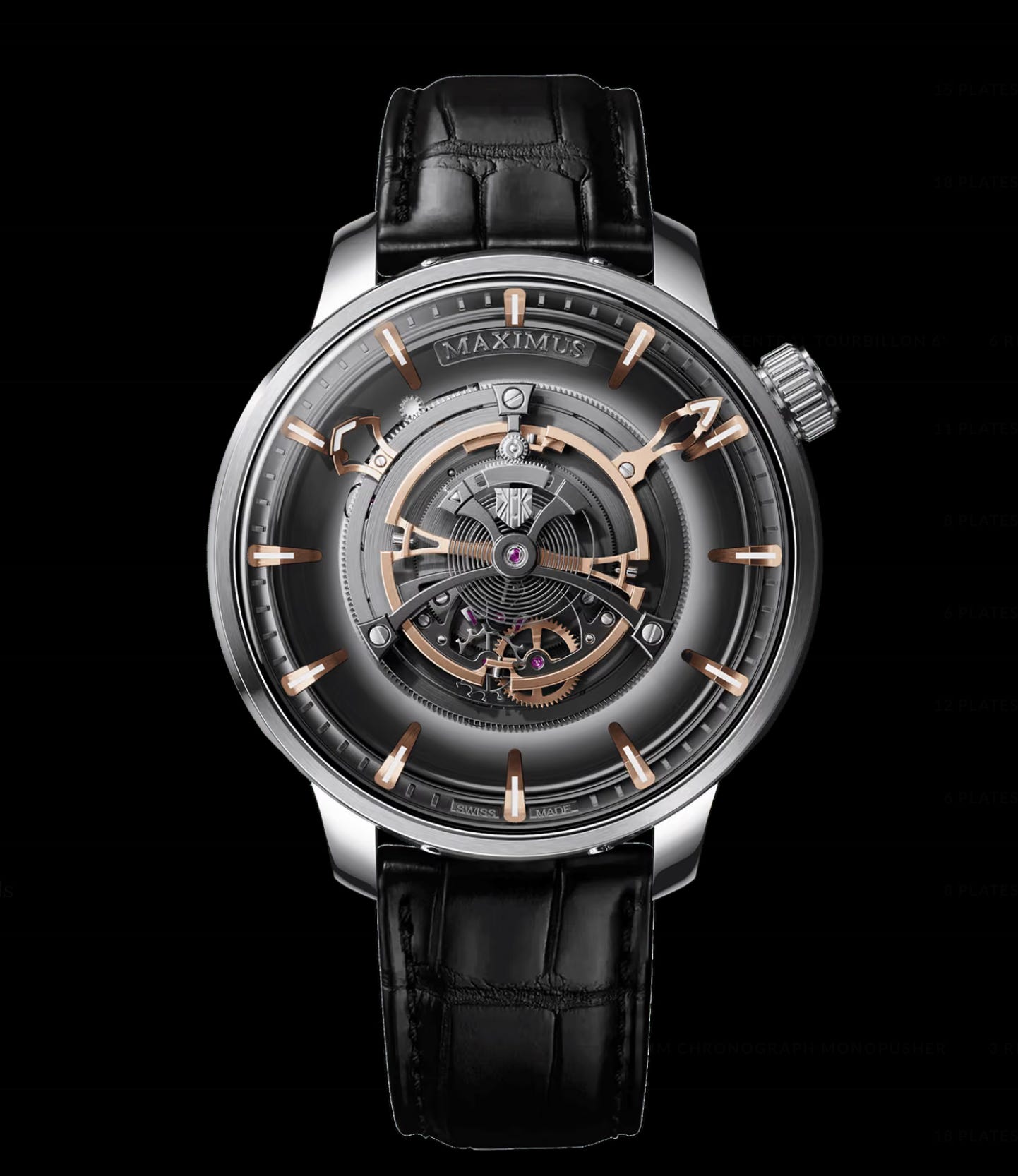
Petrosyan tells of a client who complained, on receiving one, that the hands were hard to see. Five minutes later he had stopped minding: he no longer needed to check the time, he said; the watch had become part of his body. It is the kind of story every maker tells, but here it describes the object accurately. The Maximus does not inform you about time. It shows you its mechanism doing time, slowly and at scale.
The first one is still in the Neuchâtel office. Forty-nine millimetres of round case, and at its centre a cage almost exactly the diameter of a two-franc coin, turning so deliberately that you watch for movement as you might watch a minute hand. Which, in a sense, it is. Next year it turns ten, slowly, as it does everything.
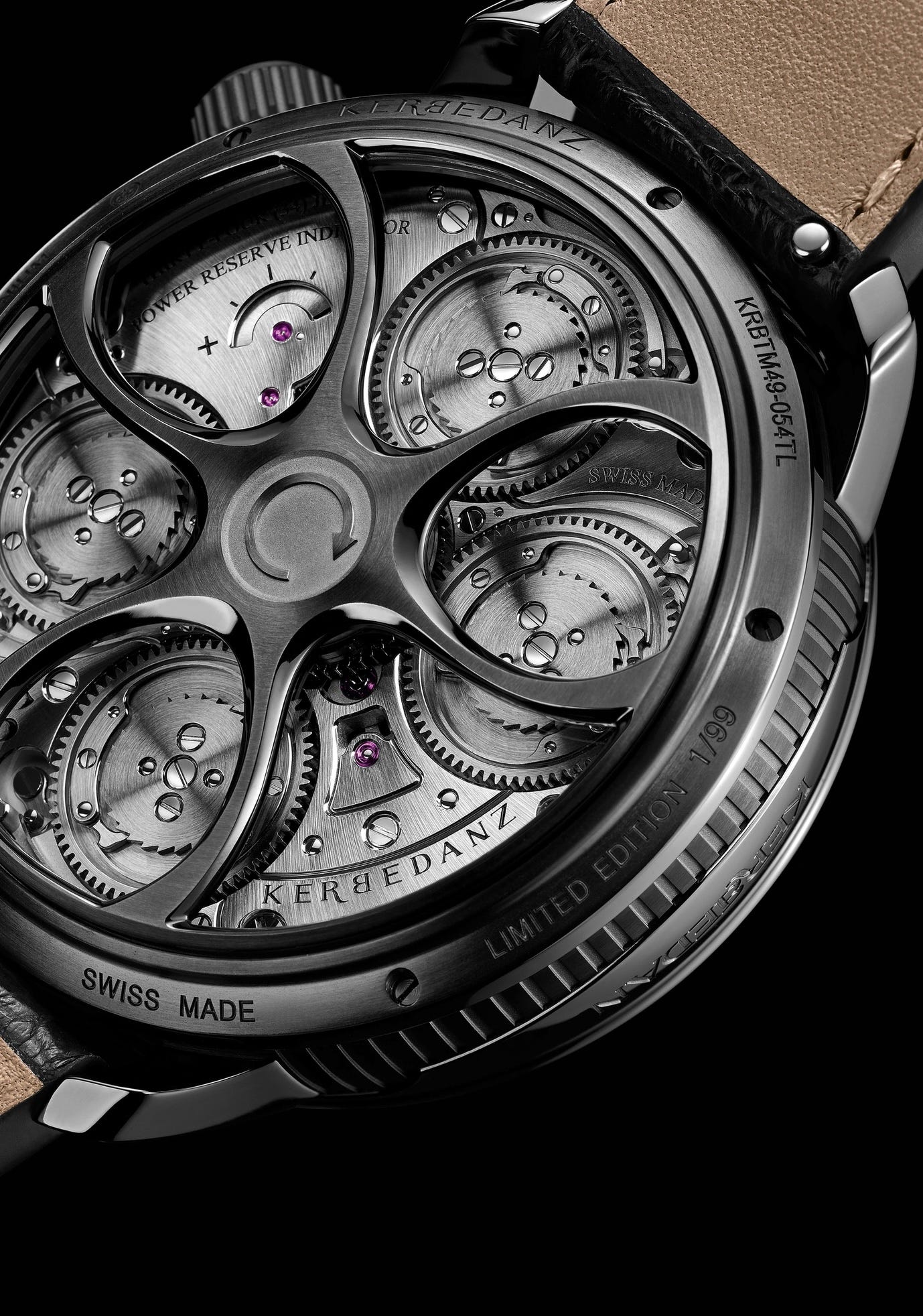
It also asks something of its owner. The Maximus is wound by hand, through a key set into the caseback, and as it turns the four barrels can be seen taking up their tension together. Petrosyan calls it a watch for the connoisseur, which is a courteous way of saying it must be looked after. The owner lends the watch a little of his own time so that it can go on showing him its own. The house has since quickened the pace. In the GR8, the cage turns in two minutes rather than six, which Petrosyan describes simply as more visible. Six minutes was patience. Two is a demonstration.
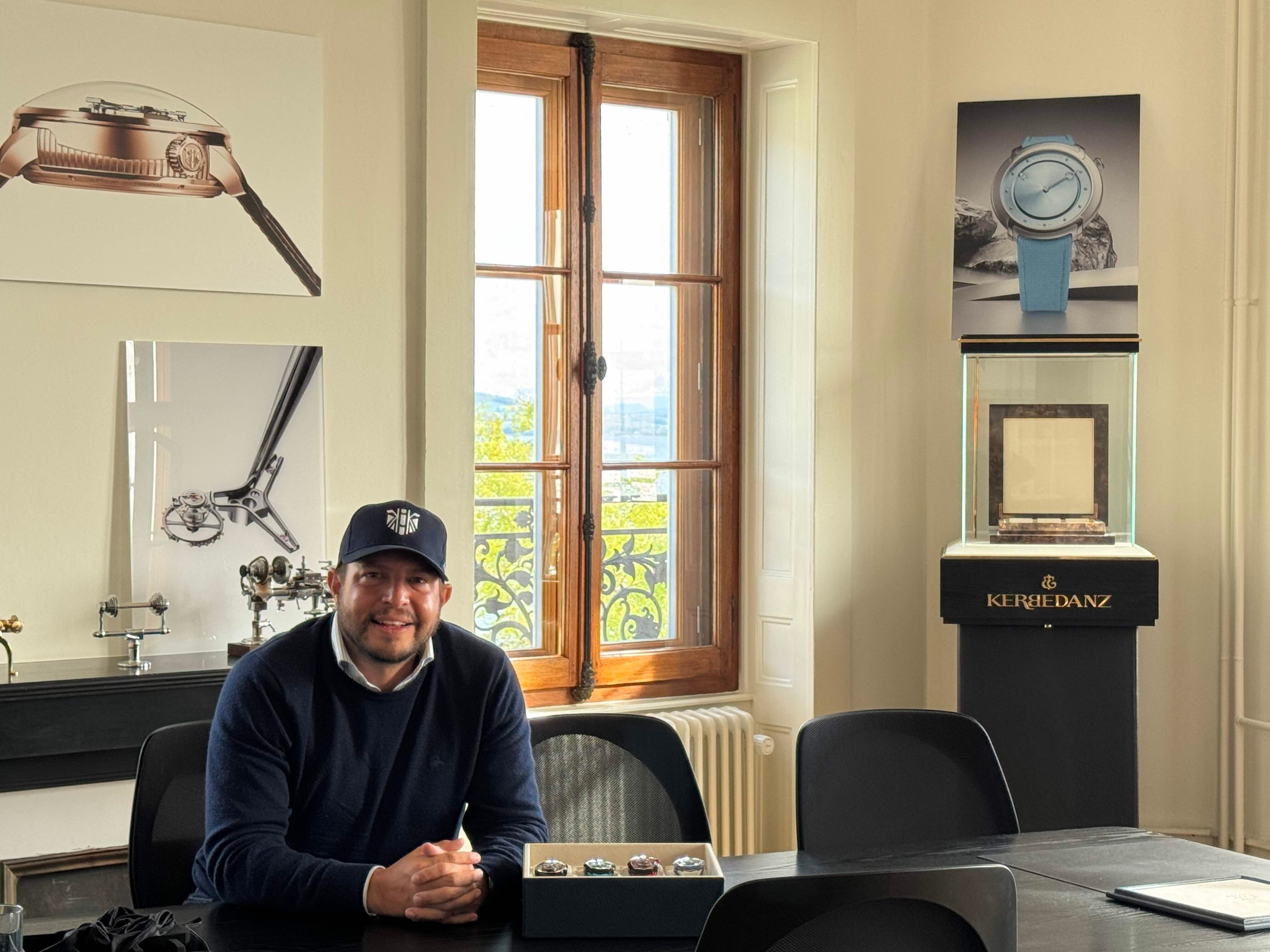
Vahé Vartzbed arrived as Chief Executive Officer in November 2025, introduced to Petrosyan by a mutual friend. The two men talked about collections and markets; they also found what Vartzbed calls an emotional link, since both are of Armenian origin. He describes Kerbedanz as “a startup with fifteen years of history”, and he has brought the market into the studio. Within days of joining, he took Petrosyan to Dubai, and a month later to Hong Kong and China, to see with his own eyes what collectors there were looking for. The 65′27″, conceived for precious metal alone, came back with editions in titanium and palladium. The cases across the range are getting smaller. The Maximus will not be exempt. For its tenth anniversary next year, Petrosyan is planning a new case and a new design, because, as he puts it, the market wants it, and Vartzbed’s brief for the year is to bring iconic pieces into a smaller size. The forty-nine millimetres in the Neuchâtel office was one man’s measure of a wrist. The anniversary may well take the market’s.
None of this has displaced the designer. Vartzbed describes the product strategy in three pillars: bespoke pieces, the collection, and what he calls the designer’s vision, the space where Petrosyan “can unleash his madness”. It is an unusual line in a business plan, and an honest one. The first two pillars answer to someone: the client, the retailer. The third answers only to the man who draws it. Petrosyan keeps a stock of sketches and makes them, he says, when he has time. In a house that now counts its pieces by market, it is the one place where a watch’s time is still his own.
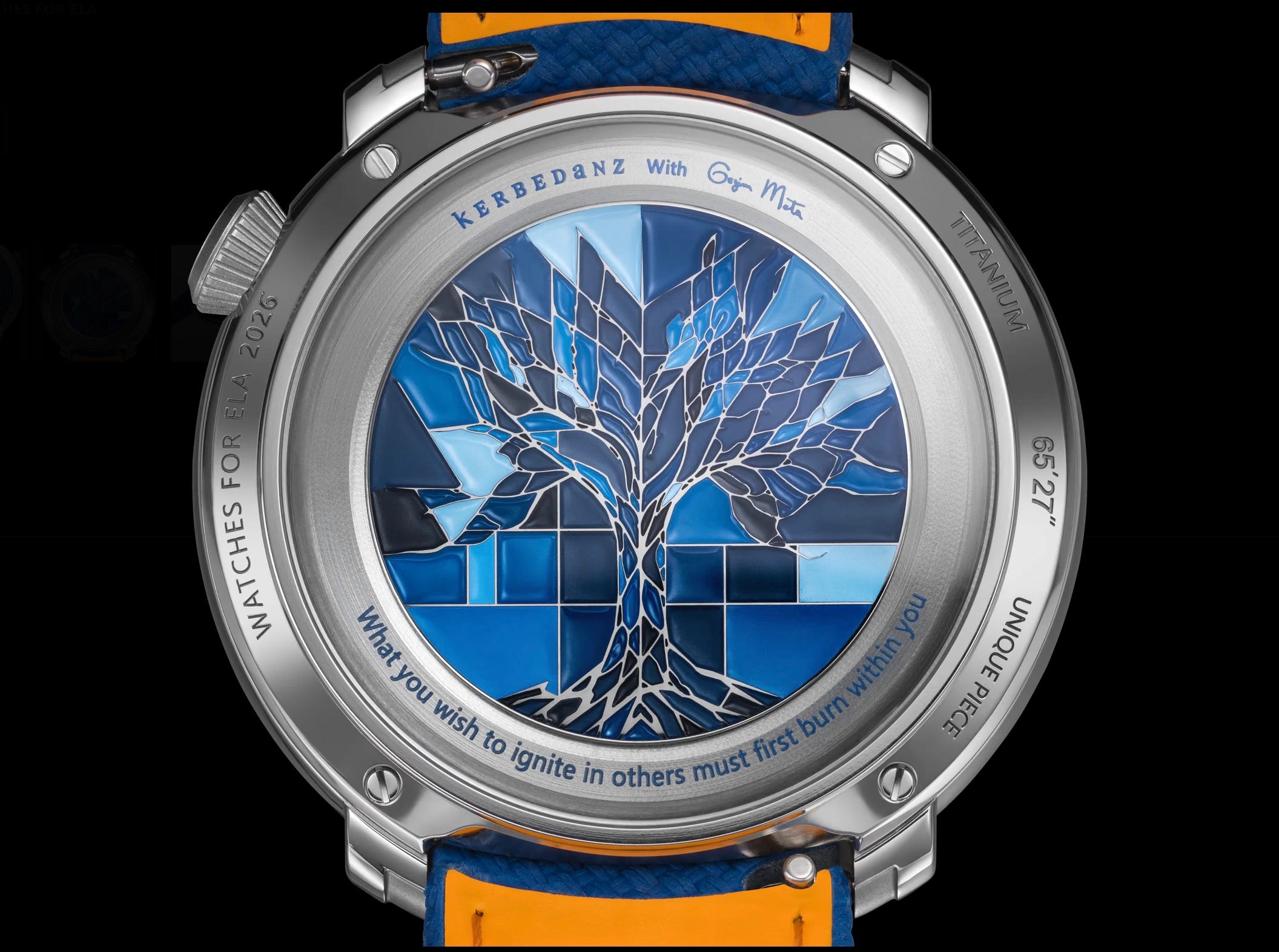
Which brings us back to the diamond under the hand. The early commissions put meaning into a watch from outside, through a symbol, an engraving, a booklet. The Maximus drew meaning from scale and slowness. The 65′27″ does something stranger: it finds a meaning that was already there, in a ratio as old as the dial itself, and discovers that it carries its maker’s birth. The older kind of meaning has not been retired. On 9 November, at the second Watches for ELA charity auction, held by Christie’s in Geneva, the house offered a unique 65′27″ whose dial the artist Gezim Meta painted in enamel with a Tree of Life, a motif from Kerbedanz’s first year. Offered without reserve, it sold for CHF 48,640, close to the top of its estimate. Vartzbed speaks of reviving such themes from the archive: fifteen years is not a century, he concedes, but there is substance in it. The same model now carries both kinds of meaning, one found in arithmetic and one chosen from a drawer.
A house can choose its symbols. It cannot choose its arithmetic. What Kerbedanz has found, perhaps without quite intending to, is a time that belongs to one man and to every watch at once. Every 65 minutes and 27 seconds, the hand and the stone meet again. The appointment will be kept; arithmetic sees to that. For whom it is kept is the question nine shop windows will now answer.
About the Author
Sergio Galanti is the founder and editor of WatchDossier, contributor to Italian and international watch publications, and advisor to private collectors.
No compensation or brand affiliation influenced this essay. Opinions are the author’s own.
