


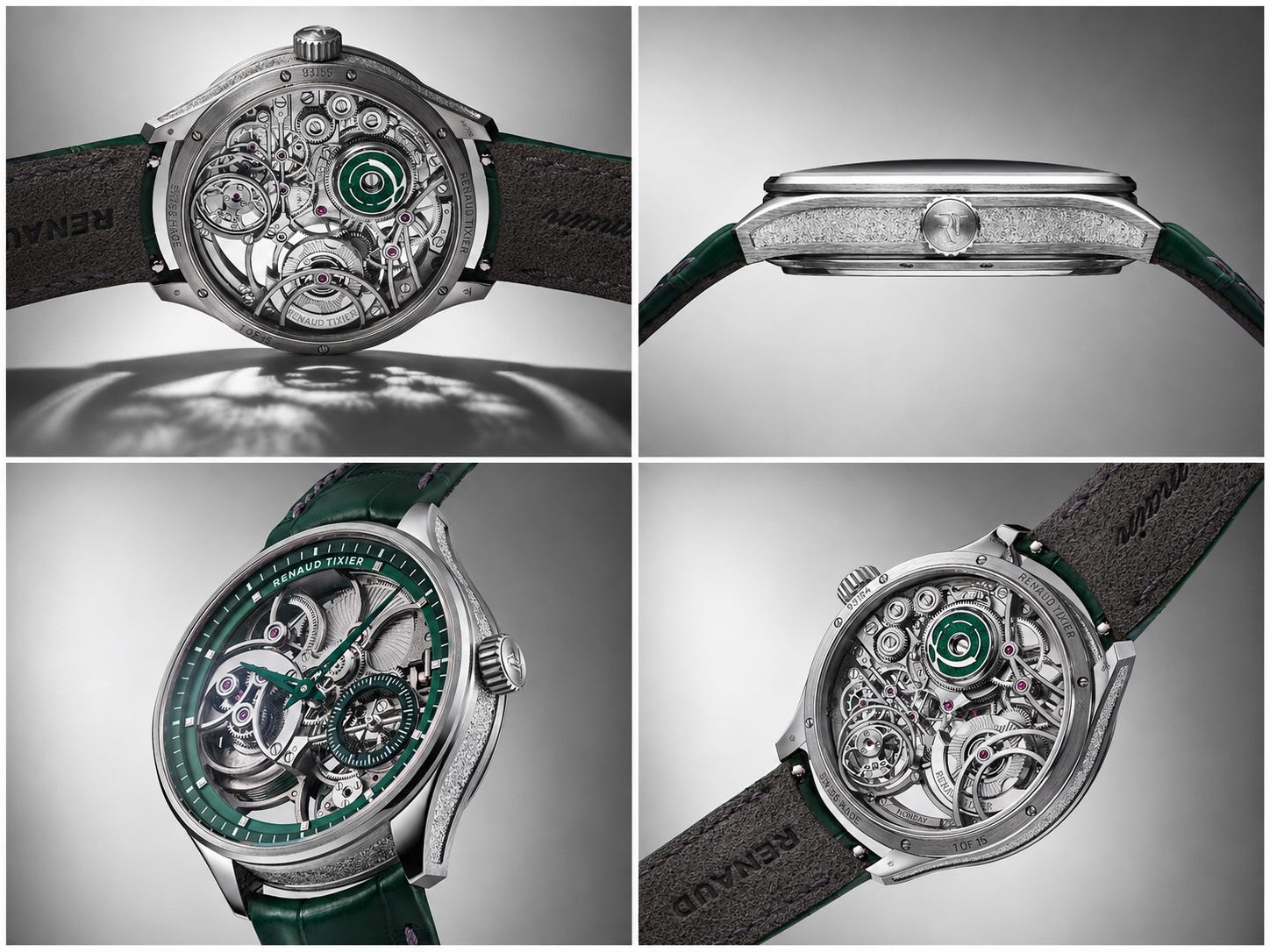
In Tolochenaz, a lakeside village between Geneva and Lausanne, someone has been counting corners. Two hundred and thirty-eight of them: the inward angles of the RVI2025 calibre, each a sharp interior notch filed by hand where no machine reaches and few wearers look. The press kit is candid about the second point. Only “the keenest-eyed connoisseurs,” it concedes, will spot them. The number sits in the specification sheet, between the jewels and the micro-rotor, where anyone can.
That is the cultural moment in miniature. Haute horlogerie has learned that labour, to be valued, must first be counted.
Monochrome puts the closed-dial original at 187 inward angles. The Monday Skeleton has 238. Fifty-one more corners since 2024: in an industry short of good news, few figures have grown so dependably.
The house behind them is a meeting of generations. Dominique Renaud co-founded Renaud & Papi in 1986, the complications workshop that Audemars Piguet would absorb and through which Robert Greubel, among others, passed; he sold out around 2000 and stayed away for more than a decade. Julien Tixier, now in his early thirties, is a prototypist and finisher, the hand to Renaud’s drawing board. Inventor and artisan, patent and polish. The pitch was newer: a cycle of seven watches, one invention for each day of the week.
Two and a half years on, the newest watch is still a Monday.
The Monday. The Monday Organica. The Monday Skeleton. Three Mondays, and the press kit has nothing to say about Tuesday. Either way, the emphasis is strategic. The invention at Monday’s core is the company’s entire thesis, and the brand lives inside Manufacture Dominique Renaud, which said at launch that it meant to open its production to third parties. Read that way, each Monday is a demonstration model: a calibre in search of more wrists, possibly other people’s. Renaud & Papi, after all, was a supplier first.
The invention merits its billing, with a reservation. A micro-rotor buys an unobstructed view of the movement at the cost of leverage. Renaud’s answer nests a small platinum flywheel inside the platinum micro-rotor, linked by a propulsion spring the brand calls “the dancer,” so that the faint gestures of a desk-bound wrist are caught and passed on as torque, an idea borrowed, the press kit says, from automotive energy recovery. A clutch disengages the whole under shock. At the 2024 launch the company conceded that no existing instrument could yet measure the gain. A figure of forty per cent now circulates, without a stated baseline. The press kit settles on “a major gain.” Between unmeasurable and major lies the truth, which, like the angles, is largely a matter of faith.
Then the object, which is better than the argument about it.
Picture it in the palm: 40.8 millimetres of grey gold, 12.6 tall under its domed crystal, the dense, reluctant weight of precious alloy. Tilt it. The petrol-blue rehaut is brushed, so it catches light in a single sweep, like wind passing over a lake at dusk. Inside, the bridges are a lattice; their black-polished faces flip from mirror to ink as the angle shifts, and the watch appears to blink. The skeletonised dauphine hands are outlines laid over outlines. Reading the hour takes a second glance. Turn it over: the barrel-ratchet bridge, hand-engraved and chased, set with grand feu enamel, a brooch pinned to the lining of a coat.
Black polishing. Côtes de Genève. Sunray. Circular graining. Bevels, rounded bridges, 238 angles. Every word in the classical vocabulary, spoken at once, on a watch that tells hours, minutes and small seconds. SJX, which covered the launch in partnership with the brand, called the decoration “almost over the top.” When a partner raises an eyebrow, the eyebrow is worth noting.
Who, then, is buying? SJX reports the price at CHF 129,000 before tax, against CHF 79,000 for the original Monday in 2024 and a reported CHF 125,000 for the platinum Organica. The grey-gold skeleton is thus the dearest of the three. Its buyer is not paying for timekeeping, nor for metal. He is paying to see. The skeleton watch is the collector’s confession that the dial was always an obstacle; that what he wanted was never the hour but the evidence of labour behind it. The counted angle suits a collecting culture fluent in numbers: it converts the ineffable into a figure repeatable over dinner. Fifteen in blue. Fifteen in green. Thirty people who will each, eventually, say “two hundred and thirty-eight.”
As an asset, the Skeleton is a wager on authorship rather than on rarity, which is the cheap part. The open question is whether Renaud Tixier becomes a name in its own right or remains an elegant postscript to Renaud & Papi. The market rewards cults and punishes programmes. A seven-day plan whose latest release is still a Monday has the dignity of patience and the risk of looking like a circle. Its cultural capital is genuine: the watch admits its owner to the small room of people who know who Renaud & Papi were, a room more satisfying than the one where everyone knows what a Royal Oak is.
Subtract the week, the automotive metaphor and the census of corners, and something survives: a superbly finished, slightly overdressed time-only watch whose one real idea hides in its smallest moving part. That would be enough. It is rarely allowed to be.
There is a last irony in the dancer. It was conceived to harvest gestures that mean nothing (the twitch, the fidget, the idle turn of a wrist) and bank them against a reserve of seventy-two hours. It is the most contemporary thing about the watch: a machine for making even our restlessness productive. The skeleton completes the thought by making the time the hardest thing on the dial to find. One buys it to watch the work. The hour is still in there, somewhere behind the bridges.
Whatever day it is in Tolochenaz, the watch says Monday.
About the Author
Sergio Galanti is the founder and editor of WatchDossier, contributor to Italian and international watch publications, and advisor to private collectors.
No compensation or brand affiliation influenced this essay. Opinions are the author’s own.
