Telling Real from Real — Part I of II
The steel automatic Daytona ran for thirty-eight years toward a kind of perfection. Its admirers ran the other way.
To know a steel Daytona you have to open it. All four references — the borrowed-hearted original of 1988 and its three sealed descendants — wear a solid caseback, a disc of steel screwed down over the movement, so that the single most consequential fact about any given example, the calibre turning inside it, is the one fact you cannot establish by looking. You take it to a watchmaker. He fits the correct tool to the back, breaks the gasket’s seal, lifts the disc away, and only then — the column wheel and the free-sprung balance laid open under the loupe — can you say with confidence what you are holding. The watch withholds itself. Knowing it requires a small act of surgery, performed by a specialist, at the risk of the seal that keeps the water out.
That gesture — the loupe, the opened back, the specialist consulted — is the whole subject, though it takes a while to see why.
Here is what the four references look like laid end to end, which is how the market and the auction houses and the reference sheets prefer to lay them. The story runs forward and it runs in one direction: toward control. A movement borrowed from a competitor, then replaced by one Rolex built itself. An engraved steel bezel that wore, then a ceramic one that cannot. Hollow end links made solid. A plain inner flange, then one engraved with the brand’s name in miniature, over and over, ringing the dial. A serial you could read in sequence, then a serial scrambled past reading. A crown laser-etched, invisibly, into the sapphire above the six. An escapement made immune to magnetism. Read the columns of any authentication guide left to right and you are watching a manufacturer progressively close, harden and de-risk a single product across nearly four decades, until the watch is very nearly impossible to counterfeit and — the same thing, achieved by the same means — very nearly impossible to read by eye — to know, without a loupe, what you are holding.
Now read the price column.
It does not move with the engineering. It moves against it. The cheapest of the four references, by a clear margin, is the one most engineers would name the moment the Daytona finally became fully and properly Rolex’s own — the first to carry the in-house movement, the first with the anti-counterfeit flange, the first sealed against forgery. The market calls it the low point, the underperformer, the high-risk score. The two references that command the most money are the oldest (first automatic model), with the borrowed heart, and the newest, with the most withheld face. The watch’s worth reaches toward the two ends of its own history and sags in the middle, exactly where the competence is highest. Price is not a function of how good the watch is. It never was. It is a function of something else, and the something else is what we are here to find.
So: two clocks, turning in opposite directions. One is the history of the object, and it runs forward, toward sealing. The other is the history of the desire, and it runs backward, toward the least sealed thing. Where they cross is the watch.
The forward clock starts in an attic.
In the mid-1970s, a foreman at Zenith named Charles Vermot was told that the company was finished with mechanical movements. The Americans who then owned the firm had read the same memo everyone in the valley had read — that quartz had won, that the mechanical watch was a buggy whip, that the future kept time with a battery and a vibrating sliver of crystal and did not need a balance wheel or a mainspring or a man like Vermot. The tooling for the El Primero — the presses, the cams, the cutting tools for what had been, in 1969, one of the first automatic chronograph movements in the world, and the fastest, beating at thirty-six thousand vibrations an hour — was to be scrapped. Vermot did not scrap it. He catalogued the tools, crated them, and walled them into a disused room above the workshop, and he wrote down where everything was, and then for years he said nothing, while the industry around him contracted and men he had trained went to work in other trades.
This is the part of the story the watch world tells fondly, and it tells it fondly because it ends in vindication. The mechanical watch did not die. By the mid-1980s the appetite for it had returned — not as a tool, the tool question having been settled in quartz’s favour for good, but as something else, an object you wore to say that you valued the thing the battery had made obsolete. And when Rolex, the most self-sufficient house in the industry, the firm that made its own gold and its own cases and very nearly its own everything, went looking in 1988 for an automatic chronograph movement to put inside a Daytona, the only credible high-beat base in Switzerland was the one Vermot had hidden. The most independent watchmaker in the world built its grail on a borrowed heart. It is a genuinely fine irony, and the book this piece feeds will not waste it.
But notice what Rolex did to the thing it borrowed, because the modification is the first turn of the forward clock. They took the El Primero and they slowed it down. The whole glamour of the movement had been its frequency — thirty-six thousand beats an hour, the high-speed balance that let it time a fifth of a second — and Rolex throttled it to twenty-eight thousand eight hundred, the four-hertz cadence of every other Rolex, because the high beat was harder on its lubricants and demanded the watch come back for service sooner, and Rolex would rather have a movement that ran longer between visits than one that ran faster on the page. They removed the date. They remade something close to half the parts. They fitted their own balance — free-sprung, regulated by tiny weights on the rim rather than by a moveable index, with a Breguet overcoil curling up and over the hairspring — which is a more expensive and more stable way to keep time and also, not incidentally, a signature almost impossible to fake convincingly. The borrowed heart was, by the time it went into the case, no longer quite anyone else’s. It was the calibre 4030, and it was the most reliable thing Rolex could make out of the most exciting thing someone else had made, which is a fair description of the company’s entire method.
The watch that resulted was not, at first, an object anyone fought over. That is worth saying flatly, because the present tense erases it. The manual-wind Daytonas of the 1960s and ‘70s, the watch’s whole first life, had been slow sellers, discounted, left in the case while customers reached for a Submariner. The automatic that replaced them in 1988 sold steadily and unremarkably for years. The grail was not born a grail. It became one. And the becoming is the second clock.
Look closely at the thirteen years the first reference ran, and you watch the market teach itself a skill it did not previously have: how to price a flaw.
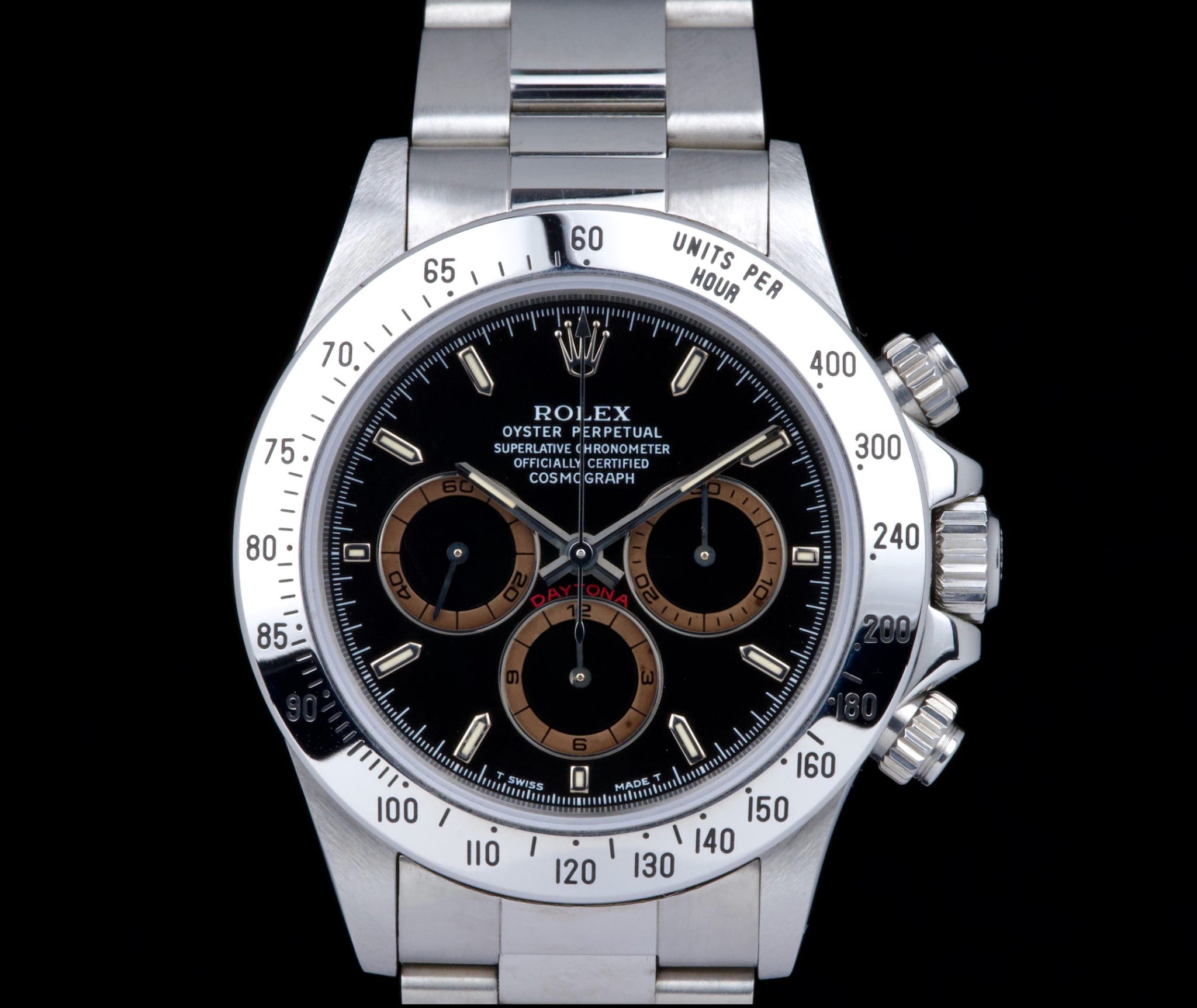
The reference sheets divide those years into a taxonomy of dials so fine, and so contested, that no two authorities agree on how to count them — one house numbers the variants to eight, another to five, another runs them one through nine — and the disagreement itself tells you something, because you do not build a numbering system, several incompatible numbering systems, for an object whose worth tracks its specification. You build it for an object whose worth has come loose from its specification and attached itself to detail. A ‘6’ on a sub-dial printed upside down, on the earliest examples, before someone corrected the printing tool. A fifth line of text that floats, detached, above the word COSMOGRAPH, on a glossy porcelain-finish dial made for perhaps fifty steel pieces. And, most tellingly of all, a cheap varnish.
The varnish is the one to dwell on. On certain black dials made between roughly 1993 and 1997, Rolex used a lacquer — Zapon, the trade name — that did not hold its colour. Over years, on the wrist, in light, the clear coat over the sub-dial rings oxidised and went brown, an uneven warm patina creeping across what had been crisp white printing. By any standard a watch is held to as a tool, this is a defect: a material that aged badly, a finish that failed. The market decided it was the most desirable thing the reference produced. A well-developed example of this failure — the dial the factory would have been embarrassed by — can be worth most of double a clean one. It carries the name of the auctioneer, Osvaldo Patrizzi of Antiquorum, who is credited with first calling the room’s attention to it, and so a degrading varnish became a named variant, a connoisseur’s category, a premium.
The watch that aged worst became the watch worth most. This is not sentiment; it is the market’s flat verdict, and it is the hinge of everything. What the room had learned to love, across those years and at those auctions, was the unrepeatable — the inverted printing tool that got fixed, the porcelain run that ended, the varnish that failed in its own particular way on its own particular wrist and will never fail that way again. The value lived in precisely the qualities that could not be reproduced, controlled, or specified. It lived in the accident. And the accident is exactly the thing a competent manufacturer exists to eliminate.
So the two clocks are already, by the year 2000, set against each other, though no one has yet said so out loud. The market has spent thirteen years learning to price flaw, decay and the unrepeatable error as the highest virtues a Daytona can possess. And Rolex is about to spend the next twenty-three years engineering all three out of existence.
WatchDossier Feature WD23
Adapted from The Grail Problem: The Most Famous Watch Nobody Could Buy, set for release at the end of 2026. Reply if you would like to be kept posted.
About the Author
Sergio Galanti is a Swiss-based independent writer specialising in the luxury watch industry, and an advisor to private collectors and investors. He is the editor of WatchDossier (watchdossier.ch), a publication exploring the cultural and philosophical undercurrents of contemporary horology, and the author of Against the Grain: A Cultural History of Swiss Independent Watchmaking.
No compensation or brand affiliation influenced this essay. Opinions are the author’s own.
Subscribe to watchdossier.ch to receive more insights on luxury, craftsmanship, and collecting


