Part I of this essay left the two clocks — the forward history of the object, the backward pull of desire — already set against each other by the year 2000, though not yet said aloud. What follows is the collision, and its verdict.
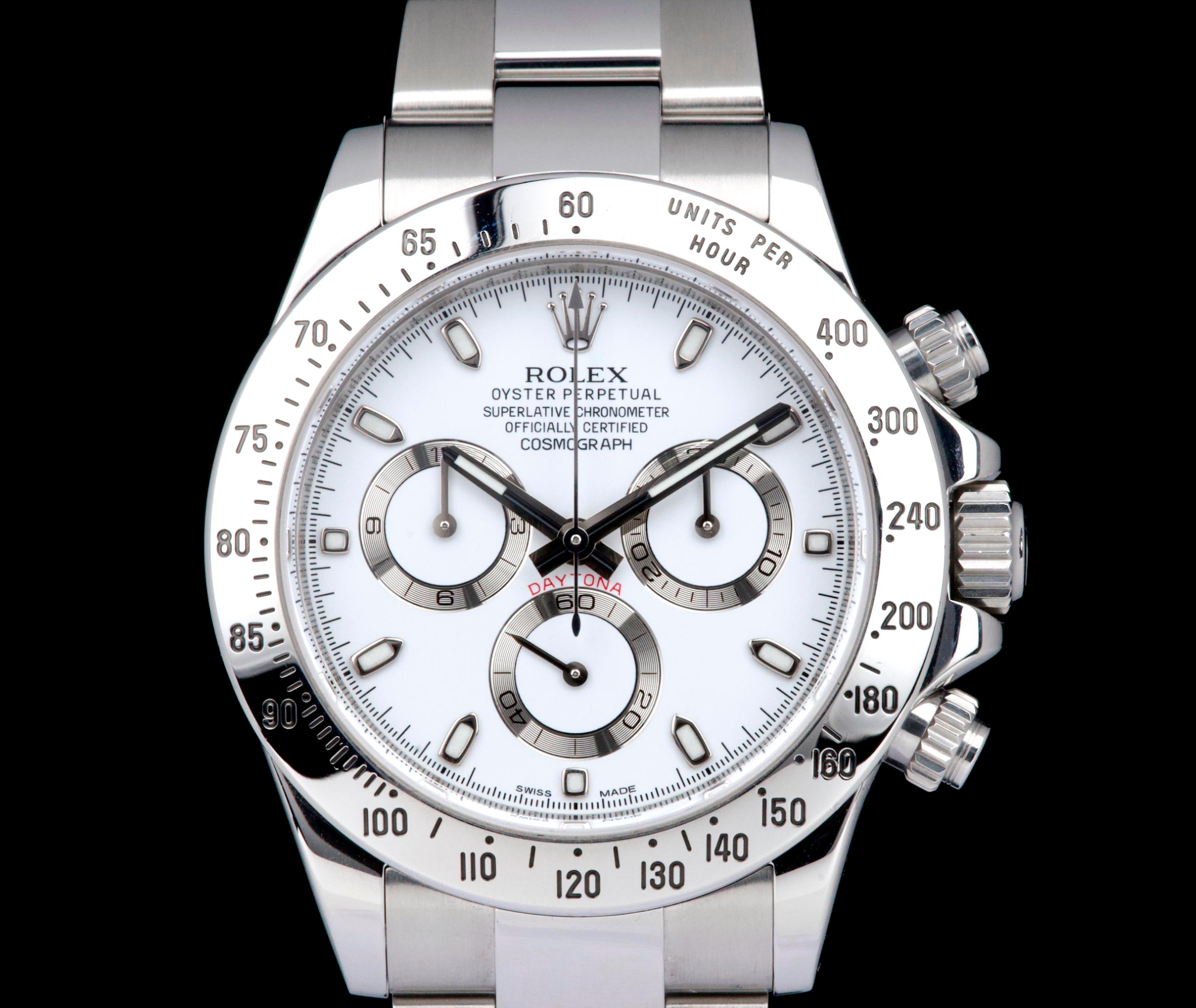
The in-house movement arrives in 2000, and it is, by every measure a watchmaker would use, the moment the Daytona grows up. The calibre 4130: Rolex’s own design at last, the borrowed heart finally retired. Fewer parts than the movement it replaced, which in a chronograph means fewer things to fail. A vertical clutch in place of the old lateral one, so the running seconds engage without the faint stutter that betrays the older architecture. A full bridge across the balance rather than a cantilevered cock, which is to say the regulating organ is held at both ends rather than one, steadier, more resistant to shock. It is a better movement. Nobody serious disputes that it is a better movement.
And around it, over the following decade, Rolex builds the apparatus of sealing. Not all at once — this is the thing to understand about the securitisation, that it was not an event but a process, layered on year over year, like a man adding locks to a door. An inner flange, the rehaut, engraved with ROLEX ROLEX ROLEX in miniature, ringing the dial, around 2002. A crown laser-etched into the sapphire crystal above the six, so faint you need light at the right angle to catch it, phased in across the same years. The serial number, once a legible sequence you could read like a date, eventually scrambled into randomness. Each of these is sold, when it is mentioned at all, as a defence against the counterfeiter. Each is also, and this is the quiet point, a defence against reading — a closing of the watch’s own legibility, a making-opaque of the object to everyone, forger and owner alike. The watch becomes harder to fake by becoming harder to know.
Then comes the verdict, and it is worth stating in the cold flat register the fact deserves.
The best-built steel Daytona is the cheapest one. The reference with the first in-house movement, the first sealed flange, the first proof against forgery — the watch that finally deserved, on the merits, to be called fully Rolex’s own — is the low point of the entire family. The market today underperforms it, scores it high-risk, prices it below the borrowed-hearted antique that preceded it and below everything that followed. The thing they got right is the thing nobody fights over. Competence, it turns out, is not what the desire was ever tracking. The desire was tracking the accident, and the accident is exactly what competence removes.
The two clocks have crossed. From here they only diverge.
In 2016 the bezel turns black, and the turn is instructive, because it is the moment the forward clock starts engineering against the very thing the backward clock loves.
The old steel bezel, with its tachymeter scale cut into metal, had a vulnerability the catalogue never advertised: it could wear. Polishing thinned its numerals; decades softened them. And no two wore alike — the engraving going shallow in its own places, the steel taking the particular scratches of one wrist and one life, each bezel a slightly different account of the handling it had taken. The 2016 reference replaced all of that with Cerachrom: a ceramic bezel, fired hard, with the tachymeter numerals engraved and then filled with a microscopic layer of platinum, so that the scale is not painted on but is, in effect, metal fused into stone. It does not fade. It does not scratch in any way a wrist will manage. It will look, in forty years, exactly as it looks now.
Read that as engineering and it is a triumph: a manufacturer has defeated time on the one surface where time used to show. Read it against the second clock and it is something stranger. Rolex spent the better part of two decades watching its customers fall in love with patina — the browning varnish, the softening bezel, the warm decay of materials that aged — and then built a watch on which patina is no longer possible. The same firm whose oxidising lacquer the auctions had sanctified now sold a bezel chemically incapable of changing. The blue lume that came with it, brighter and longer-burning than the green it replaced, was held up as an improvement, and it was; it also glows, on every example, identically, for as long as the watch exists, where the old tritium had quietly died over the years and turned, on the oldest dials, a creamy fault-line gold that the market — of course — had learned to pay for.
This permanence is the deepest thing the materials science does, and it is almost never said: ceramic is the death of aura. The browning Zapon dial was worth double because it was singular — one watch’s particular failure, unrepeatable, a thing that had happened once on one wrist and could not be made to happen again. A Cerachrom bezel is the opposite of singular. It is permanent, identical, reproduced and reproducible without limit, every example the twin of every other and of itself in four decades. You cannot project onto it the way you project onto a flaw, because there is nothing accidental left to receive the projection — and a projection needs something to catch on, some small unrepeatable irregularity, the way the eye needs a stain on a wall or a knot in the grain before it can find a face there. The aged watch had given the market exactly that: a surface that recorded where it had been. The sun it had sat in, the sweat it had taken, the particular decade of light — the patina was a kind of biography, written by use and legible to anyone who knew the hand. A watch that cannot age cannot carry a life. The ceramic Daytona refuses biography on principle. It will look in 2060 as it looks now, which is to say it will tell you nothing about the years between, having been built so that those years cannot touch it. It is not that it lacks a story. It is that it has been engineered to be incapable of acquiring one.
The last turn, in 2023, is the smallest, and the smallness is the point.
By now the differences between one steel Daytona and the next have grown so fine that the authentication sheets measure them in fractions: the rings around the sub-dials a touch thinner than the previous reference’s, the markers a shade slimmer, the case ninety microns shallower. Inside is a new escapement, the Chronergy, its components reshaped in a nickel-phosphorus alloy that no magnetic field will disturb — the last environmental threat to a mechanical watch quietly closed off, the movement made immune to the magnets in every speaker and laptop and phone-case clasp it will spend its life beside. There is a thin steel ring now framing the black bezel, an aesthetic callback to the all-metal references, and it is the quickest way to identify the watch across a room, which means it is the closest thing this generation has to an event. A ring. The drama of the newest Daytona is a ring.
And the back, of course, stays shut. This is the detail to end the forward clock on. The platinum Daytona of the same generation — the version most people will never see, let alone own — was given a sapphire caseback, a window onto the movement, the engineering finally shown. The steel reference, the one the world actually wants, the one with the waiting lists and the grey-market premium that for years ran to multiples of the retail price, keeps its solid steel back. You may have the watch the whole culture is straining toward, and you still may not see its heart. The most withheld face in the family is the one on the most wanted watch. Scarcity and opacity have stopped being accidents of supply and become features of the design — the watch you cannot buy, whose movement you cannot see, whose differences from its predecessor you cannot name without a loupe and a chart. The object has been sealed to the point where the only thing left fully open about it is the desire for it.
Which returns us to the watchmaker with the loupe, and to the small surgery the steel back demands.
There is a document — there are many versions of it, the one in front of me runs to four pages — whose whole purpose is to tell a real steel Daytona from a false one and, harder, one original example from another that is equally real and worth markedly less. It is a serious piece of work, dense with the discriminations the watch now requires: the calibre that must match the reference, the flange that must carry the engraving, the lume that must agree with the year, the lugs that must be full and unpolished, the varnish that must have browned gradually and uniformly rather than in the sharp blotches of a fake patina, the end-link code that cannot be trusted because the sources disagree, the clasp date that must square with the case. To read it is to understand how far the object has travelled from the thing you could once buy over a counter and simply own.
But the document’s deepest tell is not any single check. It is that the document exists at all. You do not build a four-page forensic apparatus for an object whose worth tracks its datasheet. You build it for an object whose worth has come unbolted from its specification entirely and floated free — onto dials and decay and provenance, onto which particular accident befell which particular watch, onto the unrepeatable. And the sharpest discriminations in the whole apparatus, the ones the experts argue over, are not fake-against-real at all. They are real-against-real. A serviced movement against an original one, both entirely genuine. A polished case against a fat-lugged one, both authentic to the bone. A factory-correct service dial — fitted by Rolex itself, decades ago, often to replace tritium the regulations no longer allowed — against the tritium it lawfully replaced, the watch a third less valuable for the swap and not one atom less real. The connoisseurship the Daytona now demands is the connoisseurship of telling authentic things from other authentic things that the market has decided are worth far less. That is not a skill quality can teach you.
The watch spent thirty-eight years becoming more perfect. Every transition sealed it further, closed another gap, removed another way for time and chance to leave their mark — until the object was very nearly faultless and very nearly unreadable and entirely impossible, for most people, to buy. And the love did not follow it forward. The love stayed back at the beginning, with the slowed-down stolen movement and the varnish that failed and the printing tool that stamped the six upside down, with everything unrepeatable that a competent manufacturer had spent four decades learning to prevent. The forward clock arrived, on schedule, at perfection. The other clock had long since turned the other way and gone looking, as it always does, for the accident — for the one watch this could only ever have happened to, which is the only kind a person ever truly wants.
WatchDossier Feature WD23
Adapted from The Grail Problem: The Most Famous Watch Nobody Could Buy, set for release at the end of 2026. Reply if you would like to be kept posted.
About the Author
Sergio Galanti is a Swiss-based independent writer specialising in the luxury watch industry, and an advisor to private collectors and investors. He is the editor of WatchDossier (watchdossier.ch), a publication exploring the cultural and philosophical undercurrents of contemporary horology, and the author of Against the Grain: A Cultural History of Swiss Independent Watchmaking.
No compensation or brand affiliation influenced this essay. Opinions are the author’s own.
Subscribe to watchdossier.ch to receive more insights on luxury, craftsmanship, and collecting.


