The Aerospace Engineer of the Enlightenment
Ferdinand Berthoud, the Longitude Problem, and the Birth of Marine Chronometry.
In the 18th century, the longitude problem was not an abstract scientific puzzle. It was a geopolitical liability.
Latitude could be measured with tolerable confidence. Longitude could not. Minutes of error became hundreds of miles at sea. Ships vanished on unseen coasts. Fleets missed rendezvous. Trade routes faltered. Naval supremacy — and with it colonial wealth and strategic leverage — depended on the reliability of portable time.
Marine chronometry emerged as the century’s defining precision-engineering challenge. It demanded simultaneous advances in metallurgy, balance theory, temperature compensation, friction control, and manufacturability. It required sea trials, sustained funding, institutional oversight, and political negotiation. Britain and France pursued parallel programs, each recognizing that mastery of time at sea meant mastery of oceans.
This was not a craft rivalry. It was state engineering under strategic pressure.
Into this contest stepped Ferdinand Berthoud — not as a solitary genius in pursuit of elegance, but as something closer to a systems engineer. He would not produce the most radical escapement of his age. What he built instead was arguably more consequential: a coordinated program of experimentation, documentation, and institutional alignment.
To understand Berthoud properly is to see the longitude race for what it was — less a duel between inspired inventors than an 18th-century precursor to aerospace engineering: publicly funded, strategically urgent, and decided not by brilliance alone, but by structured execution.
Born in 1727 in the Val-de-Travers and established in Paris by mid-century, Berthoud entered the field at a moment when marine timekeeping had become a matter of state. By 1753 he had been received as a master watchmaker. Within a year, he was depositing sealed proposals with the Académie royale des Sciences outlining plans to measure time at sea. These were not private experiments conducted in obscurity. They were formal submissions into a national evaluation framework.
In 1763 he traveled to London to examine John Harrison’s marine timekeepers. Negotiations over access to Harrison’s methods revolved around sums that read less like artisan payments than strategic investments. In 1770, Berthoud received the title Horloger Mécanicien du Roi et de la Marine, along with a pension tied explicitly to performance.

The title itself reveals the scale of the problem. This was not decorative horology. It was infrastructure.
Berthoud’s work unfolded accordingly. Rather than seeking a single decisive solution, he developed a sequence of marine clocks and watches — numbered, revised, improved. Marine Clock No. 1, completed around 1760, employed a spring-driven fusee-and-chain transmission with twin balances. Later iterations incorporated remontoire mechanisms, maintaining power devices, gridiron compensation systems, alternative escapements, and revised approaches to friction and isochronism.
He oscillated between spring-driven and weight-driven systems as he confronted the realities of shipboard motion. He adjusted materials, reshaped pivots, reconsidered lubrication, and tested amplitude behavior under varying conditions.
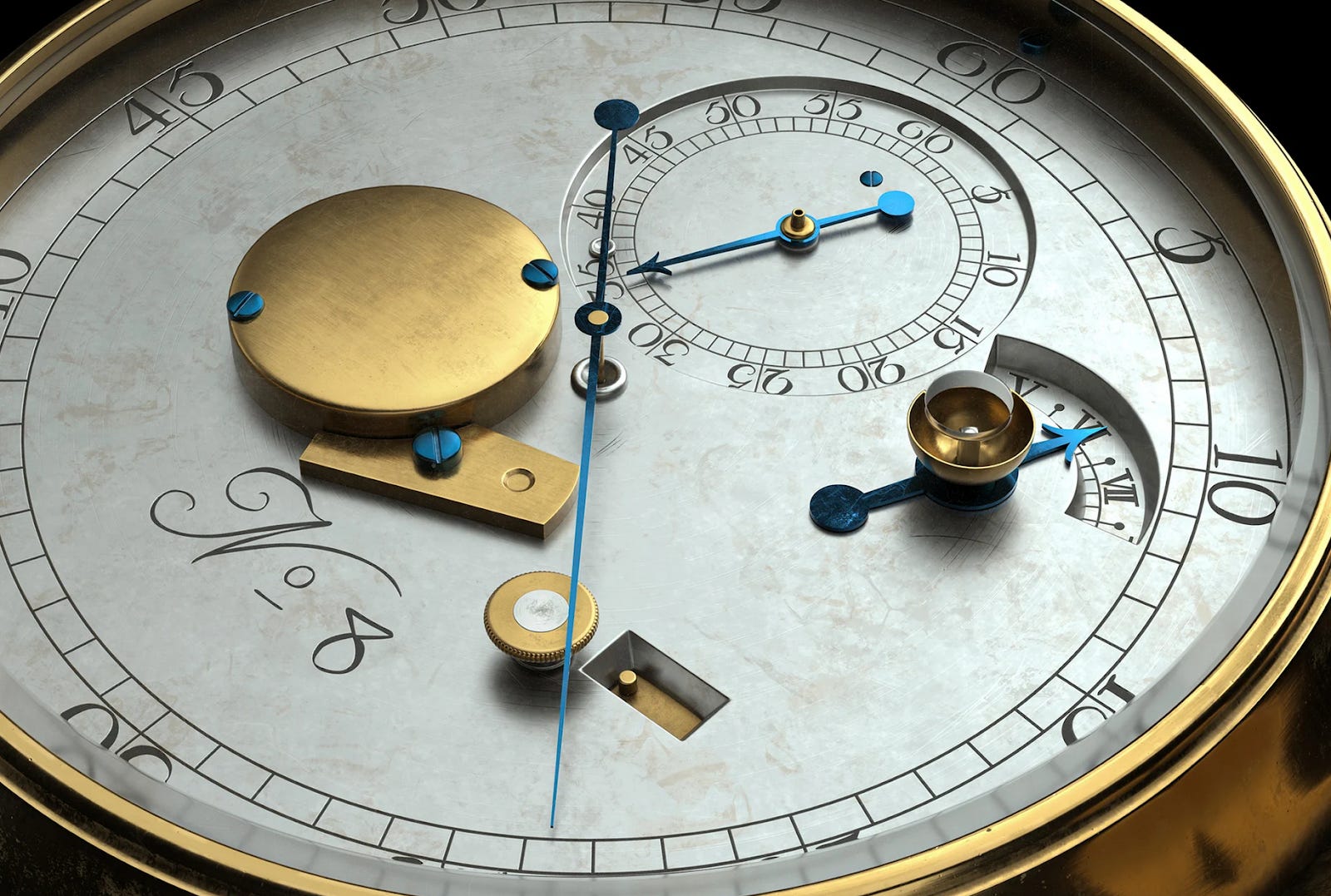
Between 1760 and 1787, he produced dozens of marine timekeepers across more than twenty calibers. By 1792, his instruments had been deployed on twenty-four sea voyages. Marine Clock No. 8, tested aboard the corvette Isis, enabled navigators to determine longitude within roughly half a degree — an achievement measured not in admiration, but in nautical miles.
This was iterative prototyping before the term — or the bureaucracy — existed.

What distinguished Berthoud was not the pursuit of a singular breakthrough, but the construction of a development cycle: propose, build, test at sea, revise, document, redeploy. Success emerged through managed iteration rather than theatrical invention.
He approached horology as experimental science. He constructed devices to study balance-spring elasticity. He articulated principles for minimizing friction: reduce mass to necessity, proportion pivots correctly, pair dissimilar metals, limit motive force to sufficiency. He wrestled with temperature compensation and recognized what later generations would call secondary error. He replaced escapements when they proved insufficient, sometimes favoring robustness over theoretical purity.
He was not always first. He was rarely flamboyant. But he was systematic.
The contrast with Pierre Le Roy clarifies the distinction. Le Roy’s detached escapement represented a conceptual leap — elegant, efficient, arguably more radical than many of Berthoud’s refinements. If horological history were organized solely around intellectual originality, Le Roy might stand higher.
Engineering races are not won by elegance. They are won by systems.
Berthoud secured state backing. He delivered instruments in quantity. He embedded testing within naval operations. He formalized production commitments. He built a body of work that could be studied, replicated, and improved. Where Le Roy offered brilliance, Berthoud constructed a program.
The rivalry extended beyond mechanics. In his early Traité des horloges marines, Berthoud omitted mention of Le Roy entirely. Only later, in his 1802 Histoire de la mesure du temps, did he acknowledge and correct certain omissions. The episode underscores a quieter reality: technological races are also contests over narrative authority. To define the theoretical framework is to define the lineage of innovation.
Here, Berthoud’s publishing program becomes central.
At a time when horological knowledge was guarded as commercial property, he chose disclosure. His Essai sur l’horlogerie (1763) spanned nearly a thousand pages, accompanied by extensive engraved plates. Subsequent treatises expanded the corpus. By the end of his career, he had produced roughly 4,000 quarto pages and more than a hundred plates detailing his mechanisms and experiments.
These were not craft manuals. They were engineering literature.
In an era of secrecy, Berthoud institutionalized knowledge. He transformed tacit workshop expertise into documented methodology. He described experiments with sufficient clarity that they could be replicated. He preserved reasoning alongside results. He rendered horology transmissible.
Modern aerospace engineering advances through documentation standards, specification languages, and archived test data. Designs survive their creators because they are written, diagrammed, and standardized. Berthoud grasped, instinctively, that if France were to compete at sea, knowledge could not remain embodied in a single artisan. It had to be structured, published, and remembered.
This is what separates the artisan from the engineer: not talent, but survivable method.
Berthoud’s later honors — membership in the Royal Society, appointment as Watchmaker-Mechanician to the King and Navy, elevation to the Légion d’Honneur — reflected more than technical ability. They recognized alignment with a national engineering effort. He became an institutional figure, not merely a skilled practitioner.
His influence persisted. The Berthoud name continued through successive generations until 1876, and his disciplined approach to documentation and calibration anticipated the increasingly organized practices that would characterize 19th-century Swiss watchmaking. The transition from Enlightenment treatise to industrial manufacture required habits he had helped normalize: systematic testing, standardization, transmissibility.
He did not merely refine horology. He institutionalized it.
Then the name receded into archives.
More than a century later, it resurfaced in a different context. In 2006, Chopard acquired the rights to the Ferdinand Berthoud name and, in 2015, established Chronométrie Ferdinand Berthoud in Fleurier. The modern watches are technically serious — fusée-and-chain transmissions, remontoire mechanisms, chronometer certification, meticulous finishing. They are also deliberately scarce, produced in limited series for collectors.
The revival is respectful. It is also revealing.
Berthoud labored to make precision reproducible. He published so that knowledge would not remain confined to one bench. He worried about domestic capability, about whether France could execute critical components without foreign dependence. He sought systems that others could adopt and extend.
Contemporary luxury operates through rarity. Value derives, in part, from limitation. Engineering heritage becomes narrative capital. Infrastructure becomes aesthetic reference.
There is no accusation in this contrast — only perspective.
In the 18th century, marine chronometry was a strategic necessity. In the 21st, it is a cultivated fascination. What once secured fleets now secures collector interest. The function has changed; the mechanisms endure.
Berthoud’s importance does not rest on whether his escapement surpassed Le Roy’s in conceptual daring, nor on whether his clocks were the most visually refined of their age. It rests on his recognition that the longitude problem demanded coordination: state sponsorship, theoretical transparency, iterative testing, and institutional memory.
He operated less like an inspired artisan and more like the director of a national research program.
Seen in this light, Berthoud represents a model of watchmaking that understands itself as engineering — accountable to method, documentation, and public consequence. When watchmaking remembers this dimension, it builds infrastructures of knowledge. When it forgets it, it risks producing objects untethered from context.
The Enlightenment required engineers.
Ferdinand Berthoud answered that requirement — and in doing so, left behind not only clocks, but a framework for how precision, organized and sustained, can alter the course of history.
About the Author
Sergio Galanti is an independent brand strategist and writer in the luxury watch industry. He is the editor of WatchDossier, a publication devoted to the cultural and philosophical undercurrents of modern horology.
No compensation or brand affiliation influenced this essay. Opinions are the author’s own.
Subscribe watchdossier.ch to receive more insights on luxury, craftsmanship, and collecting.


