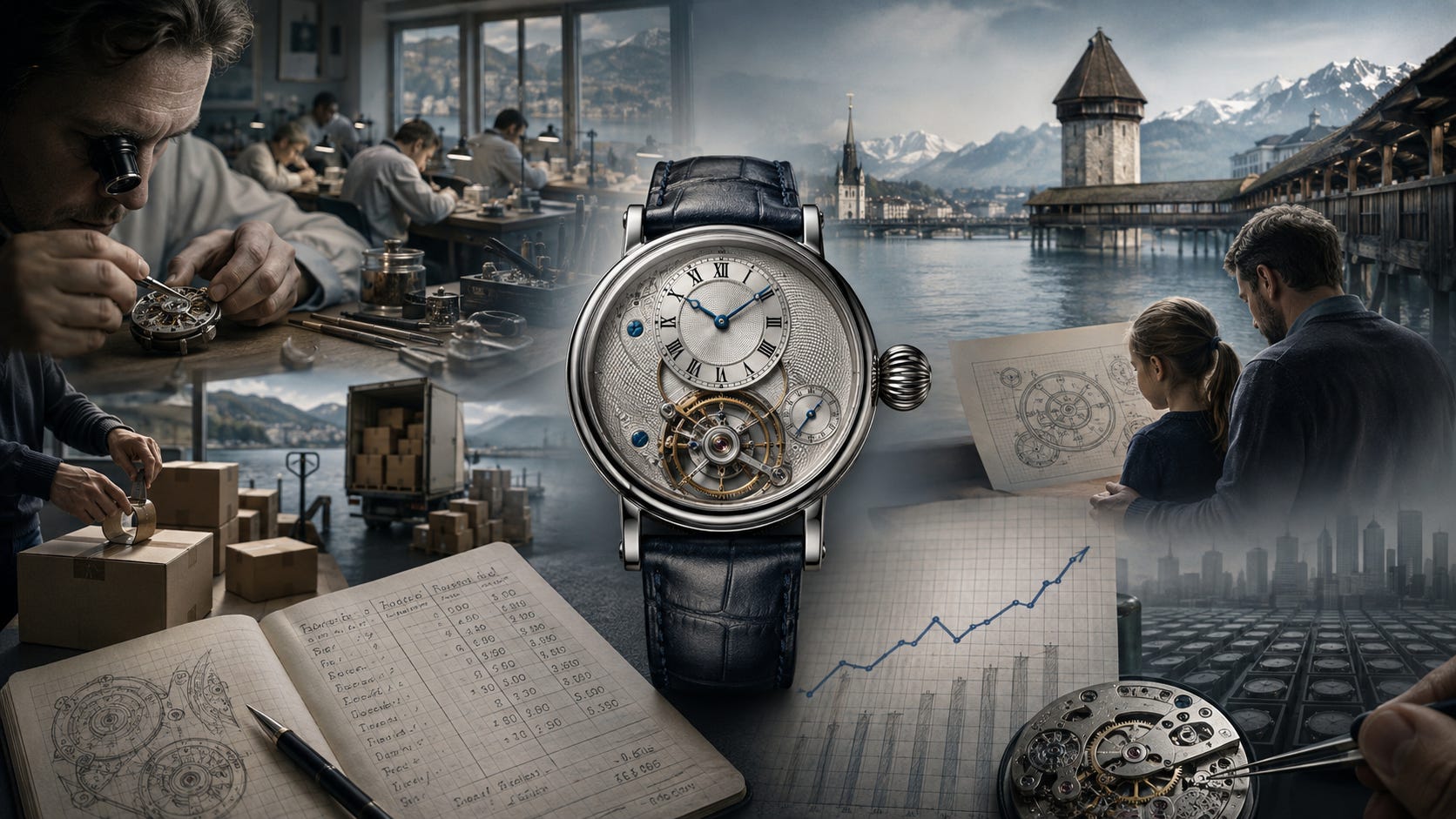
The Arithmetic of Independence: Interview with Oliver Ebstein, CEO of Chronoswiss
Lucerne, July 2026.
Oliver Ebstein came to watchmaking from banking and pharma, bought a company in trouble, and rebuilt it. Staying private, for him, is a strategy, not a sentiment.
The weekend the United States set its tariff on Swiss goods at 39 per cent, Chronoswiss spent it packing watches. The rate applied on the date of shipment, not arrival, so the company rushed as much stock as it could to its American partner before the number took hold. “We asked everybody to come in to help pack watches to be sent to our partner in the United States,” Oliver Ebstein says. “They only gave us like 48 hours.”
The tariff fell back to 15 per cent within months. “They went back to 15 per cent and then we left it as it is.” Nothing structural changed; there is no production in the United States to move. This is what an independent watch company is: twenty-odd people in a building in Lucerne, improvising against a number set in Washington, absorbing what they cannot dodge.
Ebstein is not a watchmaker, and that matters to how the company is run. He came from banking — UBS — then spent years in pharmaceuticals, and arrived at Chronoswiss sideways, as a collector who admired the brand before he owned it. “It was kind of a coincidence that I met with Mr Lang,” he says. His parents had been in jewellery and accessories, and as a boy he went to the Basel fair for the catalogues. He did a due diligence, took a month or two, and bought.
What he bought was in trouble. The founder, Gerd-Rüdiger Lang, had built Chronoswiss out of the 1983 quartz crisis, but by 2012 it was distressed, and the product was the only part working cleanly. “I had issues in supply chain. The first year I was just trying to repair the supply chain.” The disorder was startling: “We had 50 different SKUs and I think 30 different cases. And 30 different fournisseurs.” He treated it as a business to organise, not an atelier to admire — the reflex of the industries he came from. It took years; a watch company cannot be rebuilt the way a bank is. “If you are in banking and you go to another bank, you can take your key team with you. We had nothing.” Owning the company outright was its own hazard. “Suddenly you are sitting in a driver’s seat and you can do whatever you want, which is not so easy, because nobody is hindering you.” Nobody hindering him also meant nobody catching the mistakes: “a lot of money that I paid for learning, a lot.”
That outsider’s method now governs the numbers. Chronoswiss makes about 1,500 watches a year, with a staff of between twenty and thirty. The figures look like the ceiling of a brand that would grow if it could. They are a decision, and Ebstein is about to reverse it.
The company once made more. “If you go back 10 years, probably double,” he says. It cut the number on purpose. “The idea was also to reduce the volumes to make more complicated watches. So making more complicated watches is more pricey. In terms of financial, we stayed similar, but we reduced.” Now the direction changes again. “We are about to lifting it. The strategy is to go up in volume.” The target is modest and specific: “We would like to probably double the volume. Still small, still exclusive, but having a wider distribution.” Not more. “The plan is not to go to 10,000, because then you become already kind of a mass producer. But let us say 3,000 is a nice goal.”
The obvious move runs the other way — fewer watches, higher prices, the model many new independents have taken. He has refused it. “In the end, I want to have a product that can grow. The range where we are in, between 8,000 to 15,000 Swiss francs, gives you a lot of customer. If you only do 500 pieces, you are a bit more limited.” And volume is a form of protection. “Having a caution for the security of the company and my employees — this amount of volume is a good and healthy environment.” Growth, here, is ballast, not ambition.
The Neo Digiteur is a reissue — a mechanical watch that shows the time with no hands, first made twenty years ago, revived this year. Reissues are everywhere now, and the logic is usually financial: the design exists, the story exists, half the work is done. Ebstein rejects the premise for a house his size. “Economics is not so much behind it, because everything has to be done new. It is not like you take something out of the drawer. The case is new, the movement is new, the dial is new.”
The distinction he draws is the entire argument of the independent. A large company reissues cheaply because it still holds the tooling and the parts, written off years ago, and can spread the cost across a catalogue. He holds nothing. “We are a small company, so we do not have stock that we can write off.” Built from old inventory, a Chronoswiss revival would be twenty pieces. “We cannot make a series of 20 pieces.”
So the reissue is not a shortcut. It is storytelling, and it is taste. “I would not do this if I would not wear the watch myself. Even though it might be super economic, profitable — if I would not wear the watch myself, I would not do it.” At this scale, heritage buys no efficiency. It buys a story, at full cost.
The absence of anyone hindering him — so expensive at the start — is now the whole point. He answers to no one on a schedule. “I do not have the shareholders in the back saying, listen, next year, 10 per cent. So there were years we did not grow much, but we also did not lose shares.” The priority he names is not the number. “It is the balance of growing, but also making sure our employees are on the secure side.”
The freedom shows most in what does not ship — the veto is his, a matter of taste. “If I would not wear the watch, it does not go out.” He measures himself against the listed houses and their swelling catalogues — thirty pages once, a hundred and fifty now, a model for every market until the identity is gone. “You do not see the DNA any more. Less is more.”
Underneath, one principle. “That is the beauty about being private. I make sure that I create value for the long term.” He is not selling only watches. “The actual watch is maybe only 25 per cent. And 75 per cent is the people behind — the service, the quality, the story.” That is not sentiment; it shows in who comes back. “We have a lot of repeat customers. Not only because of the watch, but because of the product, brand. Because what they get here is a story.” A listed brand exists to return value on a schedule. This one exists to still be here.
That instinct is inherited, not invented. When Lang decided to sell, he had offers from groups and turned them down; he spent three or four years looking for a family instead, because a group would keep the name and let the rest evaporate. He sold to Ebstein, a collector, over a long evening. The refusal at the start of the ownership story now waits for Ebstein at the other end of it.
Every independent reaches that question eventually, and his honest answer, for now, is that he does not have one. His children are young. The younger daughter likes the bench, sits at the machine, went through the new brochure and marked the names she would change — but he will not push her. “You should never push your kids. I was never pushed. It needs to come by themselves.”
If it does not come, the instruction holds regardless. “My goal is to make sure it keeps the company independent. I would make very much sure that it stays in family hands.” He reaches for one comparison to explain why — the Italian family firms his own tailor buys from, shirtmakers a century old whose names no one knows and whose quality is a promise precisely because the family is still there. That, he thinks, is where luxury is turning: not the name on the dial but the provenance behind it. “Why not go for something where you have the promise of how it is produced?” Whether Chronoswiss outlasts the Ebsteins is unsettled. What it is meant to be — a story that needs no single owner to keep telling it — he has already decided.
About the Author
Sergio Galanti is a Swiss-based independent writer specialising in the luxury watch industry, and an advisor to private collectors and investors. He is the editor of WatchDossier (watchdossier.ch), a publication exploring the cultural and philosophical undercurrents of contemporary horology, and the author of Against the Grain: A Cultural History of Swiss Independent Watchmaking.
No compensation or brand affiliation influenced this essay. Opinions are the author’s own.
Subscribe to watchdossier.ch to receive more insights on luxury, craftsmanship, and collecting.


