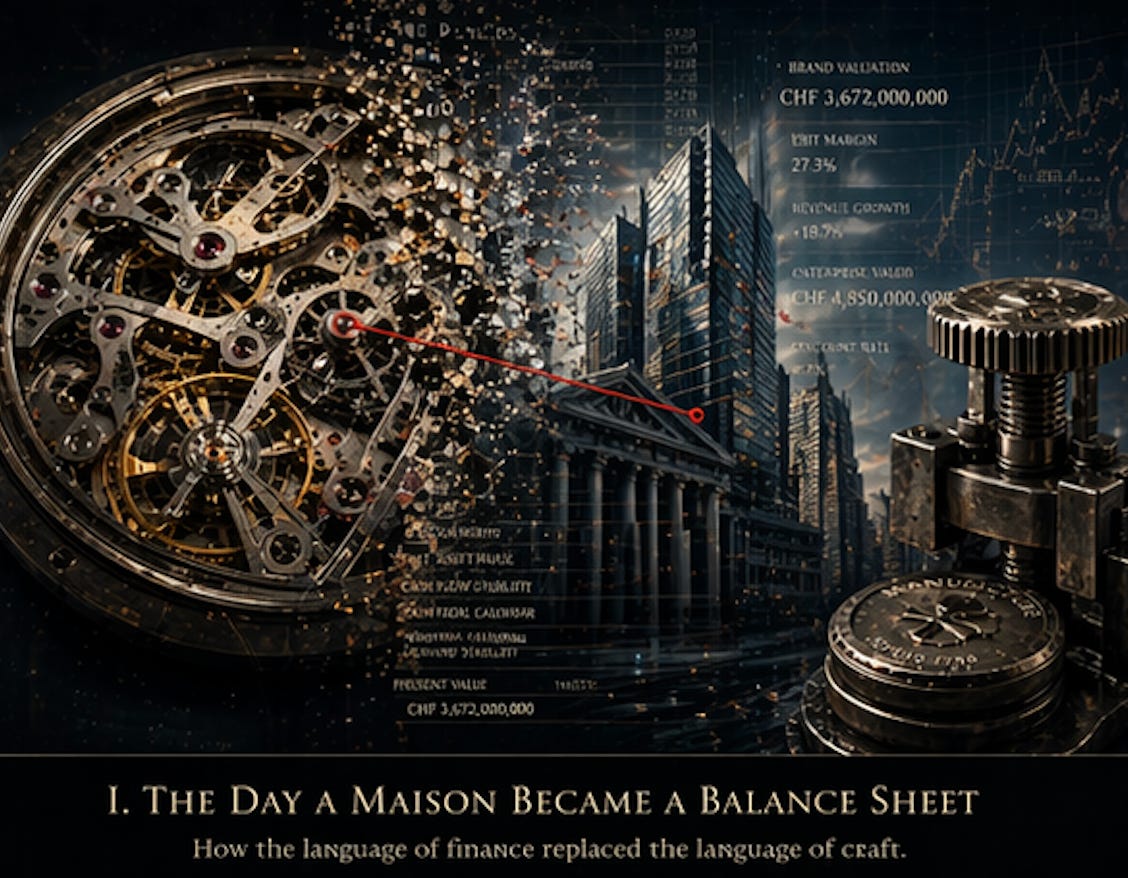
The Day a Maison Became a Balance Sheet.
In 2000, a Swiss analyst valued Breguet the same way he valued Nescafé. Nobody blinked.
The article appeared in the Swiss Watchmaking Journal in 2000, tucked between trade advertisements and export figures. Its title was plain enough — “Evaluating a Brand: The Investor’s Standpoint” — and its author, Pierre Tissot, proceeded with the unhurried confidence of someone stating the obvious. The obvious, in this case, was that a watch brand is a financial asset, and that its value can be determined using the same analytical tools one would apply to any other intangible in the consumer goods universe. Coca-Cola, Nescafé, Omega, Breguet — the methodology is the same. What varies is the price.
This is worth pausing over. In 2000, a financially literate Swiss observer could look at the Swatch Group’s portfolio — Omega, Longines, Rado, Blancpain, Breguet — and see not a collection of horological traditions but a portfolio of intangible capital assets, each one valued by its capacity to generate stable future demand. The framework was Interbrand’s: financial analysis, market analysis, brand strength scoring, legal protection. The same framework that ranked Coca-Cola as the world’s most valuable brand that year, followed by Microsoft, IBM, Intel, and Nokia. No watch brand appeared on the list. But the analytical grammar was identical. A brand, Tissot explained, is “a lasting relationship between the brand-name owner and the consumer.” It provides “a level of medium-term stability of demand.” This stability generates predictable revenues. Predictable revenues can be discounted to present value. A brand is therefore capital.
The year the article appeared was a good one for the Swiss watch industry. Exports hit a new record. The United States absorbed nearly two billion francs’ worth of Swiss watches. The average export price had climbed sharply, from 261 to 312 francs, driven by rising demand for steel and eighteen-carat gold. The industry was mid-stride in a recovery that had been building since the mid-1990s, when Swiss watchmakers completed their repositioning at the high end of the market after the devastation of the quartz crisis. China did not yet rank among the top twenty export destinations. The great Asian boom was still years away.
It was also a moment of extraordinary consolidation. The previous September, LVMH had acquired TAG Heuer for 1.2 billion Swiss francs — a figure Tissot treats not as news but as data, a benchmark against which to test the valuations of other companies. That same year, Richemont paid 3.08 billion francs to acquire Les Manufactures Horlogères from Mannesmann, bringing Jaeger-LeCoultre, IWC, and A. Lange & Söhne into its portfolio in a single stroke. The two largest watch transactions in history had occurred within twelve months of each other. The modern map of Swiss watchmaking — the duopoly of Richemont and LVMH that still governs the industry — was being drawn in real time.
Tissot’s article registers the LVMH–TAG Heuer deal and uses it as a valuation benchmark. Applying the same revenue and operating-profit multiples to the Swatch Group, he arrives at a theoretical value of 5.2 billion francs for the group as a whole — and then asks, with the quiet provocation of a man who knows his arithmetic, whether that implies the Swatch Group’s entire brand portfolio is really worth only 4.3 times the TAG Heuer brand. The stock market, he notes, appeared to agree that the answer was no. In the weeks following the TAG Heuer announcement, companies holding watch brands repriced upward, the market having absorbed the transaction multiples as a new benchmark for the sector.
But the article’s significance is not in its calculations. Financial analysts do this work every day, and the specific numbers are now a quarter-century old. What matters is the intellectual architecture — the assumptions so deeply embedded that Tissot does not think to justify them.
The first is that a watch brand and a food brand are analytically equivalent. The article moves between Swatch Group and Nestlé, between TAG Heuer and Amora mustard, without transition or apology. The Unilever acquisition of Amora and Maille, announced in November 1999, is treated as a directly comparable transaction: apply the same revenue and operating-profit multiples to Nestlé, and the food giant’s market capitalisation appears twelve to thirty per cent below its theoretical value. The same logic, the same toolkit, the same conclusion. The gap between a tourbillon and a jar of Dijon mustard is, from this vantage point, irrelevant. Both are branded consumer goods. Both generate demand stability. Both can be discounted to present value.
The second assumption is more revealing still. In the entire article — across its discussion of costs techniques, financial value methods, discounted cash flows, and market comparables — there is no mention of movements. No mention of complications, of manufacture status, of vertical integration, of the hand of the watchmaker. The word “manufacture” does not appear. The value of a watch brand resides entirely in its relationship with the consumer: trust, differentiation, the probability that future profits will materialise. Horological content is not part of the equation. It is not dismissed. It simply does not arise.
And here is where the juxtaposition with the Richemont deal becomes striking. When Richemont announced the LMH acquisition in July 2000, it described the purchase in language that would have been alien to Tissot’s article. LMH was “a vertically integrated group and a leader in Haute Horlogerie.” Its strategic value lay in “expertise in manufacturing high value movements.” Jaeger-LeCoultre’s “unique manufacturing expertise” was cited as a major attraction. In other words, Richemont was already paying three billion francs for something Tissot’s framework did not register: the capacity to make things. Two theories of value — brand as demand stability, and brand as manufacturing legitimacy — coexisted in the same year, in the same country, in the same industry, and no one appears to have noticed the contradiction.
Reading the article now, one has the sensation of looking at a photograph taken just before a landscape changed. Within a few years of its publication, the Swiss watch industry would complete the pivot toward the second theory. The in-house movement — designed, manufactured, assembled, and regulated under one roof — would become the central claim of horological legitimacy. Brands would invest hundreds of millions in proprietary calibres, and the ability to say “manufacture” would become a pricing argument, a marketing narrative, and eventually a near-doctrinal requirement for any brand seeking to position itself in the upper registers of the market. Heritage would cease to be a soft reputational attribute and become an engineered asset, curated and narrated with the precision of a financial instrument.
Which raises a question the article could not have anticipated: if the financial logic was sufficient, why did the industry need a different story? Why did the subsequent two decades produce such an elaborate architecture of artisanal mythology — the in-house doctrine, the heritage narrative, the cult of the watchmaker’s hand — if the brand-as-capital framework already explained where value lived?
One possible answer is that the financial framework was too transparent. It made watchmaking legible as a consumer goods business, which is precisely what luxury cannot afford to be. The entire pricing architecture of high-end watchmaking depends on the perception that what is being sold is not merely a branded consumer product but something categorically different — something whose value is grounded in craft, in time, in the irreducible singularity of the handmade. The mythology of the movement solved a problem that brand economics alone could not: it provided a justification for margins that demand stability, however real, could never fully explain.
Tissot closed with an observation that now reads as an inadvertent prophecy. Brands, he wrote, must prove capable of influencing stock market outperformance for long periods, and the methods for capturing this value were “still in their teething stage.” He was right on both counts. But the teething that followed produced something he had not imagined — not a better financial model, but an entirely different language of value. The industry did not refine the analyst’s toolkit. It replaced it with a story.
About the Author
Sergio Galanti is an independent brand strategist and writer in the luxury watch industry. He is the editor of WatchDossier, a publication devoted to the cultural and philosophical undercurrents of modern horology.
No compensation or brand affiliation influenced this essay. Opinions are the author’s own.
Subscribe watchdossier.ch to receive more insights on luxury, craftsmanship, and collecting.


