The Frame and the Invoice
HYT wraps its most technical watch in 5N gold and calls it metamorphosis. The gold is real. So is the invoice underneath the myth.
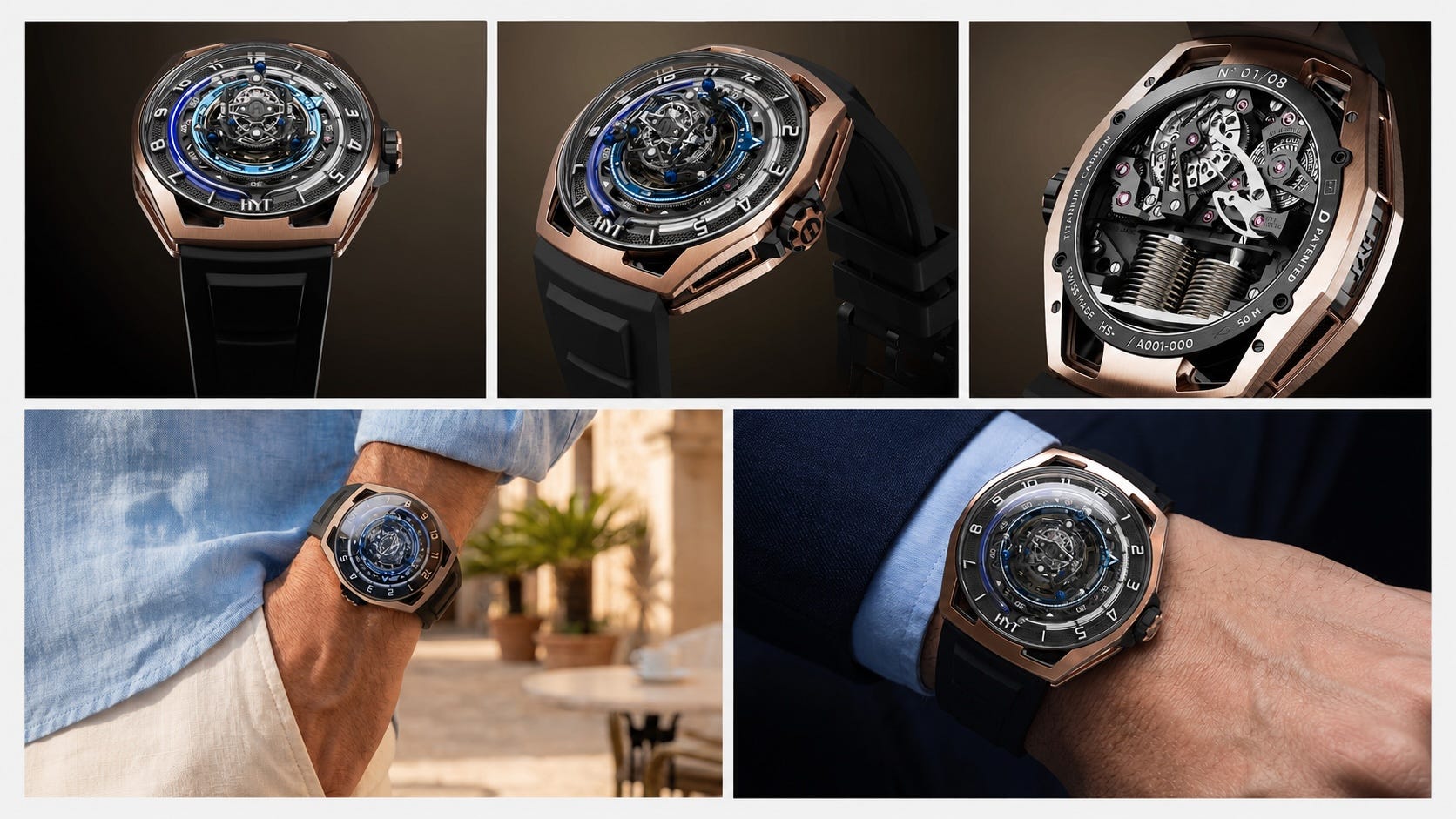
The blue arrives before anything else. At the center a skeletal tourbillon turns beneath the domed crystal, the HYT monogram floating in its cage; around it the colour organises into rings — a pale cyan track hugging the mechanism, then a deeper cobalt arc that climbs the left flank and stops, the fluid caught mid-retrograde. It is the most saturated thing on the dial: brighter than the white numerals, brighter than the gold. Set the watch going and the colour moves in more registers than a photograph can hold — the fluid rising and jumping back through its borosilicate hair, three small spheres circling the cage at different speeds (one four turns a minute, one five, one six), a central hand sweeping the minutes. Around all of it, this time, gold. Not the blue’s rival but its setting: 5N rose gold on the crown and the flanks, black DLC titanium receding behind it, a case built, HYT says, to let the blue be seen.
It is a beautiful object. That should be said plainly, because most of what follows complicates the saying.
The Midnight Blue’s whole argument is material. HYT has taken the Conical Tourbillon — its most technical creation — dressed it in 5N gold, and the release reaches for metamorphosis: a “bold evolution,” a “new form of life.” The prose wants you to feel a threshold crossed. Look at the price list instead. The 2023 Titanium Blue, in carbon and titanium, listed at CHF 335,000; the 2024 Panda, in titanium and white ceramic with no gold, at 355,000; the gold Midnight Blue, at exactly that. The most precious material the house can name commands not a franc over a ceramic-coated cousin. This is not an accusation — gold is an honest thing to sell. It is only worth noticing that a maison calling this a metamorphosis has priced it, to the franc, as the colourway it is.
And the thing being framed is not, in the sense the boilerplate implies, HYT’s own. The brand’s “About” text still describes an approach “developed entirely in-house.” The tourbillon at the center of this watch — the reason it exists, the reason it costs what it costs — is Eric Coudray’s. Coudray is the maestro behind Jaeger-LeCoultre’s Gyrotourbillon and the Spherion in watches by MB&F and Purnell; he works today through Tec-Group. His conical tourbillon reinterprets an inclined design Walter Prendel built in Groitzsch in 19281, itself an application of Alfred Helwig’s theory2. HYT credits every name of this generously — in the same document that elsewhere says “entirely in-house.”
That is the gap. It is not a lie.
The decision HYT made was the correct one: partner with the finest living tourbillon-maker and hang his work at the center of your dial. The story told over that decision is one of essence — an independent maison whose excellence is native, unbroken, its own. Both are true at once. Mythology is not the opposite of fact; it is the tense fact gets told in. Here the tense is timeless, and the timeless quietly erases the invoice from Tec-Group and the name of a man who has spent twenty years making other people’s tourbillons famous.
Where HYT’s own genius actually lives is quieter, and harder to photograph. It lives in the fluidic module: a glass capillary eight-tenths of a millimetre across, a pair of bellows with walls a quarter the thickness of a human hair, a system that translates the movement’s energy into the motion of a liquid with nothing visibly driving it. This was Lucien Vouillamoz’s problem3, solved through the sister firm Preciflex, and it is genuinely HYT’s — the one thing nobody else in watchmaking does. Turn the case and the fluid answers. Bring it to the light and the line where the blue meets the clear is the hour itself — a moving boundary you learn to read the way you learn a tide. It is unreasonably satisfying, and the satisfaction is real craft, not narrative.
So the object is honest even where the copy turns mythological. But the copy asks for one thing more than the object can carry. This is the sixth dress on one caliber. The Eklipse. The Sapphires. The Titanium Blue. The Panda. The Diamonds. Now the Midnight Blue. The same 750 components, counted the same way each time — 533 in the movement, 159 in the cage — redistributed across cases, colours, and stones. Metamorphosis is a strong word for a colourway. Eight pieces of it, forty-eight millimetres across and twenty-five deep, engineered so the time is the hardest thing on the dial to read. A watch that buries the hour inside a spectacle is not concealing a flaw. It is stating a preference, loudly, in gold: this is for being seen wearing, only incidentally for telling the time.
Which is the strategy, and a shrewd one for a house in HYT’s position. The “About” section narrates an unbroken line — born 2012, faithful to its philosophy to this day. It does not mention that in March 2021 the company filed for bankruptcy, that Kairos Technology Switzerland bought the assets, that the maison you are reading about died and was repurchased. The continuity is the myth performing its most useful labour: sealing a rupture so cleanly you would never guess the watch on your wrist comes from a company on its second life. The leadership has turned over again since — the chief executive who ran the revival’s later phase left in late 2025. A CHF 355,000 gold tourbillon, editioned to eight, is how a revived independent buys back its seriousness. It may well work.
Strip the myth to the wire — the bought-in tourbillon, the colourway sold as metamorphosis, the maison that died and was reassembled — and one decision survives every subtraction, because it was never a claim. This watch makes the time the hardest thing to read on its own dial, on purpose — not a defect it failed to fix but a position: that the hour is worth more as spectacle than as information. Most watches want to be read at a stoplight. This one wants to be watched, and dares you to prefer that.
The nerve of it is the thing that lasts. Not the gold, which is priced by the gram; not the story, which unravels on contact. The conviction.
Which leaves the reader somewhere less comfortable than admiration. To want this watch is to agree with it — to concede that you, too, would rather have the illegible column of moving liquid than one that merely tells the time. That is the small transgression, and it survives full knowledge of the overstatement.
The watch is not the transgression. Wanting it, eyes open, at that price, from that brand, is.
Good sense would file this under things one admires from a safe distance.
Good sense is not what anyone spends three hundred and fifty-five thousand francs to acquire.
But curiosity is. HYT is the only house on earth that tells the hour in liquid — and it died once and came back to keep doing it. Forget the story. What it makes next is worth waiting for.
Walter Prendel: German watchmaker of Groitzsch, Saxony, who around 1927–28 built a unique pocket watch with a six-minute flying tourbillon whose balance was inclined 30° to the horizontal — an “oblique” tourbillon meant to even out the rate difference between the watch’s flat and upright positions. Eric Coudray’s conical tourbillon revives and reworks that design.
Alfred Helwig (1886–1974): master watchmaker and long-serving instructor at the German Watchmaking School in Glashütte, celebrated for inventing the flying tourbillon in 1920 — a cage cantilevered from a single side. Prendel drew directly on his construction.
Lucien Vouillamoz: Swiss inventor and physicist by training, who conceived HYT’s liquid time display in 2002 after contemplating the ancient clepsydra, and devised its fluidic module — two unmixing liquids whose meniscus, the moving line where they meet, marks the hour, driven through a fine capillary by miniature bellows.
About the Author
Sergio Galanti is a Swiss-based independent writer specialising in the luxury watch industry, and an advisor to private collectors and investors. He is the editor of WatchDossier (watchdossier.ch), a publication exploring the cultural and philosophical undercurrents of contemporary horology, and the author of Against the Grain: A Cultural History of Swiss Independent Watchmaking.
No compensation or brand affiliation influenced this essay. Opinions are the author’s own.
Subscribe to watchdossier.ch to receive more insights on luxury, craftsmanship, and collecting.


