


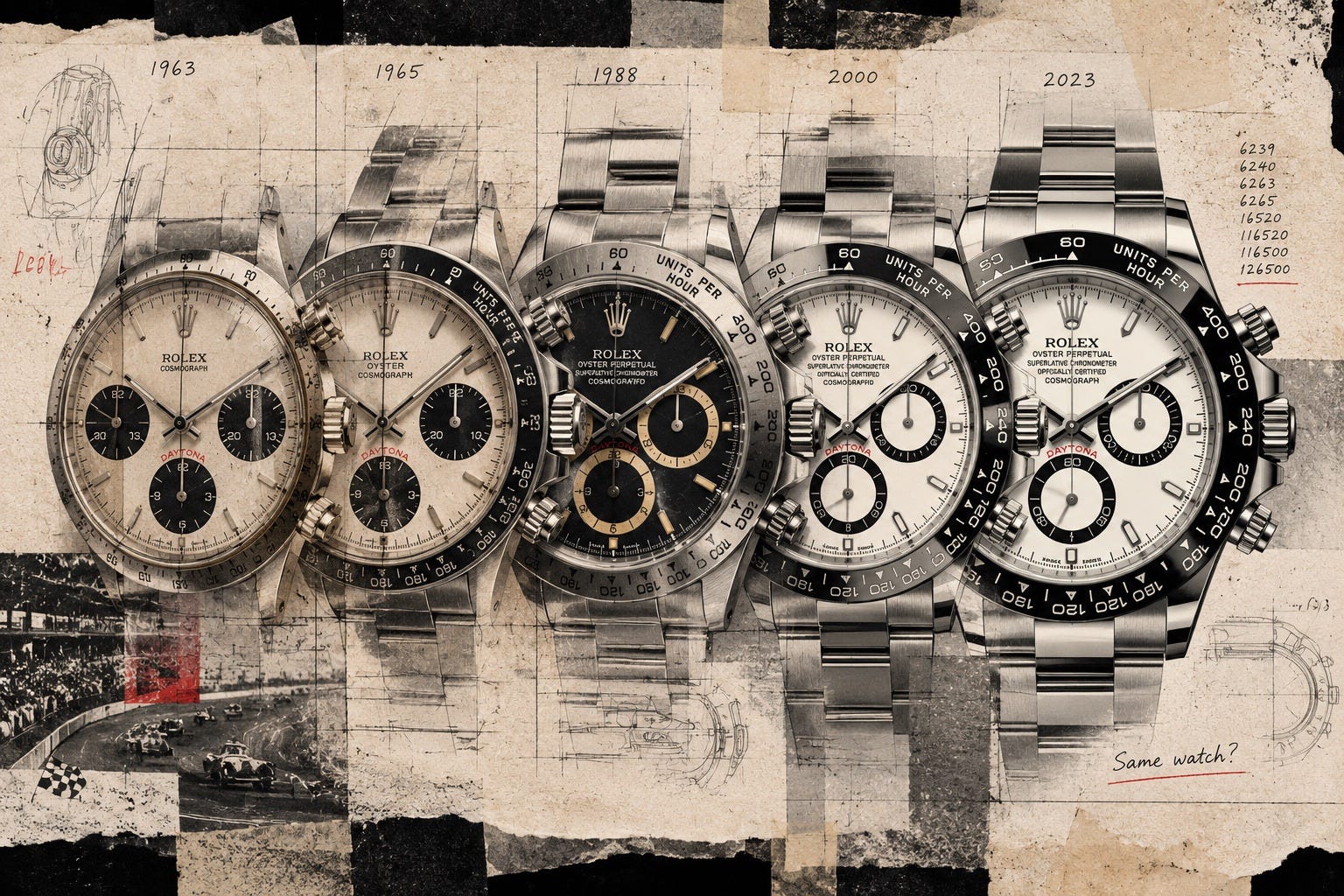
Put a Daytona from 1965 beside one from 2023 and something strange happens, and what happens depends on who is looking. To a stranger they are nearly the same watch: round, steel, three small dials, a scale around the rim, a name that means fast cars. To anyone who knows, they share almost nothing. Different movement, different winding, different case, different crystal, different bezel material, different dial construction, different luminous compound, different diameter — different, in fact, in every property that can be measured. Sixty years of unbroken change lie between them, and by every technical standard they are strangers.
And yet the stranger is not wrong. They are the same watch.
That is the trick, and it is worth taking apart slowly, because it is one of the most quietly sophisticated things a manufacturer has ever pulled off. Almost everything about the Daytona has changed since 1963. Its movement has been replaced more than once. Its winding system changed. Its frequency changed. Its case grew. Its crystal went from acrylic to sapphire. Its bezel went from steel to acrylic to ceramic. Its bracelet, its clasp, its dial furniture, its lume, its tolerances, its whole manner of being manufactured — all of it changed. The extraordinary cultural achievement of the watch is the exact opposite impression: that it has barely changed at all. The contradiction is only apparent. Rolex changed the physical object, repeatedly and drastically, precisely in order to keep the conceptual object still. The Daytona does not resist change. It metabolises it.
The ordinary logic of manufactured goods runs in one direction. A new thing appears; the old thing is quietly discredited by its arrival; the difference between them is what persuades you to buy again. The current model enjoys a kind of privilege simply by being current, and last year’s model pays for that privilege by beginning to look like last year. This is the engine of nearly everything sold, from cars to kitchens to telephones, and the Daytona half-obeys it. Each new reference must be new; there would be no reason to release it otherwise. But it must do something no ordinary product is asked to do. It must be new without making the previous one wrong. The novelty has to justify a fresh purchase while confirming, rather than embarrassing, everything that came before it. That is a far harder problem than mere renewal, and the history of the Daytona is really the history of solving it.
* * *
It begins, in 1963, not with a finished object but with a grammar. Reference 6239 moved the tachymeter off the dial and onto the bezel, set the chronograph registers in contrast against the face, and gave the watch a clearer, more assertive structure. But it was not yet the frozen archetype we now carry in our heads. The pushers were plain pump pushers. The word Daytona was not reliably present. The Oyster promise was incomplete. What 6239 established was not the Daytona but a field of permissible identity — three registers, an external tachymeter, strong dial contrast, a racing chronograph in the Oyster idiom — a set of rules loose enough to let later watches change while remaining recognisably descended from the first. The code was born before it was complete.
The references that followed reveal the principle that would govern the object for sixty years: in this watch, innovation tends to make the thing more itself. The 6240 brought screw-down pushers, which improved water resistance and, not incidentally, made the word Oyster mean something on a chronograph. The 6263 and 6265 stabilised the mature manual-wind face so thoroughly that they stayed in production into the late 1980s. Seen at the time, these were ordinary technical improvements. Seen now, they look almost ontological, because screw-down pushers have become inseparable from the very idea of a Daytona. The change did not make the watch different from itself. It made the watch look more like our later idea of what a Daytona had always been. This is the recurring miracle of the object: its developments acquire such authority that they seem, in retrospect, to have been latent from the beginning. The Daytona kept changing, all through the sixties and seventies, and by changing it became more recognisable.
Here is the first paradox, and everything else follows from it. Most products advertise progress through visible difference; the new car should look new, the new phone should make its predecessor look tired. Rolex increasingly did the opposite. Technical change accumulated beneath a narrowing range of appearances. There came to be two histories of the Daytona running at once — a technical history in which a great deal happens, and a semiotic history in which a small number of signs are slowly locked in place — and as the decades pass, the two histories pull apart. The watch becomes less and less like its ancestor in every measurable way while looking more and more like the thing we agree a Daytona is. That divergence is the whole of it. When people say everything changes so that nothing changes, the ‘nothing’ is not the mechanism. The mechanism changes constantly. The ‘nothing’ is the identity.
The system’s severest test came in 1988. For a quarter of a century the Daytona had been a hand-wound watch, and in 1988, with reference 16520, it became automatic. Rolex took a high-grade automatic chronograph movement from outside, re-engineered it heavily — by its own account replacing more than half the components — and produced calibre 4030. The case grew. The dial changed. The registers rearranged themselves. The watch entered a different technological era. Had the Daytona been merely a fixed physical design, this should have broken it; a watch with a new heart, a new size and a new face has a fair claim to being a new watch. Instead Rolex called it a Daytona, and nobody argued, because the signs survived the rupture. Three registers, tachymetric bezel, screw-down pushers, Oyster bracelet, the contrast of the sub-dials, the racing association — the recognisable vocabulary carried across the break intact, and the watch remained legible even as its mechanism was replaced wholesale. Nineteen eighty-eight proved, in effect, that Daytona identity did not live in any particular set of parts. The parts could go. The grammar had to stay.
There was a second, subtler consequence, and it is one of the most revealing things the object does. Once the automatic watch was accepted, it changed the meaning of the watches that came before it. Until there was an automatic Daytona, nobody needed to call a 6263 a manual-wind Daytona; it was simply a Daytona. The new watch created the category that the old watch now belonged to. This happens again and again. Ceramic makes acrylic historically expressive. The in-house movement makes the earlier one collectible under a name it never had while in production. Novelty does not merely replace the past; it produces the past, retrospectively, as difference. The present is forever reaching back and re-labelling what preceded it, turning ordinary features into heritage the moment they are superseded.
If 1988 was the test, the year 2000 was the confession. Reference 116520 introduced calibre 4130, a chronograph movement designed and built entirely in-house — fewer parts, better reliability, simpler servicing, a genuine engineering achievement. It could have justified a dramatic redesign. Rolex did almost the reverse. Its own account of the moment states that the aesthetics were kept deliberately faithful to the codes established by the 1988 watch, while the real innovation stayed inside the case. It is easy to read past a sentence like that. One should not, because it is the company describing its own method in plain language: a major technical transformation deliberately prevented from becoming a visible one. Innovation internalised; continuity externalised; the most consequential thing about the new watch made invisible on the wrist. When the object under analysis turns out to be conducting the analysis itself — narrating its own semiotic strategy in a press document — the honest response is not gratitude but suspicion, and then a kind of admiration. Rolex is not naïve about what it is doing. It is telling us, and telling us does not break the spell.
This is why ‘conservative’ is the wrong word for the Daytona, though it is the word everyone reaches for. Conservatism implies a reluctance to change, and the Daytona changes freely: movements, escapements, hairsprings, materials, processes, bracelets, clasps, lume, tolerances. What is conserved is not the object. It is the recognition of the object. The watch is technologically restless and semantically loyal, and calling it conservative collapses the two things that make it interesting into one. A better description would be controlled transformation — the constant substitution of everything except the small set of signs by which we know it.
* * *
And this is what allows the trick that matters most, the one that reverses the usual fate of things. In an ordinary product cycle, the new makes the old obsolete. Within the Daytona, the new makes the old ancestral. The distinction is everything. A dated object belongs to a fashion that has passed; an ancestral object belongs to a lineage. Because each new Daytona resembles the last, the last does not come to look wrong when the new one arrives — it comes to look like the origin of the new one. The 16520 does not make the 6263 worthless; it makes it the manual-wind ancestor. The 116500LN does not embarrass the 116520; it makes it the last of the steel-bezel line. The old watch tells the new watch that it belongs to a tradition sixty years deep; the new watch tells the old watch that it was always part of the correct tradition. Past and present validate each other, endlessly, and the ordinary arrow from new to obsolete is bent into a circle. What most products do to their own history — consume it — the Daytona refuses. It accumulates its history instead.
The clearest single demonstration is the ceramic bezel of 2016. The Cerachrom insert was thoroughly modern: scratch-resistant, colourfast, indifferent to ultraviolet, plainly superior to what it replaced. And Rolex used this cutting-edge material to bring back something old, noting that the black bezel recalls the black Plexiglas bezel of the 1965 watch. The material changed completely; the sign returned. Acrylic became ceramic, vulnerability became durability, and the newest available technology was spent reproducing the appearance of the oldest. Progress arrived dressed as memory. By this point the watch’s own past has become one of the materials it is built from — a black bezel that means both present performance and historical identity at once, a set of contrasting sub-dials that quote earlier chronographs while being made by wholly contemporary methods. The present Daytona is a composite of times: its movement belongs to now, its silhouette to a line stretching back decades, its details to particular moments along the way. Rolex manufactures not merely watches but continuity.
By 2023 the method is fully mature, and reference 126500LN performs it almost as a set-piece. The case and dial were redrawn; calibre 4131 arrived with a new escapement, new shock protection, a redesigned rotor, better finishing; the platinum version even gained a transparent caseback, an unusually loud change by Daytona standards. Set a 126500LN beside a 116500LN and the differences are obvious to anyone who knows the watches and nearly invisible to anyone who does not. That gap is not a failure of design. It is the design. The knowledgeable eye is given novelty; the general eye is given continuity; the same object speaks on two levels at once. From across the room: Daytona. Up close: new Daytona. The real problem Rolex solves with each generation is not how to innovate but how to find the maximum quantity of change compatible with instant recognition — an invisible envelope inside which almost everything may eventually change, and outside which lies the danger of having made a different watch. That envelope, not any single component, is the thing being designed.
There is a consequence for the people who buy these watches, and it is a peculiar one. The collector consumes difference in reverse. The ordinary consumer is pushed toward the current object; the serious collector often moves backward, hunting precisely the moment before something changed — before ceramic, before the in-house calibre, before sapphire, before the automatic movement, before the exotic dial gave way to the standard one. Every innovation creates two objects, not one: the new watch that has the feature, and the old watch now defined by its absence. Change does not merely move the line forward. It doubles the difference on both sides of itself, and each closed category — the manual-wind years, the Zenith years, the steel-bezel years — becomes legible as a category only once it has ended. Closure creates legibility; legibility creates collectibility. Newness, here, adds value to oldness, which is very nearly the opposite of what newness is supposed to do.
None of this means the Daytona has dwindled into pure sign. That reading is too easy, and it is wrong. Calibre 4130 and 4131 are not decorative gestures at progress; they are real engineering, and Rolex goes on spending heavily on performance nobody can see. The point is not that function has been replaced by meaning. It is that the two run at different speeds. Technical function evolves quickly and invisibly; symbolic form evolves slowly and in full view. The object holds these two rhythms together, and much of its authority comes from the holding — a watch genuinely of the present pretending, convincingly, to be outside time.
There is finally something of the old philosophical puzzle about all this. Replace enough of a ship’s timbers, plank by plank, and you must eventually ask whether it is the same ship. After six decades nearly every physical aspect of the original Daytona has been replaced, and yet the culture does not hesitate for a second: the 126500LN is a Daytona. Identity here does not reside in continuity of matter. It resides in continuity of relation — in the persistence of the arrangement of signs while the things arranged are swapped out beneath it. The parts change. The syntax survives. And a watch, it turns out, can be a syntax.
So the Daytona is not timeless because Rolex stopped changing it. It is timeless because Rolex learned how to change it without letting the change become its meaning. The ordinary sequence — new, desirable, old, obsolete — was quietly rewritten into another one: new, desirable, superseded, historical, desirable again. The old reference never leaves the system; it migrates within it. The result is a product that accumulates its past instead of spending it, so that every new difference throws the older differences into sharper relief, and each generation confirms the one before rather than discarding it. Everything changes, and the changing is not incidental to the permanence; the changing is how the permanence is made. The most durable component of the Daytona is not its case or its calibre or its bezel. It is the reflex, in the rest of us, by which we look at whatever Rolex has done this time and say, without hesitating: that is a Daytona.
© 2026 Sergio Galanti. All rights reserved. This essay is an extract from the author’s forthcoming book The Grail Problem: The Most Famous Watch Nobody Could Buy; no part of it may be reproduced, in any form, without the author’s written permission.
About the Author
Sergio Galanti is the founder and editor of WatchDossier, contributor to Italian and international watch publications, the author of Against the Grain: A Cultural History of Swiss Independent Watchmaking, and advisor to private collectors.
No compensation or brand affiliation influenced this essay. Opinions are the author’s own.
Subscribe to watchdossier.ch to receive more insights on luxury, craftsmanship, and collecting.