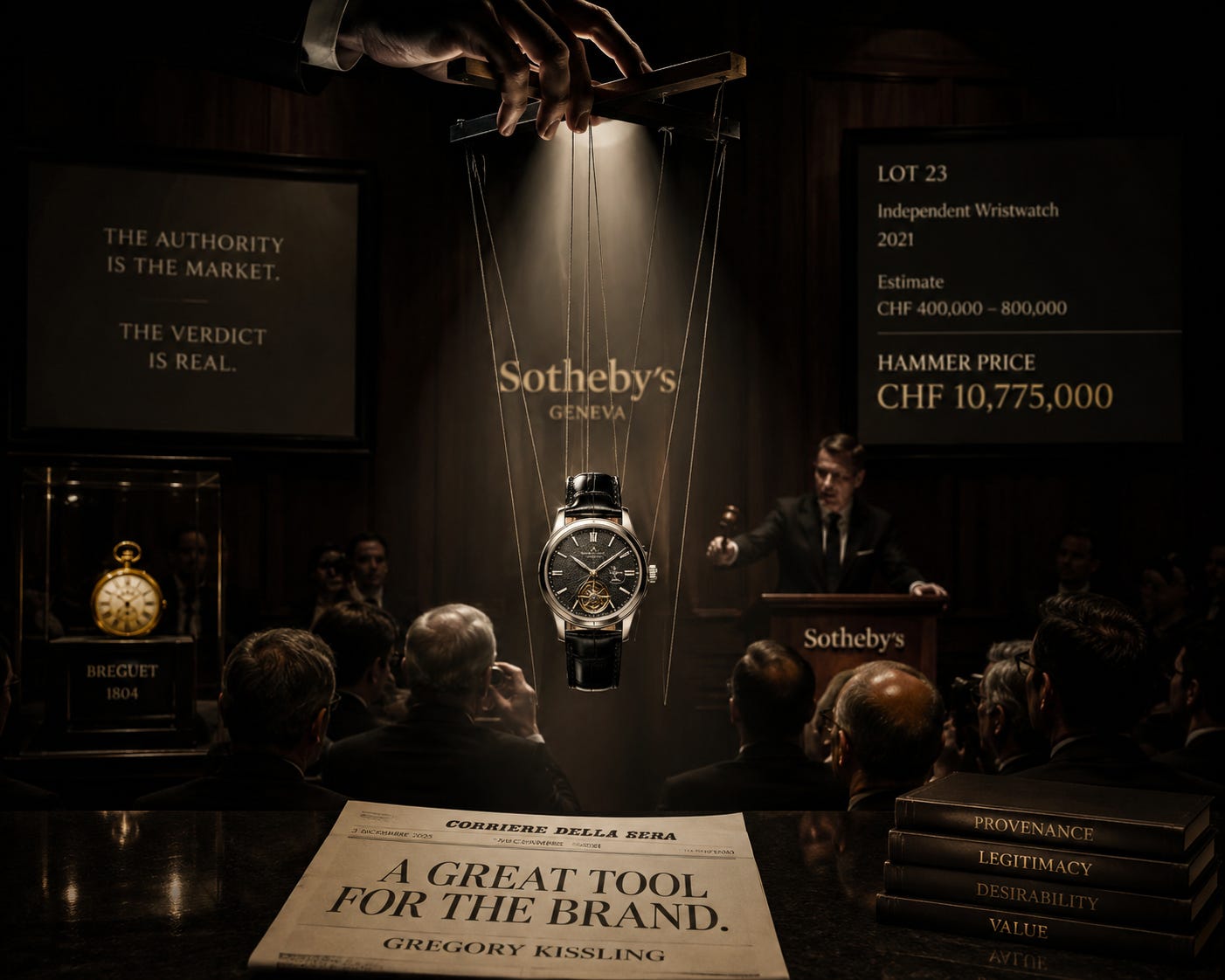
The Legitimacy Machine
When a brand stages its own validation, it is no longer being validated. The auction room's secret is that it cannot survive transparency.
On December 3, 2025, the Corriere della Sera published a short piece about a Sotheby’s auction in Geneva. The occasion was A Celebration of Breguet’s 250th Anniversary — seventy-three lots, hammer prices that climbed to 1.88 million Swiss francs for a gold tourbillon pocket watch made by Abraham-Louis Breguet himself in 1804. Gregory Kissling, speaking before the first lot was called, described what the auction was for. Not what it was selling, or what the results might say about the historical importance of the objects. What it was for. “Un grande strumento per valorizzare il marchio,” he said. A great tool for enhancing the brand. It was the kind of sentence that repays attention not because it is surprising but because it is unusually candid — the mechanism named, without euphemism, by someone inside it.
The mechanism Kissling described has a specific architecture. When a centuries-old object is sold at public auction — a marine chronometer, a pocket tourbillon, a watch made by hand in the first years of the nineteenth century — two things happen simultaneously. The object is priced. And the brand that made it is narrated. These are not the same transaction, though they occur in the same room. The provenance of the object confers a quality of permanence on the living brand: evidence, externally verified, that what the brand says about itself is also what time has said. The auction room, under these conditions, functions as a neutral third party. It does not speak for the brand. It speaks for the market, which happens to agree with the brand, which is a very different and much more powerful endorsement. The authority of the mechanism depends entirely on that distinction being real. The brand’s mythology and the market’s verdict must appear to arrive from separate directions.
There is a further condition. The objects being sold must be categorically separate from anything available in a boutique window. A pocket watch completed in 1809, carried by a Russian count, dormant for two centuries before appearing under auction lights — this object cannot be confused with a current reference, cannot be purchased as an alternative to it, cannot benchmark against it. The categorical distance is structural to the mechanism’s legitimacy. The auction room works as a brand laboratory because the experiment it runs is historically sealed: the variables are fixed, the outcome cannot be manipulated, and the verdict arrives with the authority of objects that have survived the test of time in the most literal sense.
Something has changed. The watch auction room, over the past decade, has undergone a structural shift that the trade press has reported largely as a market story — stronger results for independents, softer results for sports references, the ascent of complicated dress watches — without examining what the shift means for the mechanism itself. By June 2024, the structural reorientation was sufficiently pronounced that Christie’s own head of watches, speaking after the New York sale, identified demand for independent makers as the defining story of the room. At Phillips in December 2025, a wristwatch completed in 2021 — four years old, by a living maker — sold for 10.775 million US dollars, a world record for any wristwatch by an independent watchmaker and for any non-charity twenty-first-century timepiece at auction. These are market facts. But they are also symptoms of a structural change in how the auction room is being used.
What the auction room now offers contemporary independents is the compression of legitimacy. What once required a generation — the slow accumulation of collector consensus, the secondary market developing organically, historical standing accruing through decades of production — can now be manufactured in an afternoon. A single result at a major auction house performs, in public and with institutional imprimatur, the same function that heritage brands accrued through a century of patient waiting. Timelessness, it turns out, can be produced on demand. The question this compression raises is whether what is produced is structurally equivalent to the earned kind, or whether it is a different and less stable substance — legitimacy in the form of legitimacy, rather than legitimacy itself.
The heritage brand auction case is sealed in time. A contemporary independent auction is not. When a recently completed piece sells at auction, it does something the historical case never does: it benchmarks directly and publicly against its own retail price. A premium above retail validates the maker; it confirms that the market values the work beyond what the maker dares to ask. But the same result creates dynamics that the heritage case does not have to manage. Secondary market expectations solidify. Primary clients who paid retail calculate the gap between what they paid and what the auction room returned. Most critically, the categorical distance on which the mechanism’s authority depends begins to collapse.
In the heritage auction, the brand’s mythology and the market’s verdict arrive from separate directions. In the contemporary independent auction, they risk arriving from the same direction. The maker is alive. The pieces are recent. The maker may have relationships with consignors. Reserve prices may be managed. The auction house, whose commercial interest aligns with strong results, is not a disinterested party. None of this means that any given result is engineered. But it means that the conditions under which engineering becomes possible are present in a way that they are not when the objects are two centuries old and the maker is dust. The mechanism does not stop producing results in these conditions. It stops producing the thing the results were supposed to certify.
The auction room’s power as a legitimacy machine is entirely contingent on its apparent independence from the interests it serves. This is not a cynical observation. It is a structural one. The authority of market validation is borrowed from the market’s neutrality; the moment the market is understood to be a stage, the validation becomes another performance. Kissling’s December statement, examined from this angle, is inadvertently diagnostic. When the function of the auction room can be described, in plain Italian, in a mainstream newspaper, as a tool for brand enhancement — not as an incidental benefit, not as a consequence, but as the primary purpose — the mechanism’s independence is already at least partly mythological. The candor does not expose a corruption. It marks the distance between how the mechanism works and how it is supposed to appear to work.
The auction room remains the watch industry’s most powerful arena of meaning-making. The hammer price is still the only number that the market produces without the brand’s direct intervention. But the expanding presence of living makers, recent objects, and coordinated auction strategies in the same space where historical objects once accrued their authority without anyone’s management is quietly rewriting what the hammer price means. It is not yet clear what it will mean when that rewriting is complete. What is clear is that Kissling said the quiet part aloud, and that the industry’s capacity to produce legitimacy depends on the quiet part staying quiet.
About the Author
Swiss-based independent writer specialising in the luxury watch industry. Editor of WatchDossier, a publication exploring the cultural and philosophical undercurrents of contemporary horology, and author of the book Against the Grain: A Cultural History of Swiss Independent Watchmaking.
No compensation or brand affiliation influenced this essay. Opinions are the author’s own.
Subscribe watchdossier.ch to receive more insights on luxury, craftsmanship, and collecting.


