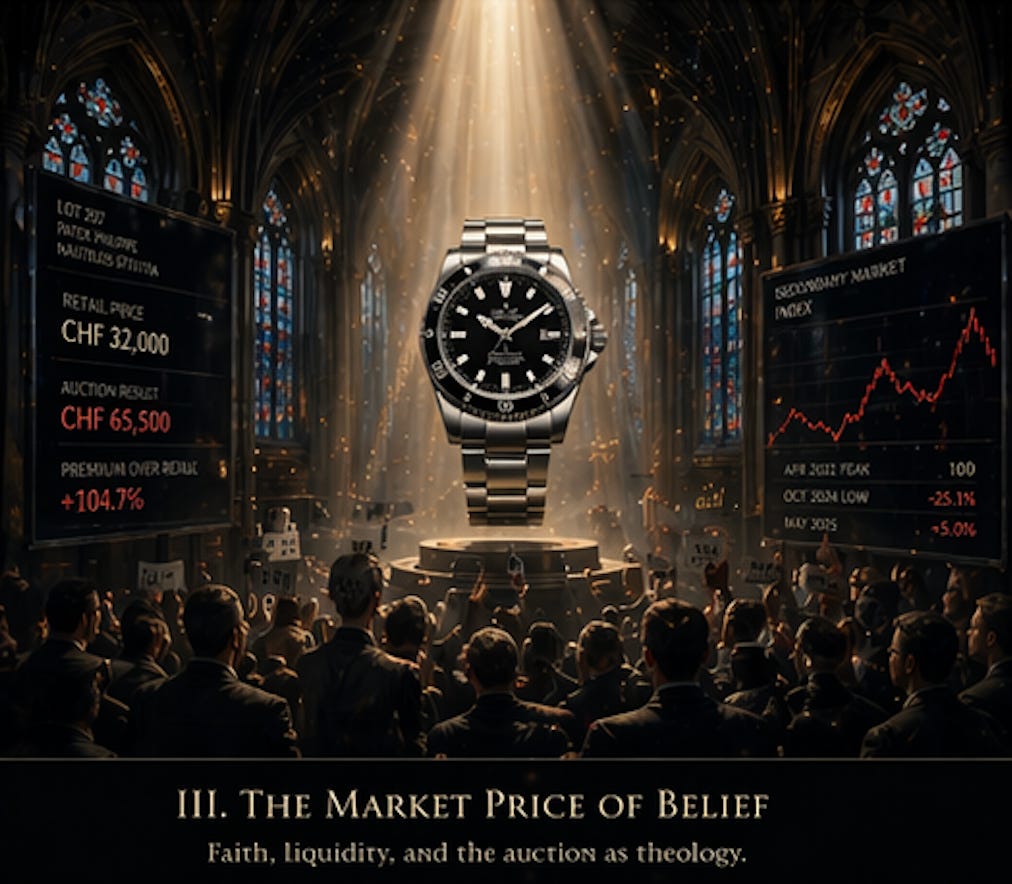
The Market Price of Belief.
Between the retail price and the resale price, there is a gap. The gap is called belief.
Consider two watches on a dealer’s desk. The first is a Vacheron Constantin Overseas, made by the oldest continuously operating watchmaker in the world. Its movement carries the Geneva Seal, which certifies that every visible component has been finished to the most exacting standard in Swiss horology. The rotor is hand-engraved in twenty-two-carat gold, a process that takes a single artisan forty-five minutes per piece. The case is fitted with an interchangeable strap system of unusual ingenuity. The second watch is a Rolex Submariner. Its movement is industrially finished and hidden behind a sealed caseback. No one will ever see it. The Submariner costs less than half the price of the Overseas at retail. On the secondary market, the Submariner trades above its retail price. The Overseas trades below. By a considerable margin.
This is not an anomaly. It is the market. According to WatchCharts, the data provider behind the annual Morgan Stanley report on the watch industry, Vacheron Constantin’s average value retention has fallen below minus forty per cent, meaning that a typical Vacheron trades on the secondary market at roughly sixty cents on the retail dollar. Rolex, by contrast, is one of only three high-volume brands whose watches consistently trade at or above retail. The other two are Patek Philippe and Audemars Piguet. Together, these three brands account for more than half of all secondary market transactions by value — an estimated ten billion dollars in annual volume. The drop-off from third place to fourth is not gradual. It is a cliff. Audemars Piguet’s secondary sales are more than double those of Omega, which sits in fourth.
The obvious objection is that the secondary market is pricing scarcity, not belief. Rolex restricts supply. Patek Philippe restricts supply. Demand exceeds availability, and the premium follows. This is true but insufficient. It explains why certain brands trade above retail. It does not explain why Vacheron Constantin — a brand with shorter production runs than Rolex, deeper horological credentials than Audemars Piguet, and a heritage that predates both by more than a century — trades at such a steep discount. Something else is at work. The secondary market is pricing not the object but the collective conviction that surrounds it. It is pricing the narrative.
The data becomes even more instructive when you look within brands rather than between them. At Patek Philippe, every model that trades above retail is a sports watch. The Nautilus and the Aquanaut command premiums of forty to fifty-five per cent above retail. The Calatrava and the Complications collections trade at discounts exceeding forty per cent. At Audemars Piguet, the Royal Oak dominates the above-retail list. Not a single CODE 11.59 model — the collection Audemars Piguet has invested most heavily in over the past five years — meets the threshold. At Vacheron Constantin, the Overseas accounts for nearly eighty per cent of the brand’s secondary market index. The Patrimony and the Traditionnelle, arguably the more accomplished collections in horological terms, barely register.
This pattern reveals something the brand-as-capital framework of Pierre Tissot’s 2000 article could not have anticipated. Tissot argued that brand value derives from the stability of demand a name generates. He was right. But the secondary market shows that demand stability does not attach uniformly to a brand. It attaches to specific narratives within a brand — to the story of the steel sports watch as the object of desire, to the mythology of the waitlist, to the social currency of being seen with a particular reference on the wrist. The Nautilus and the Royal Oak are not merely watches. They are consensus objects. The market has agreed, collectively and reinforcingly, that these are the things worth wanting. The Calatrava, for all its technical refinement, has not achieved this consensus. And without consensus, there is no demand stability. Without demand stability, there is no secondary market premium.
The hierarchy is self-reinforcing. When the secondary market corrected sharply in mid-2022, the Big Three were the first to fall. When recovery began in early 2025, they were the first to rise. By the first quarter of 2026, more than seventy per cent of tracked brands were posting positive performance, compared with just one — Rolex — a year earlier. The popular brands move first in both directions. Belief, in this market, is contagious and hierarchical. It flows downward from the top, not upward from the margins.
There are, however, exceptions that complicate the picture. F.P. Journe, a Genevan independent whose annual production is measured in the low hundreds, generates secondary market transaction volume that slightly exceeds its total production capacity. A. Lange & Söhne, which produces around five thousand watches a year, sees secondary transactions equivalent to roughly eighty-eight per cent of its annual output. These are not consensus brands in the Rolex sense. They are conviction brands — objects whose secondary market velocity is driven not by social currency or marketing scale but by a concentrated community of collectors who believe, with the fervour of the converted, in the intrinsic merit of the work. This is a different species of belief, and it produces a different market signature: lower volume, higher velocity, and a relationship between primary and secondary markets that suggests genuine collector appetite rather than speculative positioning.
Narrative-driven repricing events make the mechanism visible in real time. When the independent watchmaker Urban Jürgensen relaunched successfully in the summer of 2025, auction results for the brand’s earlier production improved immediately — the relaunch, by renewing the narrative, retroactively increased the value of objects that had not changed at all. Cartier’s resale trajectory tells the same story at larger scale. In the second quarter of 2024, Cartier’s average resale value rose by more than six per cent while Rolex declined by nearly two per cent over the same period. The shift reflected a broader reassessment of Cartier as a serious horological proposition rather than a jeweller that happened to make watches. The objects did not change. The Santos remained the Santos. What changed was the story the market told itself about what the Santos meant. The price followed the story.
This is the point at which Tissot’s 2000 framework proves both prescient and inadequate. He was right that brand value is a function of demand stability. He was right that demand stability can be measured, analysed, and discounted to present value. What he could not have foreseen is that the secondary market would become the arena in which these propositions are tested daily, with real money, by participants who have no obligation to be polite about the results. The secondary market does not care about Geneva Seals, hand-engraved rotors, or two hundred and sixty years of continuous operation. It cares about consensus — about the shared conviction that a particular object will hold or increase in value over time. This conviction is not irrational. But it is not a measure of quality. It is a measure of belief.
And belief, unlike a movement, cannot be finished by hand.
About the Author
Sergio Galanti is an independent brand strategist and writer in the luxury watch industry. He is the editor of WatchDossier, a publication devoted to the cultural and philosophical undercurrents of modern horology.
No compensation or brand affiliation influenced this essay. Opinions are the author’s own.
Subscribe watchdossier.ch to receive more insights on luxury, craftsmanship, and collecting.


