The Mozart Effect
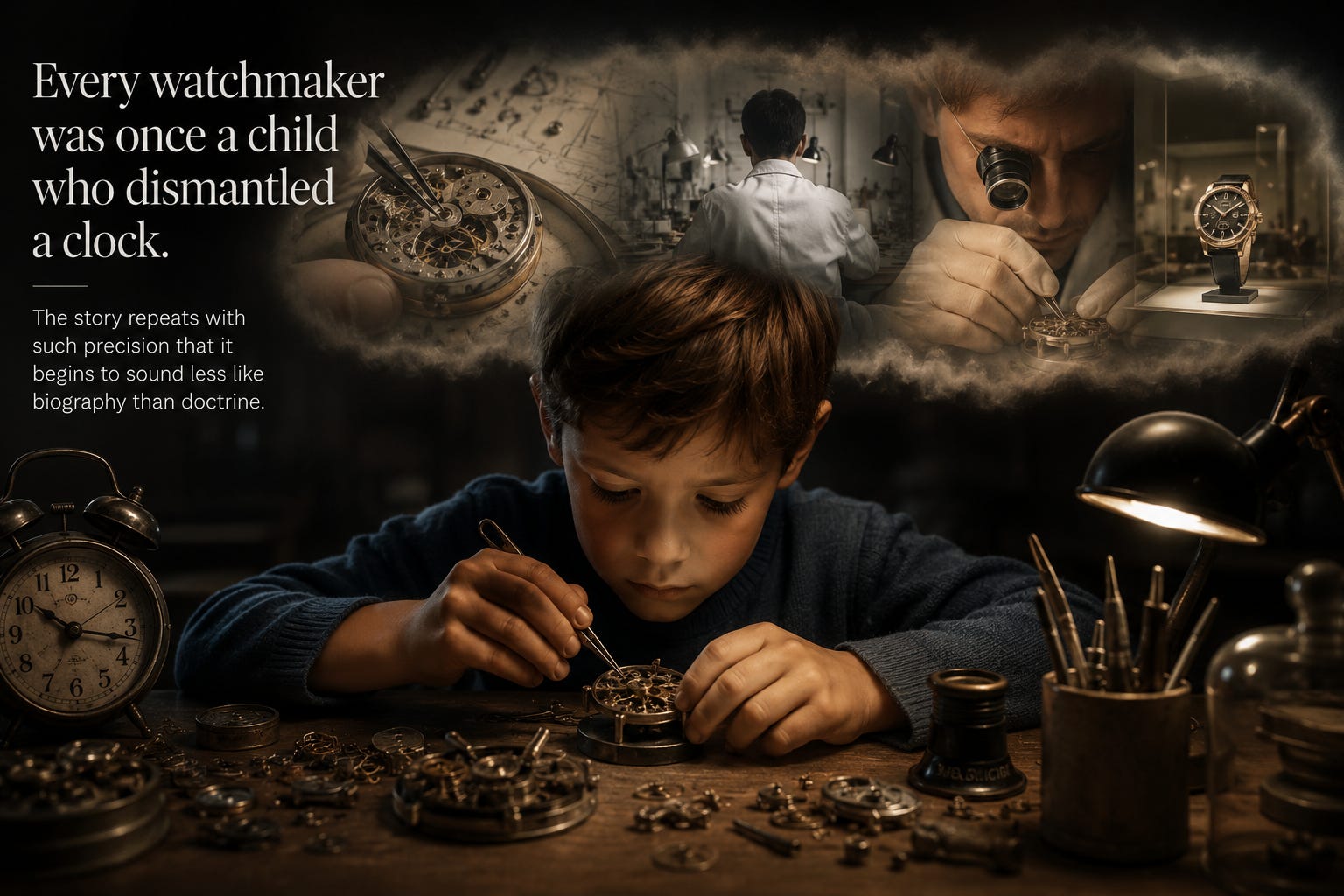
Every watchmaker was once a child who dismantled a clock. The story is always the same. That should tell us something.
It is one of the most remarkable coincidences in the history of skilled labour. Across continents and decades, an extraordinary number of watchmakers appear to have had the same childhood. A watch is encountered. The watch is dismantled. A vocation is declared, usually before the age at which most children have settled on a favourite colour. The details vary in minor ways — sometimes it is a grandfather’s pocket watch, sometimes a clock on a workshop wall, occasionally a wristwatch belonging to an indulgent parent — but the grammar is fixed. The child, we are told, was seized by fascination. The mechanism was laid bare. And from that moment, the path was set.
One reads these accounts with growing admiration. Not for the watchmakers, who are no doubt talented, but for the watches themselves — which seem to possess an almost supernatural capacity to identify future craftspeople while still in primary school. If the stories are to be believed, the Swiss movement is not merely a feat of engineering but a diagnostic instrument: expose it to the right child and it will reveal a destiny. One wonders whether the industry has considered marketing this feature.
The structure of these narratives is not, in fact, biographical. It is hagiographic. The lives of saints, as compiled by medieval chroniclers, follow a precise grammar: the child displays early and unmistakable signs of election; the calling is recognised, often against worldly resistance; mastery follows as the fulfilment of what was always ordained. The watchmaker origin story maps onto this template with an exactness that should give us pause. The fifteen-year-old who “announces” a decision to enter watchmaking is not, in the telling, making a career choice. She is answering a summons. The vocabulary is devotional even when the writer does not intend it to be: vocation, calling, passion, dedication. These are words borrowed from the cloister, not the workshop.
It is worth noting that Silicon Valley — a culture the Swiss watch industry would be mortified to resemble — relies on precisely the same narrative device. The founder built a computer in a garage at fourteen. The entrepreneur dropped out of university because conventional education could not contain the vision. The structure is identical: genius is innate, institutions merely ratify what nature has already decided. Cupertino and La Chaux-de-Fonds, it turns out, share a screenwriter.
The difficulty with destiny narratives is not that they are flattering. It is that they are, on careful inspection, quietly insulting to the very people they claim to celebrate. Follow the logic. If the child was always going to become a watchmaker — if the encounter with the mechanism was a moment of recognition rather than the beginning of a long education — then what, precisely, is the value of training? If mastery is innate, the apprenticeship is merely ceremony. The years spent learning to regulate a balance spring, to finish a surface to a tolerance invisible to the naked eye, to hold a screwdriver with the particular steadiness that separates competence from artistry — all of this becomes confirmation of a foregone conclusion rather than the hard, acquired, genuinely impressive thing that it is.
This is the paradox the origin story creates and cannot resolve. The watch industry’s most cherished narrative about its own people is one that systematically devalues the process by which those people actually became skilled. It replaces curriculum with destiny, pedagogy with prophecy, and the specific, documentable excellence of training — the thing that distinguishes Swiss watchmaking from a thousand other craft traditions that did not survive industrialisation — with a sentimental anecdote about a child and a screwdriver. The industry tells this story because it believes it is honouring its craftspeople. It is, instead, erasing the craft.
And of course, what the origin story also erases is circumstance. Not every child who dismantles a watch grows up within reach of the École d’Horlogerie. Not every teenager who announces a vocation has a parent employed in the trade, or a family that can sustain an apprenticeship, or the geographical fortune of being born in the Jura Arc rather than, say, in a Portuguese village where watch components are assembled under contract but where the mythology of the master watchmaker does not apply. The hagiographic mode has no room for these considerations. Saints are not produced by postal codes.
The reason the story persists is not mysterious. It persists because it is useful. A watch assembled by someone who was destined to assemble it carries a different commercial charge than a watch assembled by someone who completed a rigorous technical education and happens to be very good at her job. Destiny is a luxury-goods narrative. Competence is not. We prefer, in the end, the Mozart of popular imagination — the child who simply was music — over the Mozart of historical record: a boy subjected to one of the most intensive and systematically documented pedagogical programmes in eighteenth-century Europe, by a father who understood exactly what he was building and how long it would take. The watch industry has made its choice. It prefers the version where the gift was always there. It is a beautiful story. It is also, on the evidence, a way of not talking about what actually matters.
About the Author
Swiss-based independent writer specialising in the luxury watch industry. Editor of WatchDossier, a publication exploring the cultural and philosophical undercurrents of contemporary horology, and author of the book Against the Grain: A Cultural History of Swiss Independent Watchmaking.
No compensation or brand affiliation influenced this essay. Opinions are the author’s own.
Subscribe watchdossier.ch to receive more insights on luxury, craftsmanship, and collecting.


