


By five o’clock the house had taken on the silence of a place that no longer expected anyone to return. Marco had been there since morning.
The rain had begun before noon and had not let up since. Up here, under the roof, it was something heard rather than seen: a fine, ceaseless ticking on the windows, a duller drumming on the roof overhead, and from the avenue below the long wet hiss of tyres, swelling as each car approached and fading softly away.
Death, he had found, did not empty a room all at once. Every object became a question with four answers. Keep. Give away. Throw out. Ask someone.
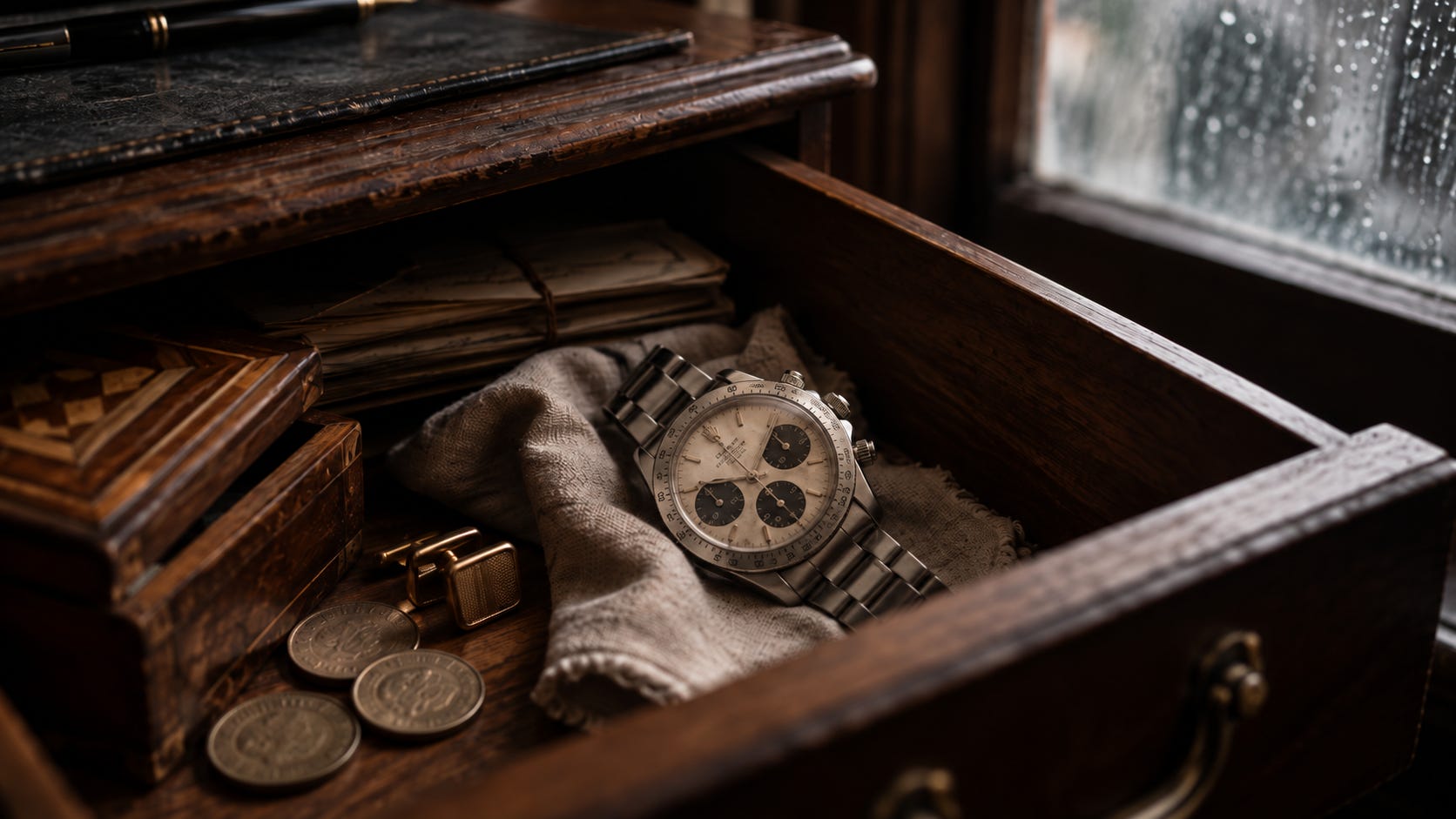
His grandfather’s bedroom was almost anonymous now. Marco sat down in the old armchair drawn up to the desk and let his eyes travel round it: the stripped bed, the wardrobe standing open with empty hangers, the shelves bare, the wood beneath the books showing cleaner against the dust around it, the cardboard boxes by the door, labelled in his own hand. A pale rectangle marked the wallpaper where the wedding photograph had hung for decades. Only the desk was as it had always been — dark walnut, heavy, the brass handles polished smooth by use. His grandfather had owned it for as long as Marco could remember, and had bought furniture the way he bought coats: rarely, carefully, expecting it to outlast him.
In the middle of it lay the leather writing pad, dark brown, worn paler along the near edge. Marco realised he had been staring at it. He drew his fingertips slowly across it; the leather was cool and very smooth. He remembered Sunday afternoons: the door opening a few inches, his own head put round it to say hello, his grandfather looking up from his writing, in this same chair, and smiling. He took his hand away.
The first two drawers gave up old letters and postcards in brittle elastic bands, writing paper, two fountain pens, a dried bottle of ink. The third stuck, shifted with a dull metallic sound, and opened only a few centimetres. Marco slid his hand into the gap and found the cause: a small wooden box with an inlaid lid, sprung half open and wedged against the drawer frame above. He pressed the lid down, and the drawer came out freely.
He lifted the lid. Three old Italian coins. A pair of cufflinks with the gold rubbed from their edges. And, a watch wrapped up inside a polishing cloth.
There was nothing ceremonial in the way it had been put away. No box of its own. No pouch. No papers. It lay face up, the bracelet folded under the case, as though a man had taken it off one evening and meant to come back to it.
It was smaller than he expected, and heavier — steel, the bracelet loose from use, the crystal a dense web of fine scratches that whitened when he tilted it to the window. Beneath them, a silver dial. Three black counters. A steel bezel engraved with numbers. At twelve, the coronet, and under it:
ROLEX.
And beneath that, smaller:
COSMOGRAPH.
The word seemed to belong to another age — scientific, optimistic, the name of an instrument from a time when machines were given titles that promised flight and orbit. He had seen it somewhere, a shop window, an article, and could not place it. He turned the watch over. The back was plain. He looked at the dial again. ROLEX. COSMOGRAPH. Nothing else. He took two photographs and sent them to Andrea.
The telephone rang in under a minute.
He had known Andrea since university, knew old watches, and had the irritating habit of remembering details other people never noticed in the first place. He disliked the word collector. He said he was interested in watches that had acquired lives.
His first question was not the one Marco expected. He did not ask whether it ran. He did not ask what it was worth. He asked where it had been found.
Marco told him.
A box? No. Papers? No. Another bracelet? No. Had he cleaned it? No. Wound it? No. Pressed the pushers? No. Taken off the bracelet? No.
There was a pause. Then Andrea told him to do none of those things. Not to clean the case. Not to wind it. Not to touch the crystal. And, particularly, not to try to remove the bracelet. He would rather see it exactly as it was.
Nothing in his voice suggested excitement. That was what made Marco uneasy.
He went back to the desk and searched it differently. An hour earlier the receipts had been refuse; now the dates mattered, and the cities. An old passport, several American entry stamps, a Pan Am luggage label. A business card from Geneva, another from a machinery firm in New York. And, caught behind the runners at the back of the drawer, a photograph.
His grandfather stood at the window of an airport terminal, perhaps thirty-five, the suit narrow, the tie narrow, the expression of a man unused to being photographed. Behind the glass, the tail of an aircraft. On his left wrist, something metallic — a dark circle, a flash of steel. It might have been the watch. It might have been any watch in the world.
By half past six the light had gone. Marco wrapped the chronograph in the same handkerchief he had found it in and drove across town through the rain.
Andrea lived in an apartment that always seemed a little too full — books on the shelves and then on the floor beside them, auction catalogues under a side table, a brass microscope by the window, wooden cases of tools where other people kept ornaments. He cleared the dining table without asking and laid a square of dark felt under a green-shaded lamp. Only then did he let Marco unwrap the watch.
Under the stronger light it looked worse, not better. The crystal was a dense weather of scratches; the case edges were soft with wear; dirt was packed where the bracelet met the steel. Whatever glamour Marco had built onto it on the drive did not survive the lamp.
Andrea did not begin with the dial. He did not look at the word COSMOGRAPH, or at the bezel, or at the three counters. He began with the bracelet.
He chose a tool, worked carefully at the upper end link, and drew it clear of the case. The exposed steel between the upper lugs was packed with a crescent of compacted grime. With a sharpened wooden peg he loosened it slowly, taking care not to score the metal. Little by little, the first traces of engraving emerged from beneath the dirt. Andrea bent closer, lowered the loupe to his eye, and read. He did not whistle, or sit back, or say anything. He simply went still — the particular stillness, Marco would think afterwards, of a man revising everything in front of him at once.
“Between the upper lugs,” he said at last, “Rolex cuts the reference. Above it, here — registered design.” He set the loupe down. “The number is a claim. It isn’t proof.”
Marco asked what he meant.
“A number is easy to cut into steel. What’s hard is for the rest of the watch to deserve it. Cases lose their dials. Bezels get swapped. Parts drift apart across fifty years and someone marries them back together because he wants them to add up.” He looked up. “So I don’t trust the number. I make the watch agree with it, or I catch it lying.”
That was the moment the evening changed. Marco stopped seeing an old chronograph on a square of felt and began to see something on trial.
Andrea began checking the watch against the reference, detail by detail.
The bezel first. His eye ran up the tachymetric scale cut into the steel — 225, 250, 275, on to 300. “There were three versions of this bezel,” he said. “The earliest ran to three hundred and included all three intermediate marks — two-twenty-five, two-fifty and two-seventy-five. The next still ran to three hundred, but dropped the two-seventy-five. The last stopped at two hundred.”
He looked again at the watch.
“This is the earliest version.”
He did not sound pleased. He sounded like a man crossing off one of the ways the watch might have lied to him.
The pushers next — how they entered the case, and what was not there. No screwed collars, only plain push-down buttons. “Right for the period. The screwed pushers come later. Collars here and we would be finished already.”
The crown. The domed plastic crystal, its scratches now a point in the watch’s favour. The case itself, some thirty-six millimetres across, the back worn smooth. He turned it on its side and ran a thumbnail along the flank beside the crown. “Rounded here, the old way. From about 1966 they reshaped this — made the curve by the crown more convex, apparently to make the case easier to open. This is the earlier profile.” Another year came off the far end of the estimate. He brought the engraved figures back under the loupe and looked not at their shape but at their unevenness, the strokes wandering a fraction out of true.
“Good,” he murmured.
It looked crooked, Marco said.
“It should. They cut these by hand, on a pantograph that shook a little. The wobble is period. It is the clean ones you worry about.”
One by one the parts agreed. Nothing on the outside of the watch belonged to a later decade than any other part of it; it was of a piece. And each time a part agreed the room grew tighter rather than easier, because Andrea did not relax. He was working toward the one place a watch like this could still betray itself.
The dial came last.
He laid the case almost flat under the lamp. The black counters sat a fraction below the silver field, ringed with fine concentric lines — running seconds at nine, minutes at three, hours at six — the applied markers throwing back small points where their facets caught the light, a little tritium still ghosting at their ends. The architecture was right. He said so, quietly. And it was the plain silver dial, he added — not the exotic printing that a decade later would make watches like it absurd at auction; only the ordinary early face.
Then he stopped.
He moved the lamp nearer, then away, tilted the watch, looked again; and for the first time that evening something like doubt came into his face.
Marco followed his eyes to the top of the dial.
ROLEX.
COSMOGRAPH.
And beneath that, nothing.
He had seen it from the first — there had never been anything else there — but the empty space under the second word seemed suddenly to mean something it had not. Everything outside the watch had sworn to one story. The dial, at the last, appeared to contradict it: a watch claiming this reference, and the one name the whole world fastened to it simply absent.
“That’s wrong,” Marco said. “The name should be there.”
Andrea did not answer at once. He looked at the emptiness under COSMOGRAPH the way he had looked at the number under the dirt. “Sometimes an absence tells you more than an inscription.”
Then he set the watch down and explained.
The earliest of these dials carried the one word only. The famous name was added later, toward the middle of the decade — tucked first beneath COSMOGRAPH at twelve, afterwards curved above the counter at six. It grew out of Rolex’s association with motor racing in the United States and, once that association had acquired meaning, found its way onto the dial. When this watch was made, the name was not there because it had not yet become part of the watch’s identity. The reference came first. The name followed.
So the thing that seemed to convict the watch was what cleared it. A forger building a legend from married parts would have put the legend on the dial; that was the whole point of the exercise. Only an early, honest example would be missing the very word that made it valuable — and be missing it correctly. The absence was the one signature that could not be counterfeited, because you had to know the name came second to know that it belonged nowhere on the dial.
Everything else had merely agreed with the number. The empty space under COSMOGRAPH was the only witness that proved it.
There was one more thing, Andrea said, almost in passing. Europe had not put the model in its catalogues until sixty-four; in America it had been on sale a year before. A man who owned one this early, in Europe, had most likely carried it back across an ocean.
Marco thought of the Pan Am label at the back of the drawer, the American stamps in the passport, the card from the machinery firm in New York.
Andrea returned the watch to the felt and, for the first time, seemed done with it. Outside, a car went along the wet street; its lights crossed the ceiling and were gone. The coffee had gone cold between them.
The watch had not changed. It was still a small, scratched steel chronograph that a man had taken off one evening and set in a drawer beneath a handkerchief and three foreign coins. They knew now exactly what it was, and nothing at all about why it had been there. Why he had stopped wearing it. Why he had buried it in a polishing cloth. Why he had kept no box, no paper, no word to anyone.
The number between the lugs answered what the watch was and none of the rest.
Back home Marco looked once more at the photograph — the young man at the terminal window, the narrow suit, the dark circle at his wrist that might have been anything at all. He had thought, that morning, that he was clearing out his grandfather. He saw now that he had never entirely known him, and that the drawer had settled nothing.
He looked back at the dial, at the empty space beneath the second word, where in a year or two the factory would have printed the name the whole world had since agreed to remember — the name this watch had been made too early to carry, and the old man, for fifty years, had never once explained.
Daytona.
Reference note — Cosmograph ref. 6239
The reference ran from about 1963 to 1969, evolved from the earlier ref. 6238, and was produced in stainless steel, 14-carat and 18-carat gold. It carried manually wound Valjoux calibres over its life: the cal. 72 B (c. 1963–65), the 722 (c. 1965–67), and finally the 722-1 (to c. 1969) — the last built on the 72 A base and engraved on the chronograph bridge in two- or five-line versions, though never listed as such in Rolex’s R20 catalogues. European catalogues showed the model from 1964; it is presumed to have been on sale in the United States a year earlier.
The bezel carried an engraved tachymetric scale in three successive forms: a first running to 300 units with intermediate marks at 225, 250 and 275; a second, still to 300, dropping the 275; and a last graduated only to 200. The dial came in two colourways — silver with black registers, or black with white or silver registers — with three counters (running seconds at nine, minute totaliser at three, hour totaliser at six). The earliest dials carried the COSMOGRAPH signature alone; DAYTONA was added around 1965, first beneath COSMOGRAPH at twelve, later along the hour-totaliser curve at six. The celebrated “Paul Newman” or exotic dial, with its stepped registers and red detailing, was a later variant.
The Oyster case measured roughly 36 mm across, 19 mm between the lugs, with an Oyster Twinlock 600-series crown, push-down (pump) pushers and a domed plexiglas crystal. The reference was engraved between the upper lugs, usually with REGISTERED DESIGN above it, and the serial between the lower lugs; hand engraving on a pantograph accounts for the small irregularities. Early cases followed the rounded profile of the 6238; from about 1966 the curve by the crown was made more convex. The caseback, punched MONTRES ROLEX S.A. / GENEVA / SWITZERLAND / PATENTED / STAINLESS STEEL, also bears the initials C.R.S., for its maker, Charles René Spielman. The bracelet was the folded-link ref. 7835, with 19 mm curved end links.
About the Author
Sergio Galanti is the founder and editor of WatchDossier, contributor to Italian and international watch publications, the author of Against the Grain: A Cultural History of Swiss Independent Watchmaking, and advisor to private collectors.
No compensation or brand affiliation influenced this essay. Opinions are the author’s own.
Subscribe to watchdossier.ch to receive more insights on luxury, craftsmanship, and collecting.