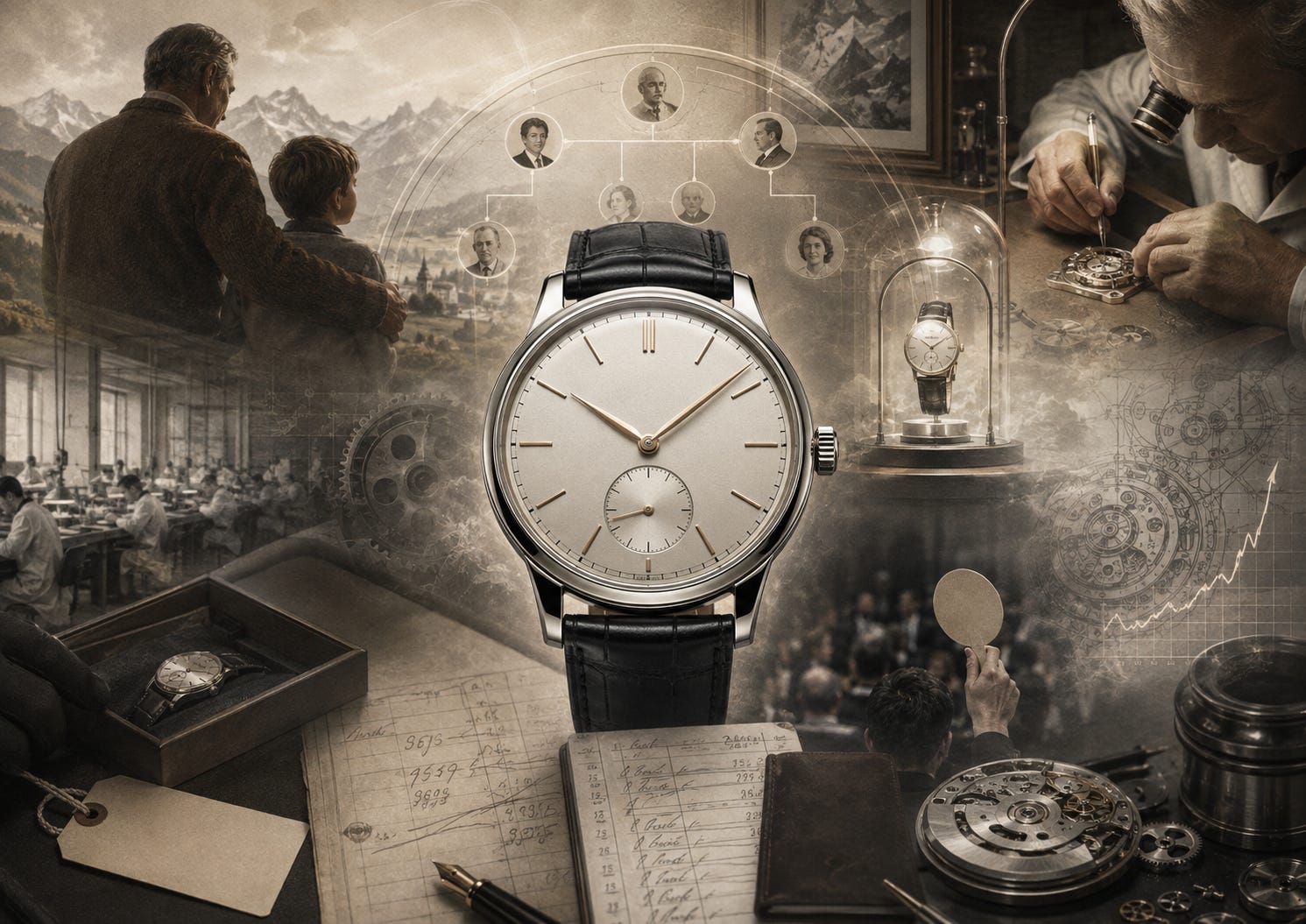
Every watch magazine runs the advertisement eventually. A father, a solemn boy, expensive light. Beneath them, the line the whole trade can recite from memory: you never actually own a Patek Philippe, you merely look after it for the next generation.
It rewards slowing down. On the surface it disclaims — do not think of this as yours — and the modesty is the trick. It takes an object you bought, at a counter, for a sum, on an ordinary afternoon, and quietly removes the counter, the sum and the afternoon. Purchase becomes custody. Transaction becomes inheritance. The watch leaves the world of things that are made and priced and sold, and enters a softer time — of lineage, of stewardship, of objects that were always simply there, passing through your hands on the way to someone else’s. You did not buy it. You were entrusted with it. The price, which was considerable, has left the room.
None of this is Patek’s invention. In 1957 a French critic collected a run of short pieces — on a wrestling match, a plate of steak and chips, the new Citroën, the wording on a box of soap-powder — and called them Mythologies. The method was simple to state and difficult to unsee. Take the images a culture treats as obvious, and show that nothing about them is obvious at all. Beneath each he found the same sleight of hand: something historical and made, presented as something natural and given. Myth, he decided, is how a culture forgets that its values were ever chosen. The critic was Roland Barthes, and once you borrow his eye you cannot give it back.
Start where he would, with the sign. A watch denotes one thing — it tells the time. Everything stacked above that is what it is made to say: permanence, taste, arrival, membership, the composure of a man who need not reach for his phone. Barthes called that upper storey myth. A sign that has swallowed its first meaning and now speaks a second, while pretending to speak only the first.
And the wristwatch is his purest specimen — the one he never got to. In the age of the phone the first meaning has drained away almost entirely. Nobody buys a Swiss mechanical watch to find out what time it is. What is left is very nearly pure connotation: an object that has eaten its own function and lives, quite comfortably, on meaning alone.
Once you see the move you see it everywhere in the vitrine, and it always runs the same way. Something contingent — a decision, a percentage, a marketing budget, an accident of history — is emptied of its particular past and refilled with an essence, while the form stays innocently intact. History in; nature out. The vitrine has four favourites.
Swiss Made. Two words that taste of alpine air and Protestant patience, of cold light and steady hands. They are, in law, an accountancy: a minimum share of manufacturing value accrued inside a border. A customs threshold, transubstantiated into a spiritual climate. Barthes did the same trick to a glass of wine, in which he found the whole of France persuading itself of its own nature.
Heritage. Since 18—. An unbroken descent from founder to boutique, one bloodline of craft. Left out of the family portrait is the decade when quartz nearly buried the entire trade and mechanical watchmaking lay in something close to a coma. The rupture is emptied out. The form — lineage — stays whole, and the near-death is reread, gently, as continuity.
In-house. Manufacture. The vocabulary of depth: everything made under one roof, nothing bought in. It is the register Barthes heard in soap-powder advertising — the promise of a substance more profound than the surface, purity set against mere assembly. That the movement blank may still arrive from a supplier shared with three competitors is precisely what the word exists to cover.
And the photograph inside all of them: the watchmaker at the bench, loupe screwed into one eye, tweezers above a jewel. This is the industry’s version of what Barthes called ornamental cookery — the still life that takes a divided, mechanised, heavily feminised industrial labour and reduces it to a single male hand, alone against time. The factory, dressed as the artisan.
All of it converges on one myth that only the watch can tell, because only the watch is made of the same material as its promise. Every other luxury object signifies status. The watch signifies time — and then proposes, very quietly, to defeat it. An instrument built to measure our finitude, sold as a token of exemption from it. Which is why the Patek line is the masterpiece of the genre. It does not sell you a watch. It sells you a place in a sequence that death does not interrupt: the next generation, and the one behind it, receiving the object the way they receive a surname. The machine that counts down your hours, offered as proof they will not run out.
Here Barthes begins to strain, and it would be dishonest not to say so. His myth was democratic in its reach — a middle-class worldview dressed as common sense and handed to everyone, an image consumed by millions who would never sit in the Citroën. The luxury watch runs the opposite way. It does not universalise; it separates. Its entire function is distinction — to set the owner apart from the crowd, and lately to set the man who was allocated the watch apart from the man still on the list. Barthes’ myth asked nothing of your bank account; it only asked you to nod. This one asks for both, and then keeps score. Where the soap-powder was an image, the watch is genuinely, expensively owned — worn on a real wrist, flipped for a real profit. Scarcity and price are not smuggled around the sign. They are the sign. For that half of the story Barthes needs company: a little Bourdieu,[^1] for whom taste is always a quiet instrument of class; a little Baudrillard,[^2] for whom the object had already become a pure token trading against other tokens. The watch is not merely naturalised. It is ranked, priced, and speculated upon — and the ranking is half the pleasure.
Still, Barthes keeps the last word, because he described the closing move before anyone else. Myth abolishes contradiction; it makes a manufactured value appear to rise from the object itself, the way scent seems to rise from a flower. The waitlist that is partly engineered, the auction result that is partly theatre, the grail a whole culture has agreed in advance to want — all of it settles into the object as though it had always lived there, as though desire were simply a property of the steel. To read the watch as myth is not to sneer at it. It is only to return what the myth removed: the hands, the budgets, the finance, and the sheer accident by which this object, and not some other, became the one we agreed to call timeless.
[^1]: Pierre Bourdieu (1930–2002), French sociologist. His Distinction argued that taste is never innocent: what we find beautiful, or vulgar, quietly maps the class we come from and the one we would like to be taken for.
[^2]: Jean Baudrillard (1929–2007), French theorist. He held that the modern object had stopped being something we merely use and become a sign — its worth set less by what it does than by its position against every other sign in the system.
About the Author
Sergio Galanti is a Swiss-based independent writer specialising in the luxury watch industry, and an advisor to private collectors and investors. He is the editor of WatchDossier (watchdossier.ch), a publication exploring the cultural and philosophical undercurrents of contemporary horology, and the author of Against the Grain: A Cultural History of Swiss Independent Watchmaking.
No compensation or brand affiliation influenced this essay. Opinions are the author’s own.
Subscribe to watchdossier.ch to receive more insights on luxury, craftsmanship, and collecting.


