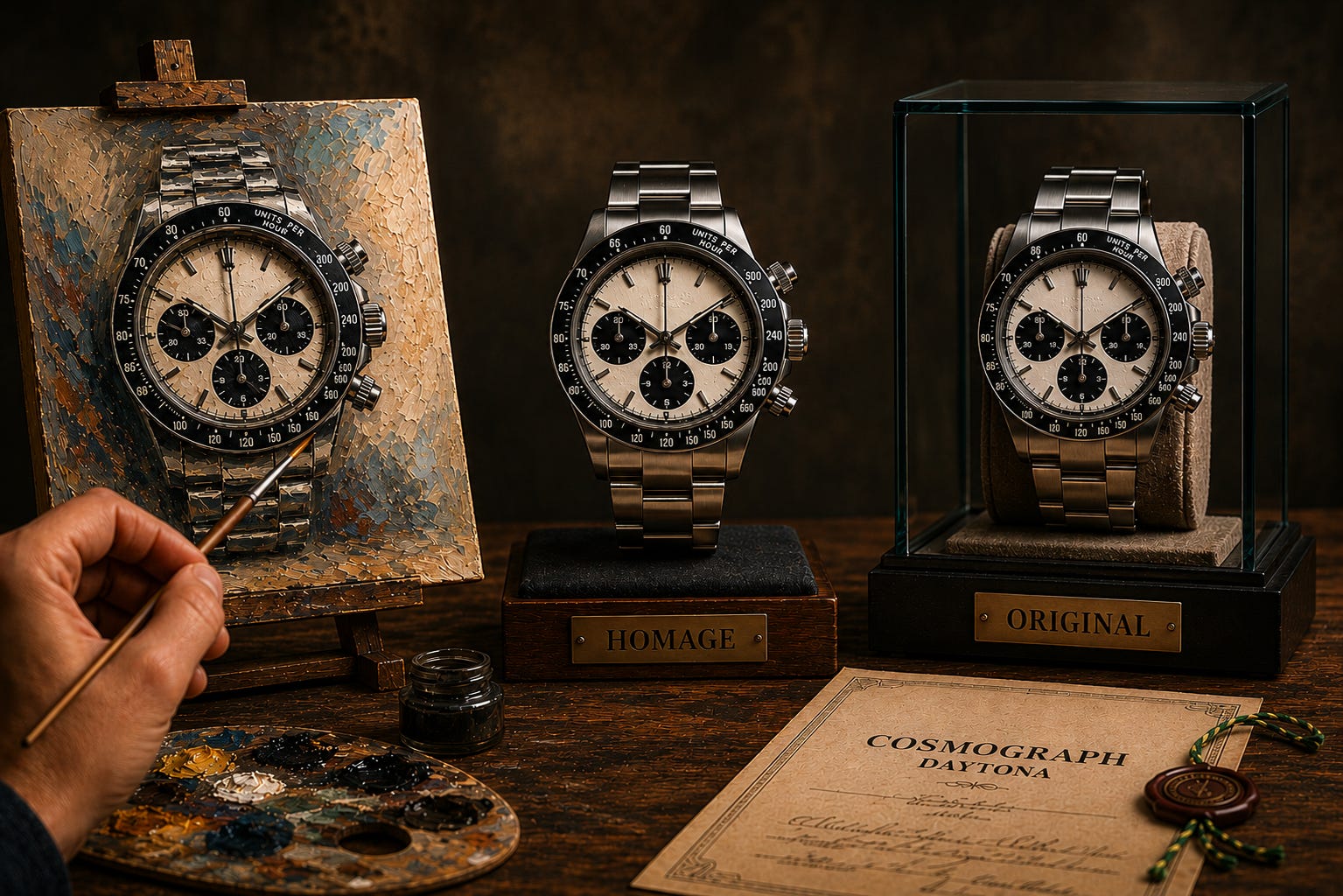
The Painter's Bed
A homage reproduces the Daytona’s design with increasing precision, yet still fails to transfer desire—revealing that collectors were never really buying the watch itself.
There are fourteen watches on the table in front of me. I am at a micro-brand fair in Milan, one of those events that occupy the borderland between entrepreneurial optimism and quiet homage. Every watch on this table has a tri-compax dial. Every one has a tachymeter bezel. The proportions are familiar in the way a cover version of a song is familiar — you recognise the melody before you identify the performer. These are not counterfeits. They are not trying to deceive. They are simply trying to be the thing they cannot be.
The prices are reasonable. Some of the finishing is surprisingly good. One piece in particular, with a panda dial and a domed crystal, catches my eye long enough that I pick it up. It feels fine. It looks, at a glance, like a Daytona. And I put it back down with the same indifference you feel when you return a postcard of a painting to the rack. The image was accurate. The experience was not.
The economics of this phenomenon are not interesting. Rolex produces fewer Daytonas than the market demands. Other manufacturers fill the gap at accessible prices. Supply, demand, arbitrage. This explains why homages exist. It does not explain why they fail — not commercially, because many of them sell perfectly well, but existentially. Almost nobody bonds with their homage the way a collector bonds with a Daytona. The form is reproduced. The desire is not transferred. And that gap between successful reproduction and failed transference is where the interesting question lives.
What does a homage actually replicate? The layout, the bezel, the case proportions, sometimes the colour palette down to the specific shade of ceramic black. What it strips away is everything else: the name, the six decades of mythology, the Paul Newman origin story, the waiting list, the social jolt of recognition when a stranger across a restaurant notices your wrist. What remains is the design, isolated. Naked. And the fact that the naked design does not generate the same longing tells us something the watch industry would prefer not to hear. The design was never the point. Or rather — the design was necessary, but it was never sufficient. We were buying something else all along.
Plato would have understood the problem immediately. In the Republic, he describes a hierarchy of reality: the ideal form of a bed, the carpenter’s bed that copies it, and the painter’s image of the bed — three removes from the truth. The Daytona homage is the painter’s bed. But here is the complication that Plato did not anticipate: the Daytona itself is already a cultural construction. Layers of narrative, scarcity, manufactured mythology, accumulated social meaning — all built over a physical object that, in 1963, dealers could not give away. The homage does not imitate the watch. It imitates the idea of the watch. And in doing so, it reveals that the idea was always what we were purchasing. The steel, the crystal, the movement — these were the delivery mechanism. The product was the myth.
René Girard saw this more clearly than anyone. Desire, he argued, is not a straight line between a subject and an object. It is a triangle: you, the thing you want, and the other person whose desire for that thing authorises your own. We do not want the Daytona because we have independently assessed its design merits. We want it because other people want it, and their wanting gives it meaning. The homage buyer is still inside this triangle. Their desire does not point at the copy. It points through the copy, toward the Daytona, toward the community of desire that surrounds it. Every homage sold is a confirmation that the original’s gravitational field remains unbroken. The more imitations proliferate, the more powerful the Daytona becomes. Imitation, it turns out, is not flattery. It is an involuntary tribute.
Walter Benjamin called it the aura — the quality an original possesses by virtue of its singular existence in time and space, its accumulation of history and presence that no reproduction can carry. The homage reproduces the Daytona’s surfaces with increasing accuracy. It cannot reproduce the weight of a sixty-year mythology. It cannot reproduce the moment Joanne Woodward allegedly gave her husband that watch. It cannot reproduce the theatre of the authorised dealer visit, the whispered spending requirements, the months of waiting that transform a purchase into an initiation. The aura stays with the original. The copy gets the case diameter.
I pick up the panda-dial piece one more time before I leave the table. It is well made. It keeps good time. It looks, in a photograph, almost indistinguishable from the reference it honours. And it proves, more eloquently than any collector’s essay or auction catalogue, that what we want when we want a Daytona has almost nothing to do with the watch.
That is not an insult to the Daytona. It may be the highest compliment the market has ever paid to it.
About the Author
Sergio Galanti is a Swiss-based independent writer specialising in the luxury watch industry, and an advisor to private collectors and investors. He is the editor of WatchDossier (watchdossier.ch), a publication exploring the cultural and philosophical undercurrents of contemporary horology, and the author of Against the Grain: A Cultural History of Swiss Independent Watchmaking.
No compensation or brand affiliation influenced this essay. Opinions are the author’s own.
Subscribe to watchdossier.ch to receive more insights on luxury, craftsmanship, and collecting.


