


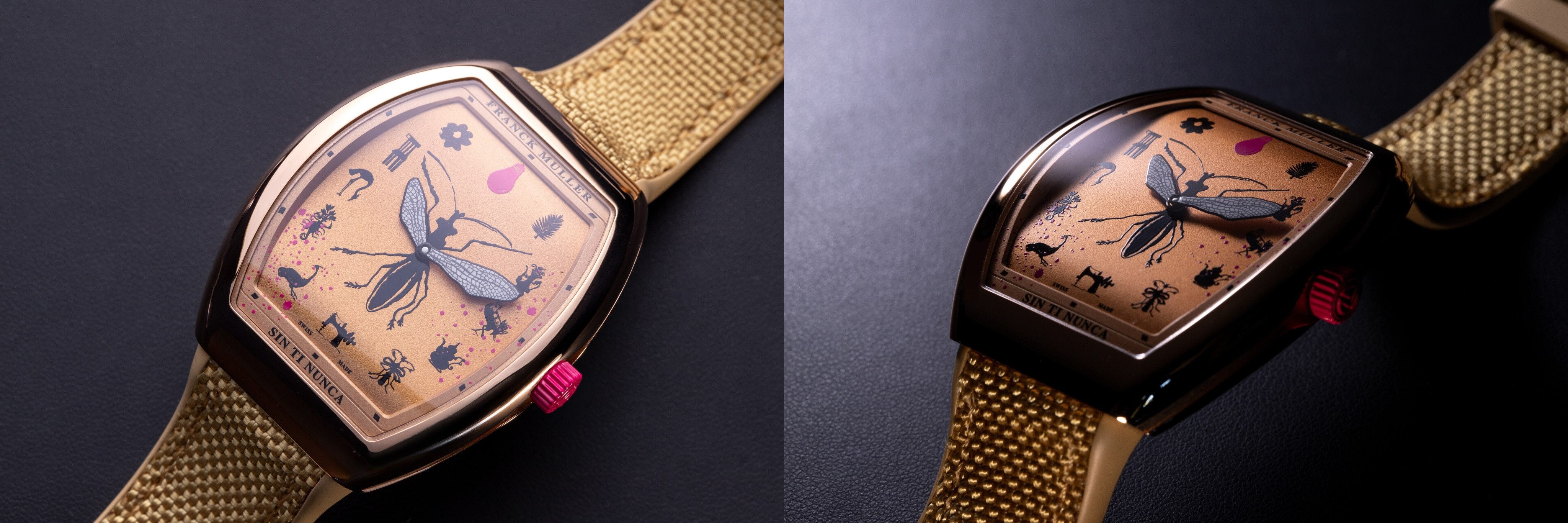
The St. Regis on Paseo de la Reforma does not look like a frontier, and in late October it was not meant to. For three days, from 20 to 22 October, the twentieth Salón Internacional Alta Relojería filled its salons with vitrines and consular handshakes. SIAR’s founder, Carlos Alonso, marked the anniversary with a short history: when the salon began in 2007, fine watchmaking reached Mexico a few drops at a time; now the country counts among the liveliest markets anywhere. The house custom is that visiting brands bring something dedicated to the host. Hautlence brought a Mexico edition of its Sphere. Franck Muller brought a painter.
The watch is the Vanguard Slim Amador Montes, a limited edition of sixty. The release itemises forty of them, thirty in steel and ten in rose gold, all 41 mm; the remaining twenty appear only on the brand’s website, as 35 mm versions in the same two metals. The brand’s release calls the collaboration The Art of Time. It does not mention that The Art of Time already had a first chapter. A year ago the same programme, developed with the Raconli Group, Franck Muller’s exclusive partner in Mexico, produced the Vanguard Alquimiamc with the sculptor Marcos Cojab: fifteen bronze pieces, sold only in Mexico. The partner does the cultural brokering. The release does the bowing.
Read it closely and one sentence carries the whole arrangement. The result, it says, “preserves the identity of the Vanguard” while introducing a concept developed for this edition.
Preserves. The artist is welcome; the case is not negotiable.
This is less a snub than a business model, and a candid one. Over the past decade the Vanguard has become Franck Muller’s passport: one curved tonneau, stamped country by country. This autumn alone it has carried Ram Lalla, the child form of Lord Ram, onto a rose-gold dial for India, 108 numbered pieces with Kapoor Watch Co. In Mexico it has worn the Rally Maya, this year, as it happens, in an edition of sixty. Southeast Asia and Australia received a streetwear Vanguard. Mexico, earlier, received one in the colours of the flag for its Grand Prix. Devotion. Motorsport. Sculpture. Painting. The case is the constant; the country is the variable. Very few watch houses have turned localisation into a product line so frankly, and fewer still have a shape distinctive enough to survive it.
What the shape stands on is another matter. The release closes with the house boilerplate, a roll of world premieres that ends on “the world’s most complex wristwatch ever made.” It names no watch, and it does not mean this one. The claim belongs to the Aeternitas Mega 4, and it was true in November 2009, when that watch and its thirty-six complications were delivered to their first owner in Monte Carlo. It stopped being true in the spring of 2025, when Vacheron Constantin’s Solaria arrived with forty-one. Boilerplate has no calendar. It keeps speaking of 2009 as if it were today, and it now lends that borrowed present to a slim, time-only watch whose ambitions lie on the dial.
So look at the dial.
Tilt the 41 mm rose-gold version under a gallery spotlight and the camel surface refuses to shine. It is micro-blasted, matte as unglazed clay, and the light settles into it rather than sliding off. Around the edge, Montes has drawn a ring of small black glyphs, a bestiary in shorthand, while a single pink teardrop hangs at twelve like a drop of ink not yet dried. At the centre sits the crane fly. Its long legs splay toward the chapter ring; its wings are the hands. They sweep the hour and the minute across their own body, so that the insect seems forever about to take off and never quite leaving. Low on the dial, in serif capitals, three words: SIN TI NUNCA. Never without you. Along the flanks, caramel inserts interrupt the gold. The crown is pink, which no one will mistake for an accident. The strap disappears into the case on two hidden screws, and a second strap, pink to the first one’s camel, waits in a box Montes also designed. The case is 9.1 mm thin, and the pleasure of it is real: a bold shape made polite.
Inside, the release names the in-house FM 708, self-winding, 136 components, and says little else about it. Fair enough. Nobody buys this watch for the gear train.
They buy it, presumably, for the crane fly, and here Montes deserves more than the release’s tally of twenty-five years and 130 exhibitions. Born in Oaxaca in 1975, he trained in graphic design in Puebla before time spent with a neighbour, a sign painter, turned him to painting instead. The crane flies come from his childhood: rainy days, dirt streets, adobe houses, the long-legged insects of the wet season. He has called them a very important part of himself, and has installed them in a lake at Chapultepec’s botanical garden, there to stay. His El Muro has hung at the London School of Economics and at Exeter’s Royal Albert Memorial Museum; its sequel, El Otro Muro, about migration, went to Poland. He has also, in 2020, put his birds and flowers on the jersey of the Guerreros de Oaxaca baseball team. He is not a stranger to applied art. He is a stranger to being asked to preserve someone else’s identity.
The buyer, then, is a specific person. Not the horological collector, who already knows the Vanguard Slim and can buy it without an insect. The Montes client is someone who owns, or would like to own, a Montes canvas; who recognises the crane fly across a dinner table in Polanco; who wants Mexico’s own painter on a Geneva shape and finds in that pairing a kind of arrival. National recognition is worn on the wrist. The watch functions as a gallery multiple with a movement.
As an asset, the arithmetic is unsentimental. Whatever premium survives will live inside Montes’s collector base, not in the watch market, and it will move with his reputation rather than with Genthod’s. The durable return accrues elsewhere: to Raconli’s standing as cultural intermediary, to Franck Muller’s franchise in a market SIAR now calls one of the most dynamic in the world, and to a programme that can be renewed every October with a new name on the dial.
None of which spoils the object. It only explains it.
What remains is the image Montes chose. The crane fly does not get long in the air; as an adult it has a matter of days. Franck Muller has given it a steel shell, a self-winding heart and a numbered certificate, and set it to measure hours it will never see. Beneath it, the dial promises never without you, which is what every luxury object would say if it could speak, and what every limited edition quietly means: never without you, at least until the next one.
The insect does not object. It is busy turning.
About the Author
Sergio Galanti is the founder and editor of WatchDossier, contributor to Italian and international watch publications, and advisor to private collectors.
No compensation or brand affiliation influenced this essay. Opinions are the author’s own.
