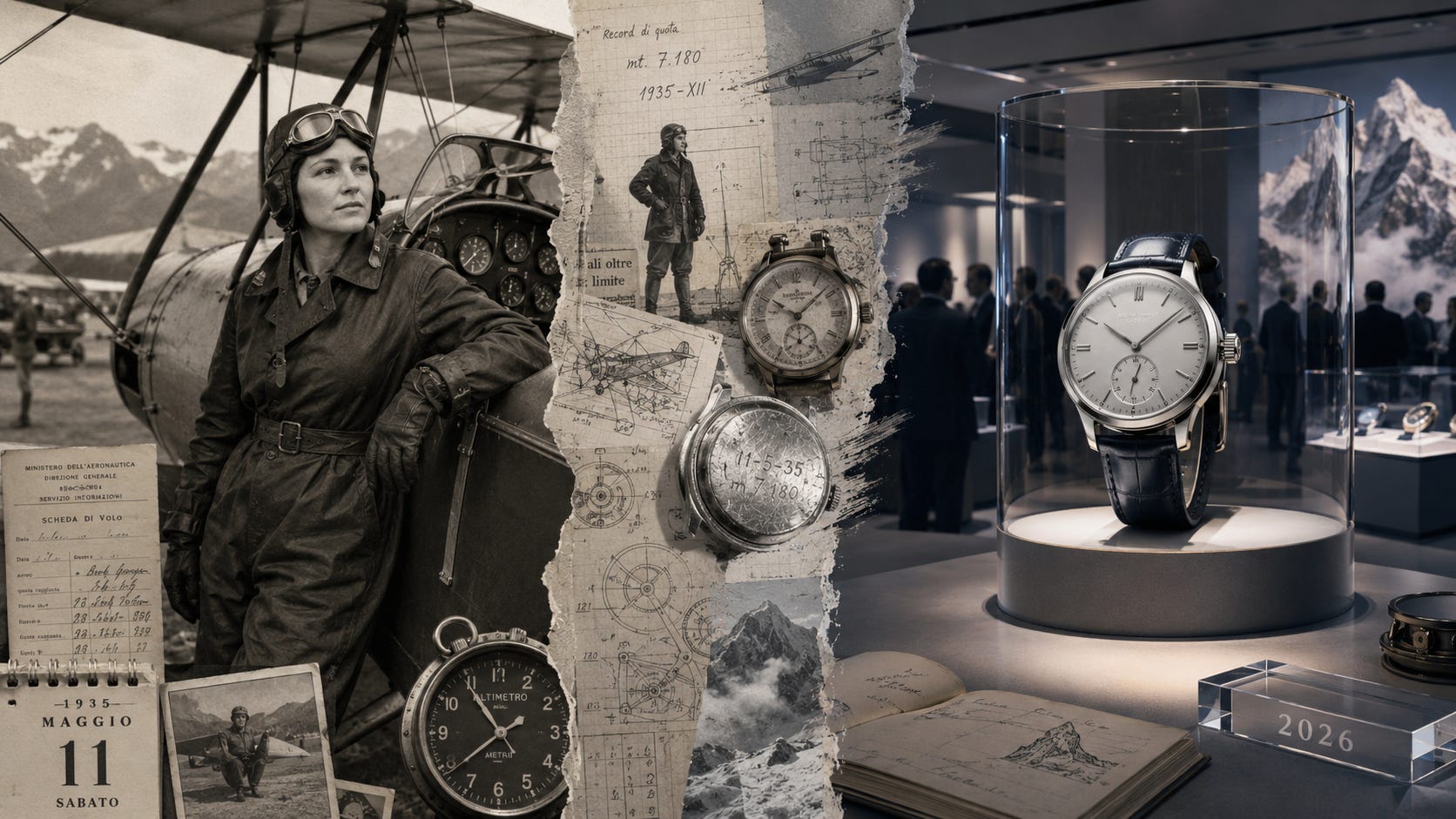
Somewhere in a July 2026 watch-magazine spread, across four pages, a woman flies a biplane to 12,043 metres and a watch company turns a hundred years old. The spread would like you to feel these as one fact. Learning to watch the seam between them — to see the join being made — is the single most useful thing a reader of this publication can acquire, because the technique on display is not Tudor’s. It belongs to nearly every heritage campaign you will ever read, and Roland Barthes laid out its machinery in Mythologies in 1957 — the same year, as it happens, that one of the two watches photographed here was made.
Begin with what is literally on the page. Carina Massone Negrone became the first Italian woman to hold a pilot’s licence in 1933. In 1934 she set a women’s altitude record of 5,554 metres; on 20 June 1935 she reached 12,043 metres in a modified Caproni Ca.113, using training then reserved for military pilots. She owned Tudor watches — a Submariner and an Advisor, the latter from a line the article dates to 1957. The watches passed to her grandchildren. Tudor was founded in 1926. In 2026 the brand made a short film, hosted an evening at a museum, and launched a centenary watch, the Monarch, at €5,460.
Each of those is what Barthes calls a sign: a marriage of image and meaning that any competent reader decodes without effort. A photograph of a steel watch means “a steel watch.” This is the first-order system, the plane of denotation, and it is honest. Nothing in the list above is false. Hold onto that, because the honesty is not incidental to what follows — it is the raw material.
Myth, in Barthes’s account, is a second-order system. It does not invent new signs; it feeds on completed ones. It takes a finished first-order sign — the watch, the record, the founding date — and demotes it to a mere form, a hollow vessel, then pours in a new concept. The steel watch stops meaning “a steel watch” and starts meaning “Tudor-was-there-for-the-greatness.” The result of that pouring Barthes calls the signification: the naturalised whole you swallow without noticing you have swallowed anything. Crucially, the form is emptied but not destroyed. Its literal meaning is left standing at the edge of the frame, alive, available — because the myth will need it later as an alibi.
You can watch the emptying happen because the article, helpfully, dates its own materials against itself. The heroism is 1933–35. The only watch it can put a year to is 1957. And the caption that describes Tudor’s identity concedes that the brand built that identity “since the fifties,” on robustness and precision. So by the article’s own accounting, the essence it wants present at the 1935 altitude record did not yet exist as an essence in 1935. Twenty years separate the courage from the character. That gap is not a flaw in the piece; it is the location of the machinery. The heading over the spread — that “the time kept by Tudor accompanies one of the most extraordinary pages of Italian aviation” — and the line that “in many of her exploits, [time] was marked by a Tudor watch” ask you to cross that gap without noticing it is there. The text never quite asserts that a Tudor was on her wrist at 12,043 metres. It juxtaposes, it personifies the watch as a “discreet, almost silent companion,” and it lets continuity framing carry you the rest of the way.
This is naturalisation, Barthes’s central charge, and his definition is exact: myth transforms history into nature. A contingent commercial arrangement — a brand, in its centenary year, deciding to attach itself to a dead aviator — is restaged as an eternal essence that merely happened to find its incarnation in her. The tell is grammatical, and once you see it you cannot unsee it. Watch for the agentless construction: “destinies destined to cross.” Whose decision crossed them? Tudor’s marketing department, in 2026. That agent is deleted and replaced by fate. Watch for essence verbs and continuity: “the same values that continue to define Tudor’s identity” — values posited as self-identical across a century, so that a new product and an old flight can be spoken of as one substance. Watch, above all, for ex-nomination, the erasure of a thing’s own name: a paid brand placement is renamed “a tribute,” and a product launch is dissolved into the passive — “a hundred years of history sublimated by the launch of the new Monarch” — as though no one launched it, as though history sublimated itself.
The single most elegant piece of myth in the spread is the scratch. “Every scratch on the case,” the text says, “tells a story of courage.” Denotatively a scratch is wear: knocks, decades, a watch kept in a drawer and taken out. The myth empties the scratch of its actual causes and refills it with courage, so that damage now reads as testimony. That is the whole operation performed on a single object, in one sentence — form hollowed, concept poured, signification served.
Perform the same subtraction on the larger frame and the erasure is graver. Record aviation in 1935 Italy was a state-instrumented arena; the military training the article mentions in passing sits inside that apparatus. The myth drains all of it and refills the vessel with brand-neutral “courage and vision.” History becomes nature; a specific, compromised, political history becomes a timeless quality you could bottle and sell.
And sell is the word, because the signification has a destination: the €5,460 Monarch. The completed myth transfers Negrone’s real defiance — of altitude, of gravity, of what a woman was permitted in 1930s Italy — onto a watch launched ninety years after her record, so that acquiring the object acquires a share of the defiance. She is kept at the edge of the frame throughout, close enough to guarantee the concept, far enough that no one has to ask what a 2026 steel watch has to do with 1935 beyond the line the myth has just drawn.
Here is the discipline, and it is the reason this reading is not a debunking. The watches were real. The heirlooms are real. The courage was real. Deny any of that and you lose, because the myth has kept those truths in reserve precisely so it can retreat to them when challenged — but she really did own Tudors. She did. Barthes’s point, and ours, is not that the piece lies. It is that the piece distorts: it takes things that are true and inflects them, naturalises a decision into an essence, and counts on your not asking who decided. The critic’s job is not to catch the lie. It is to name the naturalisation — to restore the human agent the passive voice deleted, and to mark the exact year the essence was invented.
About the Author
Swiss-based independent writer specialising in the luxury watch industry, consultant to private collectors and investors, and contributor to Italian and international watch publications. A Watch Expert certified by the FHH, he is the editor of WatchDossier (watchdossier.ch), a publication dedicated to the cultural and philosophical trends in contemporary watchmaking. He is the author of Against the Grain: A Cultural History of Swiss Independent Watchmaking.
No compensation or brand affiliation influenced this essay. Opinions are the author’s own.
Subscribe to watchdossier.ch to receive more insights on luxury, craftsmanship, and collecting.


