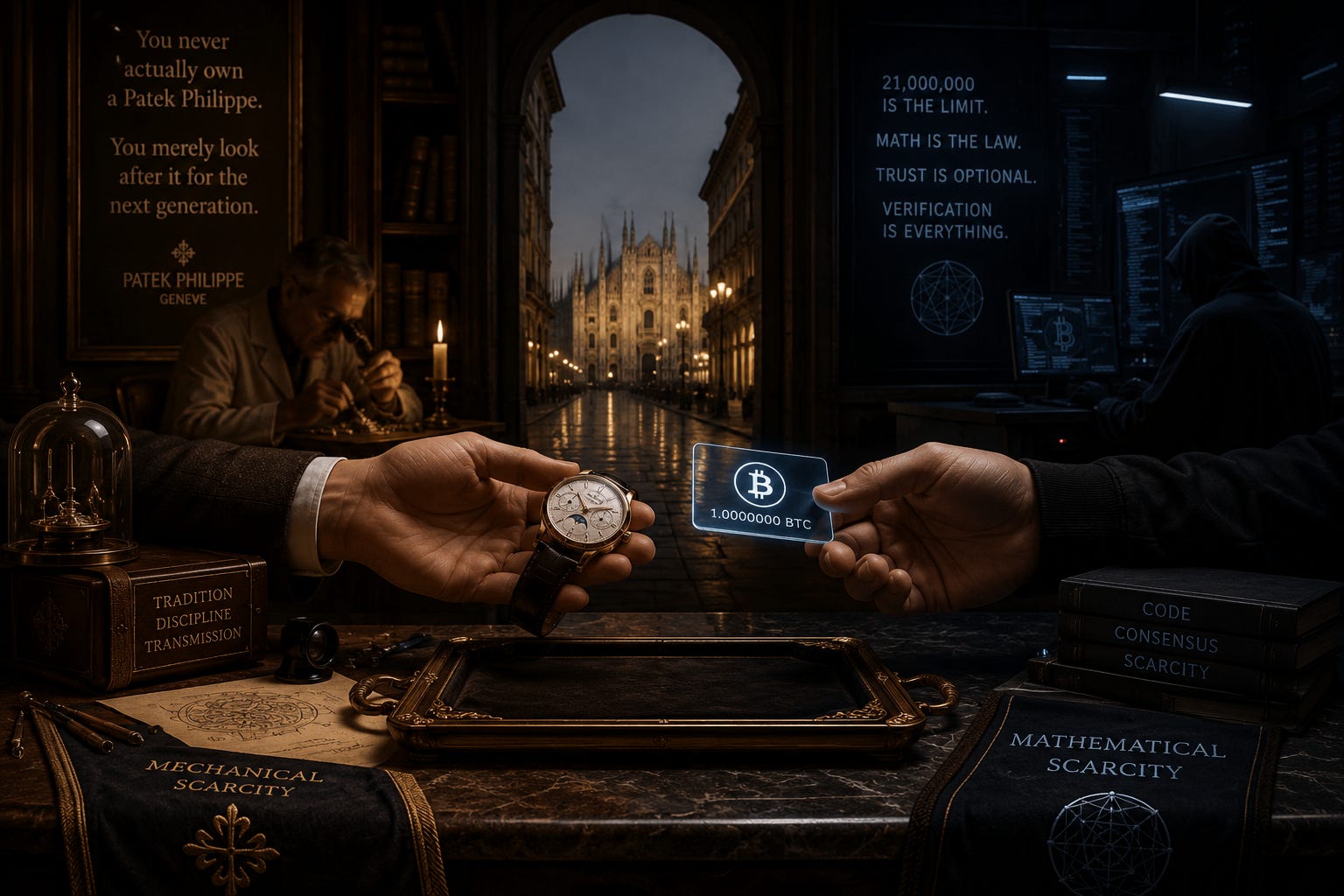
The Two Monasteries
Two communities built separate theologies around the same fear. When one finally bought from the other, the transaction exposed more than either tradition cared to admit.
Somewhere in Via Montenapoleone, a man pays for a watch with money that exists in no vault, issued by no government, backed by no sovereign promise — only by mathematics and the collective belief of people who have decided that mathematics is more trustworthy than governments. The watch he receives was made by hands, in a valley in the Jura, across months of labour so disciplined it borders on devotion. The exchange takes seconds. The watch will outlast the man who made it. The currency he tendered will outlast, if its believers are correct, every institution that once dismissed it. Two objects that refuse to age in the ordinary way have changed hands. It is worth pausing to ask what kind of civilisation produces such a transaction, and what it reveals about the anxieties that lie beneath the surface of both.
The collector of serious watches inhabits a world of carefully maintained doctrine. Its central article is scarcity: not the artificial scarcity of limited editions manufactured to stimulate demand, but the deeper scarcity of craft — of skills accumulated across decades, transmitted through apprenticeship rather than documentation, resident in human hands rather than industrial processes. The manufacture, in the vocabulary of the Swiss watch industry, is not merely a facility; it is a theology made visible. To produce a movement in-house — every wheel, every spring, every jewel conceived and finished within one atelier — is to make a claim about the independence of human skill from the logic of mass production. Patek Philippe’s famous advertising proposition, that one never truly owns one of its watches but merely safeguards it for the next generation, is not marketing language dressed as philosophy; it is philosophy dressed as marketing language, and the distinction matters. What the collector acquires, in this framework, is not an object but a relationship with time — a bet that craft, concentrated and disciplined, produces things that resist obsolescence while everything else depreciates. The implicit argument beneath all of haute horlogerie is that there are things paper money cannot replicate, and that this irreplicability is the only honest measure of worth.
It is an argument Bitcoin’s earliest advocates would recognise immediately, though they would be unlikely to recognise themselves in its making. The cryptocurrency’s founding proposition is almost verbatim the same: that scarcity, enforced by mathematics rather than by craft, produces the only form of value that institutions cannot debase. The limit of twenty-one million Bitcoin is not a marketing decision; it is a constitutional provision, as inviolable as the mechanisms that prevent a watchmaker from secretly doubling production without detection. The halving — the periodic reduction of the rate at which new Bitcoin enters circulation — functions as a kind of liturgical calendar, marking time not by the seasons but by the progressive approach of absolute scarcity. Satoshi Nakamoto’s withdrawal from the project, leaving behind a white paper and a system that no longer requires its creator to function, is understood within the Bitcoin community not as abandonment but as a form of institutional guarantee: a god who removes himself from the equation so that the equation cannot be corrupted. The maximalist’s creed is as coherent as any theological system: institutions debase, states inflate, central banks are intermediaries between savers and the slow erosion of their savings, and the only honest money is money no government can print. One need not share the belief to recognise its internal logic.
What has never been acknowledged — because neither community had reason to look at the other with sufficient attention — is that the watch collector and the Bitcoin holder are making structurally identical arguments. Both have diagnosed the same civilisational problem: that fiat currency, subject to political pressure and institutional discretion, is an unreliable vessel for value across time. Both have responded by placing their faith in scarcity enforced by a system outside institutional control — one a mechanical system refined across centuries, the other a cryptographic system designed across months but intended to function across centuries. Both speak, when they speak seriously, not of returns but of preservation. Both regard the people around them who do not share their conviction with a mixture of pity and incomprehension. The watch collector who explains to an unbeliever why a stainless steel Patek Philippe is worth more than a car, and the Bitcoin advocate who explains to the same unbeliever why a sequence of cryptographic keys is worth more than a government bond, are engaged in the same largely unsuccessful act of translation. They have simply been doing it in rooms that never overlapped.
When Chiara Pisa, speaking to the Corriere della Sera in December 2025, described the integration of cryptocurrency payments at Pisa 1940 as “a step towards adapting to the demands of a constantly evolving market,” she was using the language of operational pragmatism — sensible, cautious, appropriate for a retailer who serves a clientele she has not finished mapping. But the transaction she described is more than a payment innovation. It is the moment at which two parallel theologies, having developed in complete independence of one another, discovered that they had been reading the same foundational text in different languages. The monk who arrives at the monastery door carrying a different translation of the same scripture is not a stranger; he is something more unsettling — a mirror.
How this actually happens is less mystical than its symbolism, and the deflation is instructive. Pisa 1940 does not, in any meaningful sense, accept Bitcoin; it accepts euros that were Bitcoin a moment earlier. The payment passes through Lunu — one of a small class of gateways, BitPay and xMoney among them — that takes the cryptocurrency from the buyer and remits fiat to the merchant, the rate fixed at the instant of sale so that the retailer carries none of the volatility and, it bears noting, none of the conviction. The motives for offering this are unsentimental. A clientele of younger, crypto-native wealth holds money that conventional rails handle badly: cards balk at six-figure tickets, wires settle in days, and a buyer in Singapore would rather not surrender a percentage to foreign exchange. Crypto settles in minutes, across borders, and cannot be charged back. Whether this amounts to a movement or a gesture is the more honest question, and the honest answer is that it remains, for now, mostly a gesture. Hublot and TAG Heuer have offered the option since early in the decade; Watches of Switzerland has piloted it; a handful of avowedly crypto-native dealers have built entire businesses on it. But the great majority of authorised retailers for the grandes maisons still want a wire, and for most who do accept it the line on the checkout page operates less as a payment method than as a flag run up for a particular sort of buyer to salute. The irony the essay cannot step around is the one folded into the conversion itself: the believer who tenders the proof of mathematical scarcity must, in the same instant, watch it liquidated into precisely the fiat he distrusts, in order to leave with the proof of mechanical scarcity instead. The monk, at the threshold, translates his scripture back into the vernacular he came to escape.
The watch industry has spent decades positioning itself explicitly against speculation and volatility, against the digital and the ephemeral, against the proposition that value can exist without material form. The irony is that its most devoted adherents — not the speculators who flip references at auction, but the true collectors who acquire across decades, who speak of stewardship, who regard the watch on their wrist as a relationship rather than an asset — are motivated by precisely the same civilisational anxiety that produces Bitcoin conviction. Both are acts of faith that scarcity is real. Both are bets against time.
What does it mean that the two most self-consciously permanent asset classes of our moment have found each other? That one now denominates the other — that you may tender the cryptographic proof of mathematical scarcity in exchange for the mechanical proof of irreducible craft — is either the confirmation of a shared logic deeper than either tradition understood, or its reductio ad absurdum. Perhaps it is both. The transaction in Via Montenapoleone does not resolve the question. It simply makes it impossible to ignore.
About the Author
Swiss-based independent writer specialising in the luxury watch industry. Editor of WatchDossier, a publication exploring the cultural and philosophical undercurrents of contemporary horology, and author of the book Against the Grain: A Cultural History of Swiss Independent Watchmaking.
No compensation or brand affiliation influenced this essay. Opinions are the author’s own.
Subscribe watchdossier.ch to receive more insights on luxury, craftsmanship, and collecting.


