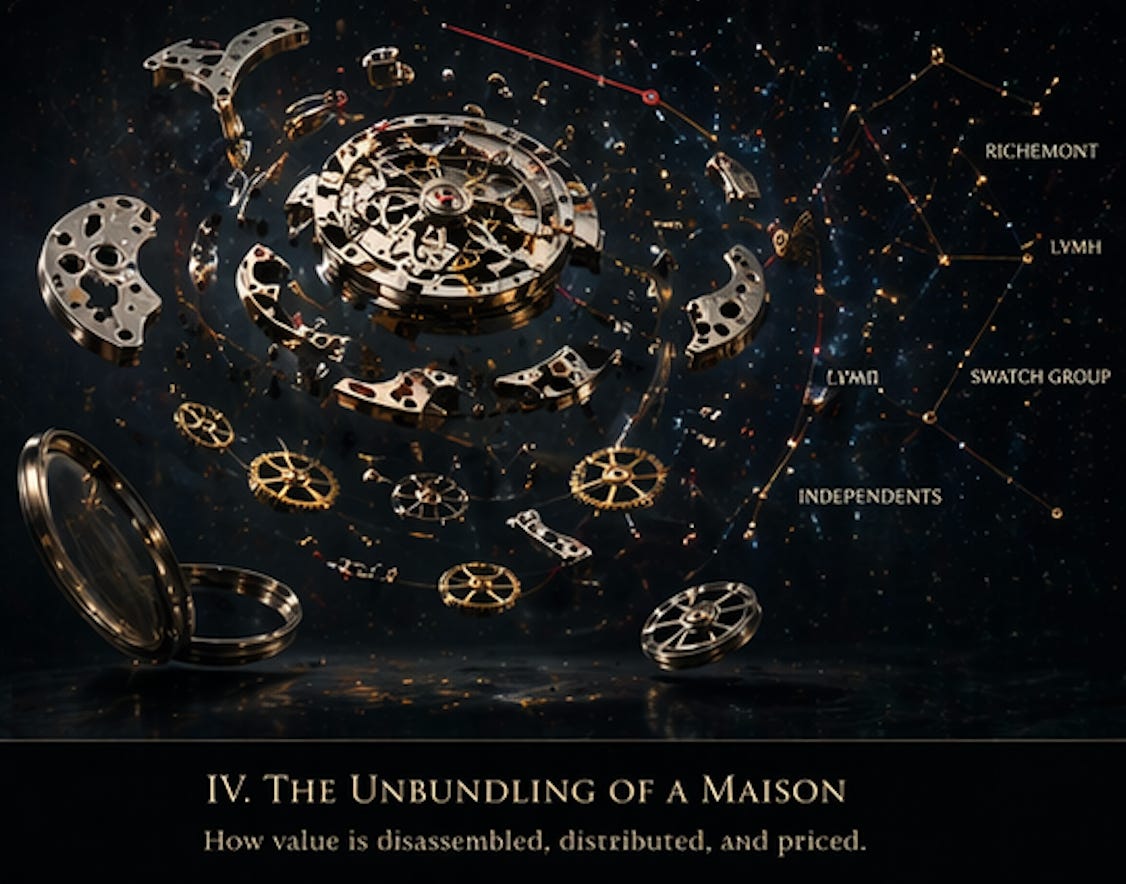
The Unbundling of a Maison.
Baume & Mercier’s sale to Damiani is not a disposal. It’s an admission.
On January 22, 2026, Richemont announced that it had signed an agreement to sell Baume & Mercier to the Damiani Group. The financial terms were not disclosed. The transaction would have no material impact on Richemont’s balance sheet. Closing was expected by summer. Richemont would continue to provide operational services for at least twelve months to ensure a smooth transition. The press release was two paragraphs long.
Everything about the announcement was designed to signal insignificance. A small brand, a private transaction, an undisclosed price, an immaterial balance-sheet effect. And yet the sale of Baume & Mercier is one of the most structurally significant events in the Swiss watch industry in years, because it reverses a logic that has governed the sector for three decades. Richemont does not sell watch brands. That is not what Richemont does. It acquires them, holds them, nurtures them over generational time horizons, and allows them to compound value within a distribution architecture that no independent brand could replicate. Johann Rupert built the group on this premise. The entire conglomerate model depends on the assumption that brands are worth more inside a portfolio than outside one. Baume & Mercier’s departure is the first admission that this assumption has a limit.
It is important to be precise about what kind of disposal this is. Richemont has shed assets before. It sold Shanghai Tang to an Italian entrepreneur in 2017 and Lancel to Piquadro in 2018. In late 2024 it agreed to offload Yoox Net-a-Porter to Mytheresa. Each of these was peripheral — a fashion label, a leather goods house, a digital retail venture. They were pruning at the edges of a portfolio whose centre was always hard luxury: watches and jewellery. Analysts understood the moves as strategic clarification, a sharpening of focus. But Baume & Mercier is not peripheral. It is a specialist watchmaker, founded in 1830, held within the Richemont architecture since Cartier acquired it in 1988. It makes mechanical watches at its own factory in Les Brenets. It sits inside the Specialist Watchmakers division alongside Jaeger-LeCoultre, Vacheron Constantin, and A. Lange & Söhne. Selling Baume & Mercier is not housekeeping. It is a statement about what the core actually is.
The statement, stripped to its structural logic, is this: the conglomerate model has a floor. Below a certain threshold of price positioning, brand heat, and margin contribution, a watchmaker cannot be profitably maintained within a group’s architecture. The group’s resources — capital, creative leadership, distribution priority, narrative attention — flow upward, toward the brands that justify the highest margins and attract the most desirable clientele. Brands at the accessible end of the portfolio do not starve overnight. They starve slowly, over years, through a thousand small allocation decisions that are individually rational and cumulatively fatal. Oliver Müller, the founder of LuxeConsult and one of the industry’s sharpest analysts, was blunt in his assessment: Baume & Mercier’s DNA and price positioning were no longer the right fit for Richemont, where the focus is firmly on luxury. Declining sales had destabilised the brand, as had the many changes in CEO and strategy. Kepler Cheuvreux, the equity research house, noted that the brand had struggled for years and that the sale underscored a more aggressive approach with problem units under Richemont’s new chief executive, Nicolas Bos.
The phrasing is worth attending to. “Problem units.” Not failing watchmakers, not underperforming maisons — problem units. The language of portfolio management, not of horology. This is the vocabulary that Pierre Tissot would have recognised in 2000, when he argued in the Swiss Watchmaking Journal that brands are intangible capital assets whose value derives from demand stability and predictable cash flows. By that logic, a brand that generates neither stable demand nor predictable cash flows is not a heritage to be preserved but an asset to be redeployed. Tissot’s framework, applied twenty-six years later, produces exactly this result: disposal.
What makes the transaction analytically interesting, rather than merely sad, is the identity of the buyer. The Damiani Group is a family-run Italian luxury house whose portfolio includes the Damiani, Salvini, Bliss, and Calderoni jewellery brands, the Murano glassmaker Venini, and — crucially — Rocca, a multi-brand watch and jewellery distributor with a significant retail presence in Italy. Damiani’s CEO, Jérôme Favier, described the acquisition as an opportunity to expand into the watch segment by leveraging the group’s wholesale distribution network and opening select mono-brand boutiques in strategic locations. This is a fundamentally different operating model from the one Baume & Mercier inhabited at Richemont. Richemont’s architecture has been moving steadily toward direct-to-consumer retail, vertical control, and ultra-luxury positioning — an environment in which a predominantly wholesale brand at an accessible price point is structurally miscast. At Damiani, Baume & Mercier becomes the centrepiece of a watchmaking ambition rather than the least consequential member of a specialist watchmakers’ division. The operating logic changes completely. The brand does not.
There is a temptation to read this as a failure story — the decline of a once-respected maison, the corporate indifference of a conglomerate, the inevitable gravitational pull of luxury toward the ultra-high end. And there is truth in all of that. But the more important reading is structural. The disposal of Baume & Mercier does not prove that the brand failed. It proves that portfolio logic has limits. A brand can be viable, historically significant, and capable of making good watches, and still be the wrong brand inside the wrong group at the wrong moment. The conglomerate model is not a rising tide that lifts all boats. It is an architecture that concentrates resources at the top, and the brands at the bottom pay the cost of that concentration whether they deserve to or not.
This is the inversion of Pierre Tissot’s 2000 thesis. He argued that brands are capital assets whose value derives from the stability of demand they generate. The implication was that aggregating brands into portfolios would compound that stability — diversification of demand, economies of distribution, shared infrastructure. For most of the past quarter-century, the industry behaved as if this logic were self-evident. The acquisition era assumed that more brands meant more value. Baume & Mercier’s departure suggests the opposite can also be true: a brand inside the wrong portfolio may lose value precisely because the group’s strategic priorities work against it. The conglomerate model does not just aggregate value. It can also quietly destroy it.
Whether Baume & Mercier is an isolated correction or the first signal of a broader deconsolidation is a question the industry has not yet answered. Richemont still holds twelve watchmaking and jewellery maisons. LVMH and Swatch Group show no signs of divesting. But the fact that the question can now be asked at all — that a major group has sold a specialist watchmaker to a family-owned Italian jeweller, and the market treated it as rational — marks a shift in the structural grammar of the industry. For thirty years, the story moved in one direction: acquisition, consolidation, portfolio expansion. In January 2026, it moved, for the first time, in the other.
About the Author
Sergio Galanti is an independent brand strategist and writer in the luxury watch industry. He is the editor of WatchDossier, a publication devoted to the cultural and philosophical undercurrents of modern horology.
No compensation or brand affiliation influenced this essay. Opinions are the author’s own.
Subscribe watchdossier.ch to receive more insights on luxury, craftsmanship, and collecting.


