The Watch of the Now, the Doctrine of the Old
For sixteen years, Ressence built its identity in opposition to industry orthodoxy. The TYPE 11 quietly confirms that orthodoxy wins in the end.
The press release for the TYPE 11 hits the pitch such announcements are now expected to occupy: the language of milestone, the cadence of ascent, the practiced honorifics of first and in-house. Antwerp has built a movement. Antwerp is COSC-compliant. The Werk RW-01 has forty jewels, sixty-seven gears, eighteen ball bearings, twin barrels, a sixty-hour reserve, and a triangular architecture said to echo the dial’s three orbits — as if the engine, having waited sixteen years, has finally learned to mimic the choreography it powers. The watch is described as the brand’s most complete. The founder is quoted on Simplication, on integration, on the quiet satisfaction of finally building the thing that drives the thing.
It is a perfectly executed rite.
Ressence was not supposed to require such a rite. Founded in 2010 by an industrial designer rather than a watchmaker, the brand made its case in opposition to most of what defines fine watchmaking: hands, crowns, traditional dials, the museum vitrine, the catechism of complications. Benoît Mintiens did not propose to repair horology’s language; he proposed to bypass it. The patented Ressence Orbital Convex System (ROCS) — rotating discs in lieu of hands, magnetic coupling, oil-filled chambers, no crown to break the silhouette — was a successful argument that watchmaking’s grammar had been fixed too early: that its rules were conventions, not laws. Underneath, an ETA 2892 turned, dutifully and without ceremony, doing what ETA 2892s have always done. The disjunction was, for many of us, the point. A radical display deserved an honest engine.
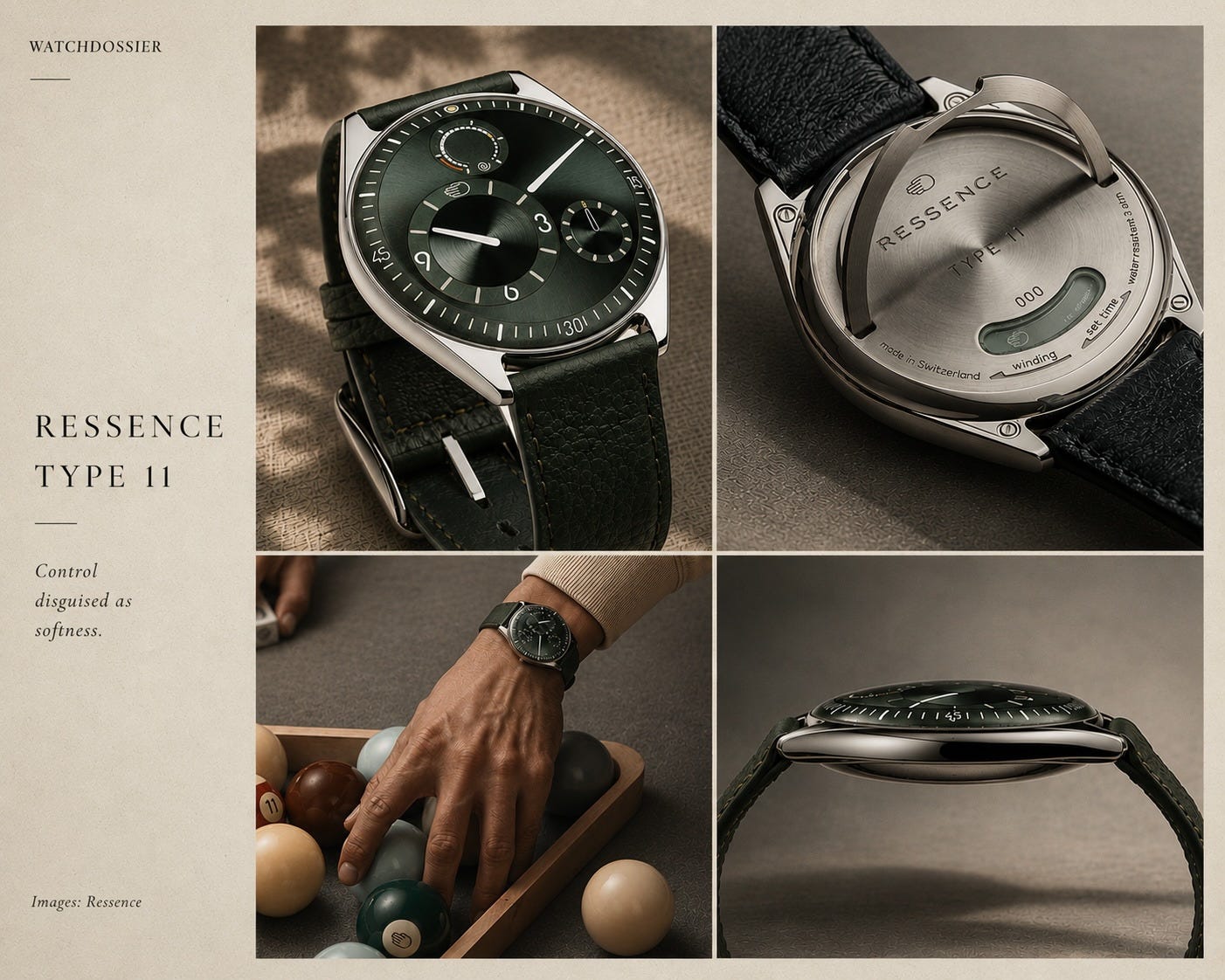
The TYPE 11 closes that argument. It does so, characteristically, with elegance. The pebble case in polished Grade 5 titanium runs forty-one millimetres across and eleven thick. The double-domed sapphire reads as a single bead of glass. In the palm — and the palm is where the watch announces itself, all forty-nine grams including strap — the Pine, Sky, or Latte dial holds the light against its hundred-millimetre convex titanium plane, the three eccentric satellites turning beneath it like small planets given their own gravity. The new power-reserve indicator is a string of ceramic micro-balls, light and dark, advancing and retreating along a curved channel as the mainspring fills and empties. Wind the watch via the caseback lever and a small population of ceramic spheres begins, very slowly, to migrate. It is unreasonably pleasant.
What Ressence has done, technically, is develop the calibre with Concepto Watch Factory in La Chaux-de-Fonds — a vertically integrated movement specialist whose other clients include Hublot, Bulgari, Bugatti, and Jacob & Co. Several of the more careful trade outlets note this; the press release does not. In-house, in 2026, is an adjective with considerable rhetorical labour to perform and a relatively small empirical core. It now means, broadly, that the brand briefed the architecture and contributed to the design while a Swiss specialist did the engineering, the prototyping, and the production. By that standard, the RW-01 is in-house. By the standard the word originally encoded — a fully integrated manufacture producing its own assortments — it is not. SJX Watches, to its credit, called the work outsourced without rancour. Mintiens himself frames the partnership openly enough. The doctrine survives because the exact location of its failure is impolite to specify.
The strategic logic is unimpeachable. At CHF 23,000, the TYPE 11 is now the brand’s most accessible piece, undercutting the oil-filled Type 3 by a substantial margin and arriving with the one credential a Belgian design house could not previously offer the cautious collector: a movement bearing its own initials, COSC-certified, theoretically defensible at resale. The Milanese mesh, the 3 ATM rating, the eleven-millimetre profile — everything signals a watch built for daily life rather than for the safe. Ressence has not abandoned its audience. It has acquired a second one. The first cared about the dial. The second wanted to be told, in language they recognised, that the engine was serious.
Both audiences are being sold the same word. The word is the product.
Held against the light, the TYPE 11 is genuinely lovely. The proportions are correct, the finishing is restrained, the integration of barrel architecture and dial motif is the kind of small, satisfying coherence that good design produces when given enough time. The watch will sell. It deserves to.
It is also a quiet concession. The Belgian brand whose entire founding gesture was to show that one could make something genuinely new without first earning the right to speak through the industry’s preferred dialect has now learned that dialect. Fluently. Mintiens calls the TYPE 11 the watch of the Now. The Now, here, looks rather like the recent past — Urwerk’s EMC moment in 2013, every design-led independent that has, at some point, concluded that the modular workaround is no longer enough. Ressence has joined a procession.
The procession is well-lit and the music is good. Whether it is moving anywhere new is another question, and one the watch itself, sitting calmly on the wrist, has the elegance not to ask.
About the Author
Swiss-based independent writer specialising in the luxury watch industry. Editor of WatchDossier, a publication exploring the cultural and philosophical undercurrents of contemporary horology, and author of the book Against the Grain: A Cultural History of Swiss Independent Watchmaking.
No compensation or brand affiliation influenced this essay. Opinions are the author’s own.
Subscribe watchdossier.ch to receive more insights on luxury, craftsmanship, and collecting.


