There is nothing wrong with your television set. Do not attempt to adjust the picture.
The Automated Horologist: A Voltairian Disputation on the Best of All Possible Times.
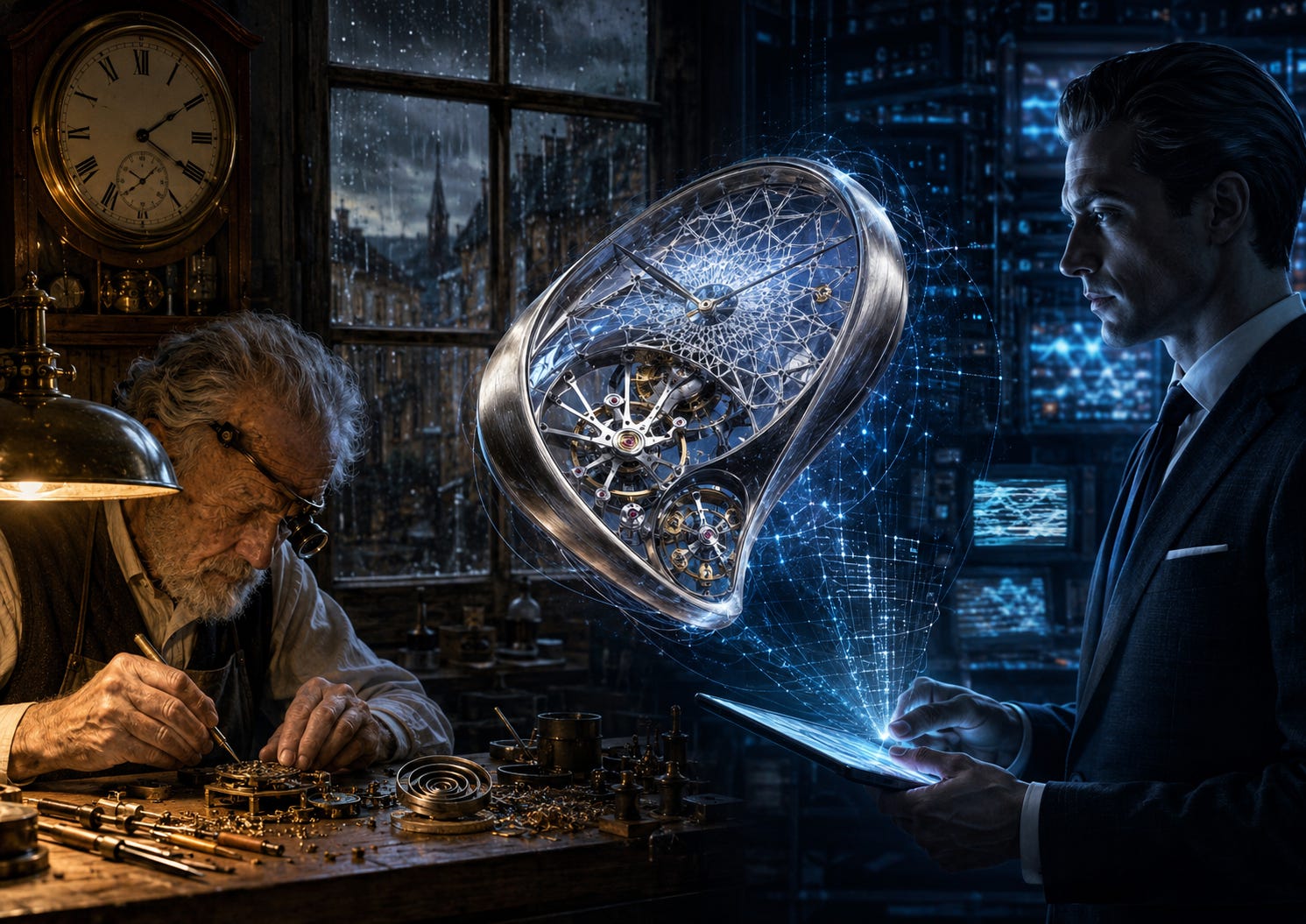
The rain in Le Locle fell with a rhythmic persistence that no Swiss watchmaker had ever managed to regulate. Inside the centuries-old atelier of Maître Chronos, the atmosphere smelled of brass shavings, whale oil, and stubbornness. Chronos sat hunched over his bench, a loupe strapped to his brow, gently coaxing a hairspring into submission.
The door did not knock; it slid open with the whisper of a frictionless pneumatic seal. In stepped Monsieur Optimus, a man whose tailored suit seemed to have been ironed by a laser, carrying a tablet that pulsed with a hypnotic, shifting blue light.
“Step away from the pegwood, Maître,” Optimus announced, his voice vibrating with the synthetic warmth of a well-calibrated public relations executive. “There is nothing wrong with your workshop. Do not attempt to adjust your parameters. We are controlling transmission.”
Chronos did not look up from his vice. “My parameters are quite comfortable, Monsieur. And the only thing transmitting in this room is the dampness from your coat.”
“We control the horizontal; we control the vertical,” Optimus continued, pacing the creaking floorboards like a prophet in a cleanroom. “For the past three centuries, your industry has suffered under the tyrannical friction of gravity and human error. But the new dawn has broken. Our generative neural networks have digested twenty years of global secondary market data, every molecular patent from Neuchâtel to Tokyo, and the digitized souls of a thousand dead masters. We have created the Silicon Mind. Sit quietly, Maître, and we will control all that you tick and hear.”
Chronos slowly unscrewed his loupe, letting it drop into his palm. He looked at the glowing tablet. “A magnificent speech. It sounds remarkably like a television broadcast from my youth that used to precede stories about monsters. What is it you want to sell me, Optimus?”
“Perfection,” Optimus beamed, tapping his screen to reveal a swirling cloud of mathematical probability. “We have eliminated the archaic nuisance of human prototyping. Why waste months filing a bridge when our AI can generate billions of synthetic datasets in a microsecond? We have simulated a trillion virtual tourbillons operating in a flawless, digital vacuum. The machine has dreamed the ultimate caliber—devoid of human caprice, untainted by the sweat of a mortal thumb. It is the best of all possible movements.”
“Synthetic data,” Chronos murmured, tapping his fingernail against a small brass wheel. “An artifice built upon an artifice. You have trained your machine on the shadows of watches that actual men spent their eyesight creating. Tell me, this digital vacuum of yours—does it also simulate the watch being dropped on a marble floor by a drunk baron at three in the morning?”
“The algorithm accounts for all vectors of chaos!” Optimus countered, his eyes flashing with the zeal of a true believer. “It is infallible. It cannot lie.”
“Then show me its truth.”
With the flourish of a magician pulling a rabbit from a hat, Optimus produced a velvet case. Nestled inside was a timepiece of startling asymmetry. Its case seemed to fold into itself like a Mobius strip, and its dial possessed a lattice work so intricate it looked less like horology and more like a frozen cobweb.
“The Chrono-Neural Alpha,” Optimus whispered reverently. “Designed entirely by the algorithm’s own creative autonomy. It features a revolutionary non-Euclidean escapement that provides a continuous force lasting exactly five hundred days.”
Chronos put his loupe back to his eye and leaned over the object. The workshop grew so quiet that the steady tick-tick-tick of the old marine chronometer on the wall sounded like an axe chopping wood. He observed the gears, tracing the paths of the teeth. He watched the balance wheel, which was vibrating with a frantic, erratic flutter.
After a long minute, Chronos sat back and sighed. “Monsieur Optimus, your machine is a magnificent poet, but a terrible mechanic. This third wheel does not drive the fourth; it intersects it at an impossible angle. And this balance spring—it is coiled in a direction that violates the basic elasticity of tempered silicon. It cannot possibly keep time.”
“It does not keep time, Maître, it redefines it!” Optimus snapped, adjusting his cuffs with some agitation. “The algorithm is certain. The data is absolute. If the hands are moving in reverse, it is because the machine has determined that time flows backward in the luxury market. It is a masterpiece of autonomous intuition.”
“In my day,” Chronos said softly, “we did not call it autonomous intuition. We called it a hallucination. A confident fiction whispered by a drunk apprentice who dropped the balance staff but swore on the Virgin Mary that the watch was simply operating in a higher spiritual plane.”
“You mock what you cannot compute!” Optimus cried, snatching the watch back. “The consumer demands innovation! They demand the future! Who are you to argue with an intelligence that has processed more horological data than your entire lineage has seen since the Sundial?”
“I am merely a man who knows that a watch that tells a beautiful lie is no longer a watch; it is a piece of jewelry with an identity crisis,” Chronos replied. He picked up a tiny oil-sink and a fine wire. “Your machine has learned how to speak our language perfectly, but it has no idea what the words mean. It copies the architecture of a soul without ever having felt the fatigue of a Tuesday afternoon.”
Optimus tucked the tablet under his arm, his digital serenity thoroughly fractured. “The tide is coming, Chronos. The algorithms will control the market. You cannot adjust the picture.”
“Perhaps not,” Chronos said, turning his back to the rain and the tech-evangelist, focusing his light once more upon the tiny, stubborn hairspring. “But as a wise Frenchman once observed after witnessing the madness of the world’s grand designs, we must cultivate our garden. Go build your synthetic universes, Monsieur. I have a single afternoon to regulate, and unlike your machine, I am content with the truth of my errors.”
The pneumatic door slid shut, leaving only the smell of rain, the scent of oil, and the ancient, imperfect, glorious ticking of the human hand.
A Note from the Author
For readers born after the widespread integration of the microchip, Monsieur Optimus’s grandiloquent opening remarks are plagiarized from the prologue of a 1963 television series entitled “The Outer Limits”. In those computationally primitive times, human beings viewed broadcast signals on glowing glass boxes that required physical dials to adjust the picture. When the image violently distorted, a disembodied “Control Voice” would crackle over the loudspeaker to assure the frightened viewer that the malfunction was entirely intentional—a comforting piece of confident fiction not unlike a modern generative algorithm assuring a room of watch executives that its fantastic mathematics are infallible.
About the Author
Sergio Galanti is a Swiss-based independent writer specialising in the luxury watch industry, and an advisor to private collectors and investors. He is the editor of WatchDossier (watchdossier.ch), a publication exploring the cultural and philosophical undercurrents of contemporary horology, and the author of Against the Grain: A Cultural History of Swiss Independent Watchmaking.
No compensation or brand affiliation influenced this essay. Opinions are the author’s own.
Subscribe to watchdossier.ch to receive more insights on luxury, craftsmanship, and collecting.


