


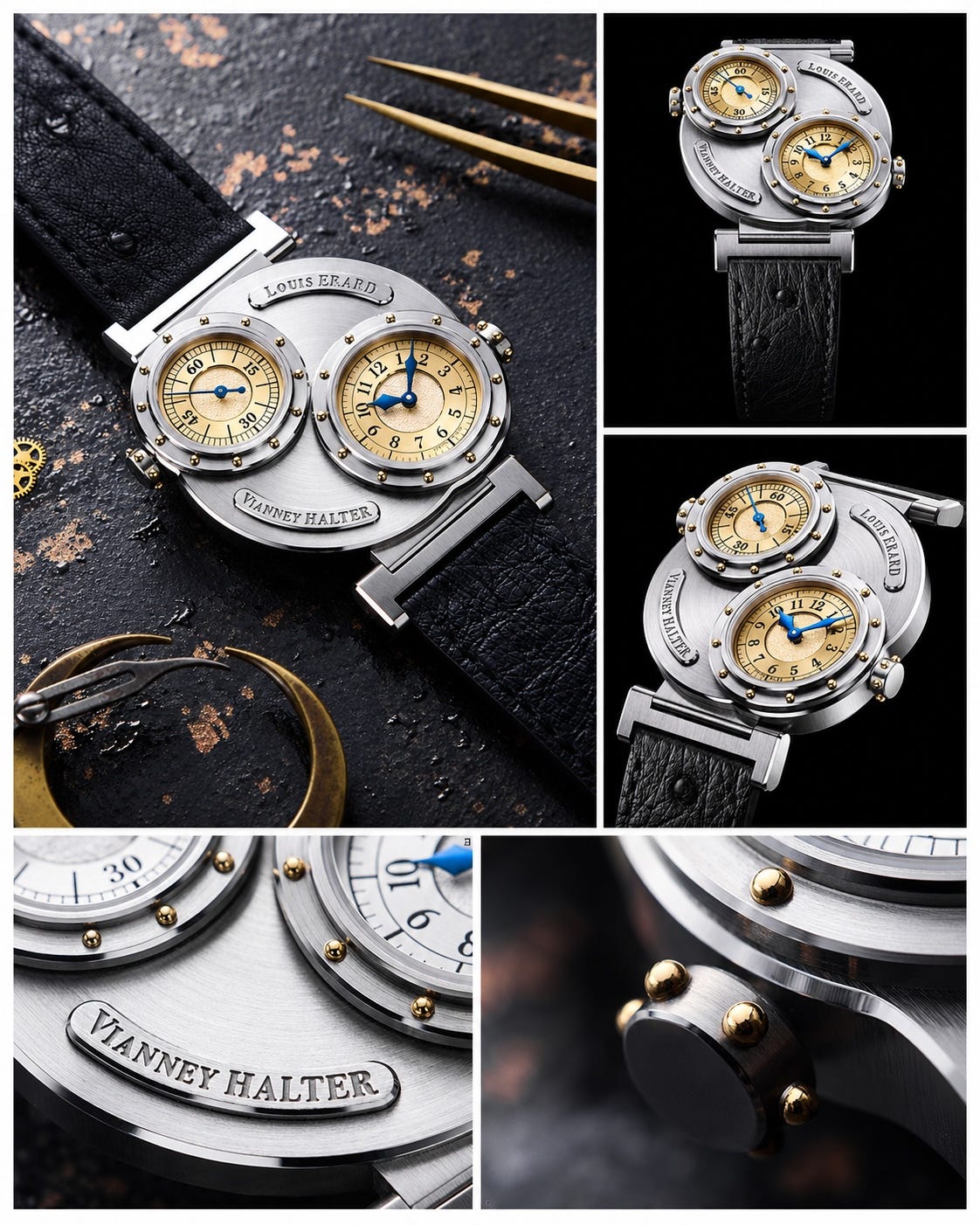
The name was already taken.
In 1998, at the Basel fair, Vianney Halter showed the Antiqua, conceived with the American graphic designer Jeff Barnes: a perpetual calendar whose indications sat behind riveted portholes. The name Halter and Barnes gave that style came from French grammar: futur antérieur, the future perfect, the tense of what will have happened. A recent Phillips catalogue note records that 110 Antiquas were made. The watch it describes sold in Geneva in November 2024 for CHF 203,200.
Louis Erard’s press kit, released on 30 October, offers a gentler origin for the title of its new Halter collaboration: a tense that suits two watchmakers with a shared past and unfinished business. Accurate, as far as it goes. It simply stops short of the Antiqua.
That small omission is the whole transaction in miniature: Halter supplies the vocabulary, Louis Erard the price. Six years of Halter collaborations have let Louis Erard, under Manuel Emch, refine a format the decade badly wanted: the independent signature at a price that requires no audition. The first Halter regulator, in 2020, cost CHF 3,500, ran to 178 pieces and sold out within hours; a year later one made CHF 9,450 at Phillips. A second regulator followed in 2024 at CHF 4,444, then a World Tour variant in 2025. Collectors who could not reach an Antiqua could at least reach its handwriting.
Emch opens the new kit by observing that collectors now know when exclusivity is merely a sales word. A few lines later, each version is limited to 178 pieces, identified as the brand’s signature number for collaborations. Silberstein. Chaykin. Halter. Scarcity, fixed as a house constant.
There is a deeper logic, and it belongs to Louis Erard. The regulator, the brand’s signature, is a philosophy of separation: hours, minutes and seconds each granted their own axis, their own small sovereignty. Futur Antérieur carries that philosophy past the dial and into the hardware. Two Sellita SW100 calibres sit side by side, unconnected. One drives the hours and minutes. The other exists to turn a seconds hand. Two rotors, two crowns, two balances keeping their own counsel. Emch’s reasoning, as reported by SJX, is practical: movements this small wander, so a second time zone would have drifted visibly within days. Better to give the second calibre a task in which disagreement cannot be seen.
Half the mechanism, then, is devoted to the indication that matters least.
And yet the case is something else. Sixty-seven components, new to Louis Erard, 38 mm across and 8.85 mm high, a thickness many single-movement watches never manage. Tilt it toward a window and the light runs along the circular brushing of the face, slides down the vertically brushed flanks, then breaks on the polished chamfer. The two bezels stand proud like fittings on a hull, each fixed with twelve yellow-gilt rivets; the crowns carry six apiece. Thirty-six rivets, counted twice for pleasure. Recessed within, the dials are grained to a soft frost and ringed by brushed collars, crossed by blued Halter hands. The ostrich strap, quill-marked and faintly theatrical, absorbs the glare the metal throws back. It reads less like a watch than a porthole from a vessel nobody ever built. SJX judges the finishing surprisingly good for a Swiss watch at the price, and would have preferred the case without names.
What, then, is being bought? Not an Antiqua: the two prices stand roughly forty to one. What is being bought is a porthole in the literal sense, a framed view into a room one is not invited to enter. Halter says, in the kit, that you recognise the family without having met this particular member. Exactly so. The buyer acquires kinship rather than lineage: the cousin at the wedding, well dressed and agreeable. Louis Erard knows its audience well enough to offer the cousin twice. Seventy-eight Duo Sets pair Gold and Silver at CHF 9,900, which is precisely twice CHF 4,950. Temptation, the brochure promises, comes in duos. It does not come discounted. The added consideration is a box of certified wood.
Retail prices have climbed with each round; the resale market for the first edition has drifted the other way. The 2020 regulator that made CHF 9,450 in 2021 sold this September, in a Phillips Hong Kong online sale, for HK$44,450, roughly US$5,700. Still above issue. Fever broken. Futur Antérieur will not repeat the first edition’s arithmetic; the format is familiar now, and familiarity is the enemy of the flip. Its value to Louis Erard lies elsewhere. Building an entirely new case for a few hundred watches makes little economic sense, which is rather the point: it proves the brand can do more than lend a dial to a stock regulator. The asset is not the watch but the competence it advertises, and the name it borrowed to do so.
Remove the name, then. Remove Halter, the Antiqua, the tense. What survives is a 38 mm steel case of real sculptural ambition, finished above its station, wrapped around a mechanical premise that is frankly a conceit. The case is the reason to want it. The second movement is the reason to talk about it.
The title, meanwhile, fits better than either party admits. The future perfect is the collector’s native tense. Nobody buys a limited edition in the present. One buys it so that it will have been the right decision, will have sold out, will have risen, will have been the one that got away from someone else. Halter once imagined an object sent from a future someone had dreamed long ago. That future has now been delivered from Le Noirmont, in two finishes, excluding tax.
Its seconds keep their own time. Nobody, of course, will check.
About the Author
Sergio Galanti is the founder and editor of WatchDossier, contributor to Italian and international watch publications, and advisor to private collectors.
No compensation or brand affiliation influenced this essay. Opinions are the author’s own.
