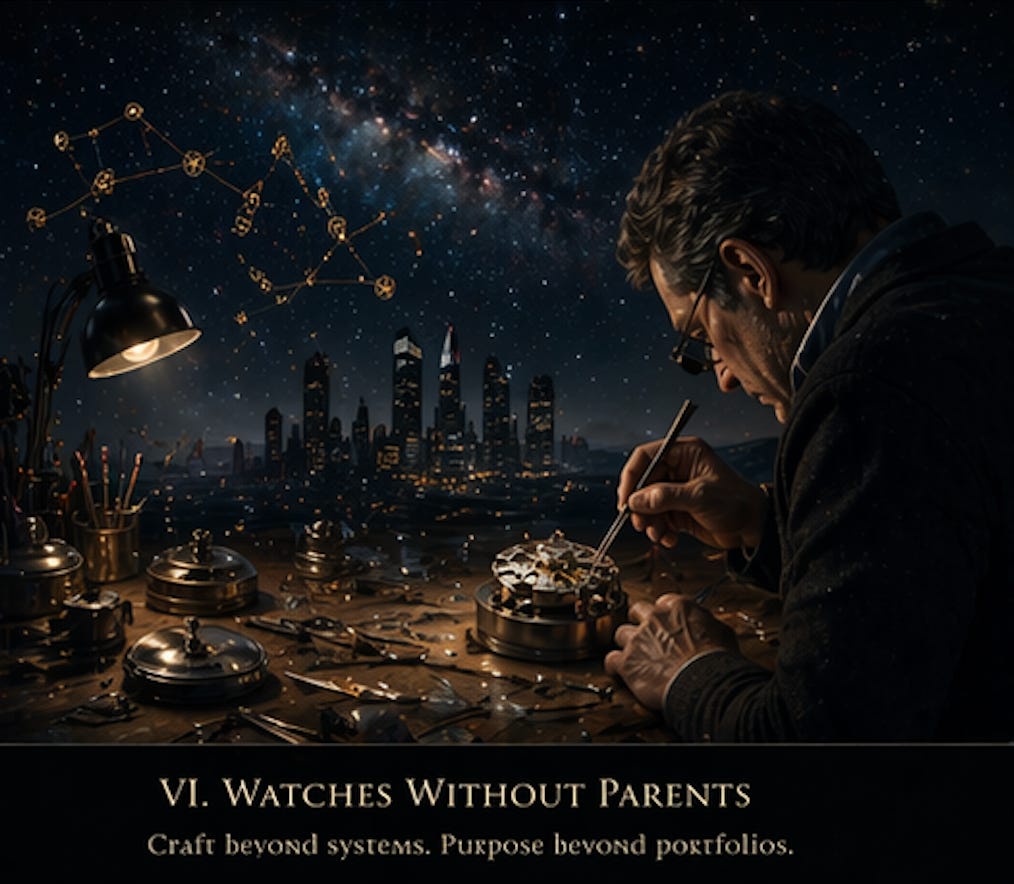
François-Paul Journe produces approximately one thousand watches a year. Rexhep Rexhepi, working from a small atelier in Geneva’s old town, makes perhaps thirty. Roger W. Smith, on the Isle of Man, makes fewer than ten. Philippe Dufour, widely regarded as the greatest living watchmaker, has effectively ceased production. These are not brands in any sense that Pierre Tissot’s 2000 framework would recognise. They do not generate demand stability. They do not offer predictable cash flows. They cannot be discounted to present value, diversified within a portfolio, or evaluated using Interbrand’s methodology. They exist outside the grammar of brand-as-capital entirely. And yet they are, by almost any measure of collector conviction, the most valued watchmakers alive.
The preceding five essays in this issue have traced the logic of brands as financial assets — from Tissot’s original framework, through the consolidation era’s narrative engineering, to the secondary market’s stress-testing of belief, and into the current mutations of portfolio strategy at Richemont and Breitling. Each essay has operated within the same gravitational field: the assumption that brands exist, ultimately, as instruments of capital. This final essay asks what happens at the edge of that field. What survives outside portfolio logic? What does watchmaking look like when no one owns the story?
The answer, at first glance, appears straightforward. Independent watchmakers survive by doing what groups cannot: producing objects of such singular craft that the work itself becomes the entire value proposition. There is no heritage narrative to engineer because the founder is alive and working at the bench. There is no brand management because the brand is a person. There is no portfolio positioning because there is no portfolio. The independent watchmaker’s authenticity is not constructed after the fact, as Essay II showed Richemont constructing Panerai’s. It is structural. It is the unavoidable consequence of one person, or a very small number of people, making things by hand.
This structural authenticity is what the collector market rewards. The data from Essay III showed that F.P. Journe’s secondary market transactions slightly exceed his annual production capacity. A. Lange & Söhne, a far larger operation but still relatively small, sees secondary volume equivalent to roughly eighty-eight per cent of its output. For Journe, every watch made is, in effect, traded again. This is not the demand stability that Tissot described — it is something more concentrated, more fervent, and more fragile. It is conviction, held by a community small enough to know one another, intense enough to sustain prices that bear no rational relationship to the cost of materials or labour.
The conviction is not irrational. What Journe, Rexhepi, and the handful of watchmakers at this level produce is genuinely extraordinary. Rexhepi apprenticed at Patek Philippe at fifteen, trained at F.P. Journe, founded Akrivia at twenty-five, and by thirty-five had established himself as one of the most accomplished hand-finishers in the history of the craft. His Chronomètre Contemporain, a time-only watch with a grand feu enamel dial, achieved its reputation through nothing more than the quality of its execution — no marketing campaign, no celebrity endorsement, no group infrastructure. The work spoke. Collectors listened. Prices followed. This is the independent model at its purest: value created by craft alone, validated by a community that cares about craft, and sustained by scarcity that is genuinely involuntary rather than strategically managed.
But the model is structurally fragile in ways that the independent watchmaking community is often reluctant to examine. The most obvious vulnerability is succession. When the founder retires or dies, the brand faces an existential question that no group brand ever confronts: can the work continue without the person who defined it? Philippe Dufour’s effective cessation of production has already created a category of watches that will never be serviced by their maker again. Roger W. Smith trained under George Daniels and inherited the Daniels method, but the method is inseparable from the practitioner. Some independents are thinking about this — MB&F has accepted investment from Chanel, a move that signals awareness of the succession problem. Journe and Rexhepi have invested in infrastructure, in training teams, in building organisations that can outlast their founders. But dozens of younger independents are producing watches without any documented service plan, spare parts policy, or continuity model. The concept of the orphan watch — a beautifully made piece that cannot be maintained once the maker disappears — is not hypothetical. It has already happened.
The second fragility is economic. Independent watchmaking depends on a collector base that is itself shaped by the marketing apparatus of the groups. The collector who pays six figures for a Rexhepi did not discover independent watchmaking in a vacuum. He arrived at it through a journey that almost certainly began with Rolex or Omega, passed through Patek Philippe or Audemars Piguet, and eventually reached the independents as a form of connoisseurship that transcends brand. The groups, through their marketing and their ubiquity, create the desire for watches in the first place. The independents benefit from that desire while positioning themselves as its negation. This is not hypocrisy. It is a structural dependency that shapes the entire independent ecosystem. If the groups were to contract — if the broader luxury watch market were to shrink significantly — the collector base that sustains independent watchmaking would shrink with it.
The third fragility is the one that matters most for the argument of this issue. Independent watchmaking’s value proposition depends on its refusal of portfolio logic. The independent is valued precisely because it cannot be acquired, consolidated, or narratively managed by a group. Its authenticity is a function of its structural vulnerability. But this means that the independent model is, by definition, non-scalable. It cannot grow without compromising the conditions of its own value. The moment an independent watchmaker begins to produce at volume, to employ marketing executives, to open boutiques in multiple cities, the structural authenticity that justified the premium begins to erode. The collector who valued the work because it was made by one person at a bench will not value it equally when it is made by a team in a manufacture. The independent is caught in a bind: it can remain pure and remain small, or it can grow and become something that increasingly resembles the groups it defined itself against.
This is the tension that runs beneath all six essays in this issue. Pierre Tissot’s 2000 article argued that brands are capital assets whose value derives from demand stability. The consolidation era tested this proposition by assembling portfolios of brands and engineering their heritage narratives. The secondary market revealed that what is actually priced is not quality but belief. Richemont’s disposal of Baume & Mercier showed that portfolio logic has a floor. Breitling’s House of Brands showed that it can be rebuilt from dormant names. And the independents show that it is possible to create extraordinary value outside the system entirely — but only on terms that the system cannot replicate, and only for as long as the maker’s hands hold steady.
There is something irreducibly human about this. The independent watchmaker is the last figure in the industry whose value is inseparable from his or her physical existence. When Rexhep Rexhepi finishes a movement, the finishing is the value. It cannot be separated from the person who performed it, transferred to a balance sheet, or discounted to present value. It is work — in the oldest and most literal sense of the word. And in an industry that has spent a quarter-century converting everything into narrative, into brand equity, into intangible capital, there is something clarifying about an object whose value is simply that someone made it, and made it well.
That may not be enough to sustain a business model. It is almost certainly not enough to sustain an industry. But it is, for now, enough to sustain a practice — and to remind us that before a watch was an asset, before it was a brand, before it was a position in a portfolio, it was a made thing. The ownership of time began there. Whether it ends there is a question this issue can pose but not answer. The answer belongs to the makers, and to time itself.
About the Author
Sergio Galanti is an independent brand strategist and writer in the luxury watch industry. He is the editor of WatchDossier, a publication devoted to the cultural and philosophical undercurrents of modern horology.
No compensation or brand affiliation influenced this essay. Opinions are the author’s own.
Subscribe watchdossier.ch to receive more insights on luxury, craftsmanship, and collecting.


