When Watchmakers Imagined Tomorrow’s World
They predicted empires, electronics, and craft. With hindsight, their visions reveal watchmaking’s enduring struggle to reconcile progress with the need for permanence.
At the turn of the millennium, five leading voices in Swiss watchmaking reflected on the forces reshaping their industry—group consolidation, technological change, shifting notions of luxury. First published in the Swiss Watch Journal in February 2000, their visions are retold here as a unified meditation, viewed through the lens of 2025.
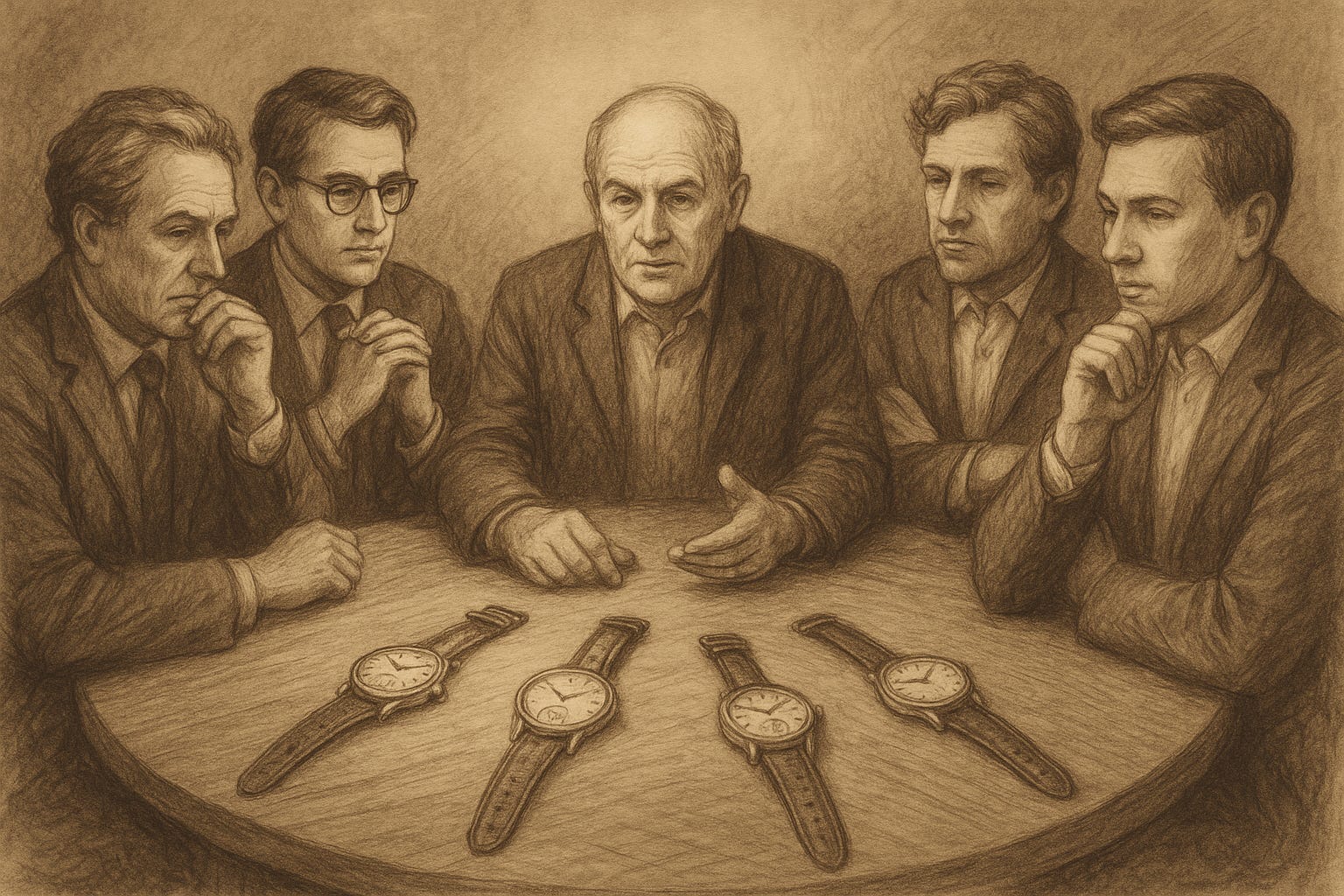
I recall a moment at the dawn of the new millennium, when the ancient craft of watchmaking stood poised between upheaval and renewal. The wounds of the quartz era had begun to heal, though their scars were still visible beneath the polish. Around me, the great maisons—those dynasties of metal and memory—felt the gravitational pull of larger groups assembling with the efficiency of empires. Independent ateliers, newly resurgent yet still fragile, tried to preserve the fragile flame of solitude in a world that seemed increasingly shaped by consolidation.
It was in this atmosphere that I listened to several of the craft’s most attentive custodians. Among them were Franck Muller, Maximilian Büsser, Olivier Bernheim, Osvaldo Patrizzi, and Karl-Friedrich Scheufele—each carrying a different fragment of what the future might become. Their perspectives differed, yet taken together they formed a single meditation on the future of a centuries-old discipline—one whose purpose had long ago ceased being the mere measurement of hours, and had instead become a vessel for desire, identity, and permanence.
Many spoke first of mergers and the swift formation of immense conglomerates. This tendency toward vertical integration—toward mastering every stage from conception to boutique window—was considered both a logical evolution and a potential affront to the craft’s human breadth. Some perceived an inevitable march toward efficiency, in which the groups would claim distribution, marketing, and the final encounter with the client as part of a unified strategy. Others feared that as these structures expanded, the individuality of each brand risked dissolution, like pigments mixed too vigorously on a palette. Would the distinct character of each workshop survive such compression? Would creativity still spring from the hand of the maker, or be shaped instead by the needs of the system?
Yet even then, a few voices expressed the opposite intuition: that consolidation, though powerful, might prove temporary. Just as empires fracture when their foundations grow too broad, so might vast watchmaking groups eventually yield again to smaller, more focused entities. In this, they hinted at the cyclic nature of human organization, in which growth and fragmentation alternate like tides.
Turning from structure to vision, they spoke of what tomorrow’s watch might become. Some imagined it evolving into a miniature terminal of technology—an object no longer confined to the tracing of hours, but capable of carrying signals, data, and fragments of one’s life. For them, the future belonged to electronic ingenuity, even if a mechanical heart might still pulse discreetly within, protected by the affection of those who cherished its silent rhythm.
Others foresaw the opposite transformation: the watch dissolving into fashion, its function overshadowed by the omnipotence of image. They believed brand identity would eclipse craftsmanship, and that the pace of trends would accelerate until the watch moved in cadence with garments, perfumes, and other ephemeral luxuries. Yet beneath their predictions lingered a quiet sadness—the recognition that utility was yielding to spectacle, and the fear that substance might disappear beneath the veil of marketing.
Still others held that the coming world, ever more virtual and immaterial, would provoke a renewed longing for what is tangible. The mechanical watch, stripped of necessity by the ubiquity of digital time, would gain in cultural weight precisely because of its anachronism. Humanity, confronted with screens and circuits, would reach instinctively toward objects that resist obsolescence. These voices believed that the upper end of watchmaking would not merely endure, but deepen its significance, serving as a counterweight to the abstract nature of modern life.
Some imagined a division: an electronic majority shaped by mass demand, and a mechanical minority protected by reverence. Inexpensive watches would become companions of fashion, changed as casually as clothing; yet collectors would continue to seek pieces that bore the imprint of hands and tools. Rarity would be not a strategy, but a consequence of integrity.
The conversation then turned to image and reality. All agreed that branding would grow ever more powerful, its influence shaping purchase decisions more decisively than any technical merit. And yet, several voices insisted that a discerning clientele would persist—those who could distinguish the quickly manufactured luxury from the creation born of long study and dedicated refinement. For such clients, exclusiveness would remain rooted in authenticity, not artifice.
Finally, each spoke of the foundations upon which they placed their hope for the future. Some found strength in total mastery of craft, believing that controlling design, manufacture, and innovation would secure their destiny. Others trusted in independence, viewing it as both privilege and burden. Some placed confidence in daring—boldness of materials, of forms, of limited creations unafraid of polarizing the public. Others believed their experience navigating markets and auctions gave them insight into the desires that shape value. Still others placed their faith in the intimacy of handcrafted traditions, transmitted across generations, defended against the erosion of time.
Years have passed since that conversation—twenty-five of them. And from my present vantage, I watch how their predictions have unfolded, like constellations slowly shifting in the night sky. The great groups indeed solidified their power; their integration of manufacturing and distribution became the defining structure of contemporary watchmaking. Yet contrary to the darkest forebodings, the identities of the maisons did not dissolve entirely. Some were protected precisely because their guardians understood that personality, once lost, cannot easily be restored.
More unexpectedly, the independent ateliers—those modest sanctuaries once dismissed as vulnerable—grew into a vibrant archipelago, each island of craft attracting pilgrims from around the world. What a few predicted only faintly has now become a defining feature of our era: the resurgence of the watchmaker as creator, not brand as monolith. The human hand, far from being rendered obsolete, has become a symbol of resistance against the impersonal.
The electronic tide rose as expected, but in ways none fully foresaw. While technological watches absorbed many functions once imagined—navigation, communication, even health—they did not extinguish the mechanical. Instead, the two now coexist like parallel philosophies: one devoted to utility, the other to meaning. The prophecy of the watch as fashion accessory also came true, though in tandem with a counter-movement in which history and craft became more prized than ever.
Thus, looking back upon those voices of the year 2000, what strikes me is not the accuracy of their foresight, but the truths about human nature that their predictions revealed. We continue to seek mastery even as we cling to tradition. We build vast structures even as we long for the intimacy of the handmade. We chase innovation while mourning what innovation destroys.
In the end, watchmaking proved less a victim of change than a mirror of it—reflecting our contradictory desires with the same patience as the hands moving across a dial. And those who spoke then, whether they imagined empires or ateliers, electronics or craft, were all, in their own way, describing the same eternal struggle: the effort to bind meaning to time, knowing all the while that time slips beyond our grasp.
About the Author
Sergio Galanti is an independent brand strategist and writer in the luxury watch industry. He is the editor of WatchDossier, a publication devoted to the cultural and philosophical undercurrents of modern horology.
No compensation or brand affiliation influenced this essay. Opinions are the author’s own.
Further Reading
Subscribe watchdossier.ch to receive more insights on luxury, craftsmanship, and collecting.


